Friday, 21 August 2020

Translation: “What Can an Ordinary Person Do About the Xinjiang Crisis?”

Early this year at The New York Times, Sarah A. Topol walked readers through the past quarter century of developments in Xinjiang by profiling a 32-year-old Uyghur woman.

The life of Xinjiang native Humar Isaac traces important social and political events—including the Han settlement of Xinjiang, the policy mandated erosion of the Uyghur language, the the 10-month Xinjiang internet blackout that followed the 2009 Urumqi riots, and the launch of the 2014 crackdown on Uyghur culture and religiosity that is still ongoing today. The crackdown has culminated in the detention of as many as two million Uyghurs and other ethnic minorities since 2017, including Humar’s parents.

In 2020, the world has become increasingly aware of the situation in Xinjiang as diplomatic pressure on Beijing has ramped up. During a year of pandemic and as the world reflects on questions of race, discrimination, and privilege, Humar has written an essay for anyone outside of Xinjiang wondering what they can do to help the situation there. On Matters earlier this week, Humar offered her recommendations. CDT has translated an excerpt. Links in bold were included in the original Chinese essay, and words within 「square quotes」were originally written by Humar in English.

[…M]y first request to you, 「stay in this with us.」

I hate the phrase 「”back to normal”, like, hell no.」

The「normality」that the world has clung to since 1989, when it watched but pretended not to see the Tiananmen Square incident, is precisely what caused the absurdity we now face.

There is no「normal」world to return to, so where do you plan to go?  How far back do you have to go to「make the world normal again?」 Back to the moment when satellite images showed the construction of concentration camps the Chinese government completely denied? Back to when Foxconn workers were jumping off buildings one by one but people still lined up all night for iPhones? To 2008 when the Olympic fireworks shone over Tiananmen Square?

Don’t go back, don’t expect to arrive back to your “normal life.” You must「move forward」with us. Don’t forget this moment, don’t leave it behind.

[…] Please don’t avoid [the absurdity], don’t look away even if it becomes too glaring and painful, you still can’t hide from it.

Stung by the absurdity, it becomes a basic moral obligation for a person living in 2020.

This being the case, I’d like to recommend some bare absurdities for your direct review. 

First off, I recommend my story written by  @satopol.

Actually, it’s my family’s story, a local perspective connecting all of Xinjiang’s post-1949 history. This can allow readers completely removed from the situation to quickly take in all of the necessary background.

Plus, it’s a pretty good story. There are so many details—you really couldn’t make it up if you wanted to. I was part of the first group of kids to go to Chinese language school. I was bullied all the way to university, and after testing into Peking University, dealt with a panicked family so I could marry my ethnically Han husband… Then, during the concentration camp years, my mother and father went missing one after the other. From afar, I ordered my little sister to run to the United States. Then, virtually by accident, I found my parents. And then, because I continued to speak out, I had a falling out with my own mother…

I find it pretty wild myself when I tell it, it truly is a good story. And, actually, Sarah’s other stories are good reads, as well. For example, after reading her Rohingya “The School Teacher and the Genocide” story, you feel like you’ve known the protagonist for a very long time, like you gradually lost contact but still care about one another. I can imagine I leave a similar impression on many who have read my story—a friend they used to be familiar with and still care for

I also recommend Darren Byler’s work. All of his monthly columns on SupChina are great reads. His writing style is gentle and restrained. His work presents real people, like they’re right at your side, you can even smell the tobacco on their fingertips.

In general, I hope that what you read will make you feel that we are real, specific individuals, who can walk by your side—not some (often times 「literally」) faceless religious followers or victims.

As for books, I can’t immediately think of many, because I don’t read many books. Off the top of my head, you can read “A Tibetan Revolutionary” or “My Liangshan Brothers.” Those both have really good Chinese and English versions, the two books are really helpful. They really allow you to get a good understanding of the current situation for non-Han people in today’s China.

I mean, this is 2020! Are Uyghurs really that special? Of course they are! But, you could also say that they aren’t that special. I hope everyone paying attention to the plight of the victims of the Xinjiang crisis also spares attention for all the other victims of the CCP. After all, we all share the same aggressor. Let’s connect our stories together, all of our stories.

Also, I have what is likely a presumptuous request.

I wouldn’t force this on anybody, no need at all for You to accept. Look—I’ve suddenly started using the honorific “You.”

I want you to know the truth, and I hope you can try to understand and accept it: We, the collective victims of the CCP, generally speaking, are 「a fucked up group of people.」

If you need victims to all be clean, beautiful, perfect people, well, then you might be able to find a few, since we are so vast in number. But, generally speaking of course, the majority of us are imperfect people.

Don’t abandon us because we aren’t perfect. Don’t abandon us because some among us support Trump (I know this is hard to 「justify… but still」). Don’t abandon us because some among us spread or even create fake news.

Sigh.

Generally speaking, please believe that 「we are all in this together.」Don’t think of yourself as an outsider, and don’t think of us as outsiders. This is my request.

If you’re feeling righteous and indignant, like you need to do something that has a strong positive influence on others in order to relieve your anger, I also have another small suggestion.

First, simply and crudely, vote with your money. Fantastic! It feels amazing, please give it a try.

Currently, the only destination for your money that I can enthusiastically recommend with the guarantee of my reputation is theXinjiang Victims Database. I knew Gene Bunin before the current Xinjiang crisis. Back then, his most well-known works were a series of essays about Uyghur restaurants. Now, his name is strongly connected to the Xinjiang Victims Database.

The number of victims in this database recently surpassed ten thousand. Two of them are my parents.

If a million people or even ten thousand people sounds like too big a number, if it makes things feel less real, this database presents cold, detailed, specific facts that will sting. (Their website is a little slow, so please go donate to them on GoFundMe!)

If it’s convenient, support Uyghur 「businesses,」 like restaurants. They’re generally all really good, anyway. However, I wouldn’t suggest you visit Xinjiang for tourism. Of course, the pandemic has closed everything, but even if there wasn’t a pandemic, I still wouldn’t recommend touring in Xinjiang.

Next, just use your voice.

Last year when Rayza went viral online, Zumret [Humar’s sister] wrote the following on Weibo:

“If you like a celebrity, blogger, painter, author, then you should say so. Don’t assume they don’t need to hear your positive comments because they have such a large following. They need it. They need your comment. Your words may encourage a disheartened author to keep writing, put a smile on the face of a bullied celebrity, or inspire a long dormant blogger.”

Don’t like in silence, because people who dislike won’t do so silently.

The same applies to the current situation. No need to write a manifesto or tell how perfect they are from head to toe. We only ask to “be seen.” Because we’ve been overlooked for too long, and because “being seen” would truly improve the situation for individual victims. You just need to say, I see you, I’m watching. This is good 「enough.」

Will we ever meet in a place without darkness? I don’t know. To be honest, this is not my concern. I only care about today, the present, as we spot one another’s distant glow light from afar, and we see one another.

Thank you for reading. [Chinese]

Translation by Bluegill and Josh Rudolph.


© Josh Rudolph for China Digital Times (CDT), get_post_time('Y'). | Permalink | No comment | Add to del.icio.us
Post tags: , , ,

Feed enhanced by Better Feed from Ozh


source https://chinadigitaltimes.net/2020/08/translation-what-can-an-ordinary-person-do-about-the-xinjiang-crisis/

Thursday, 20 August 2020

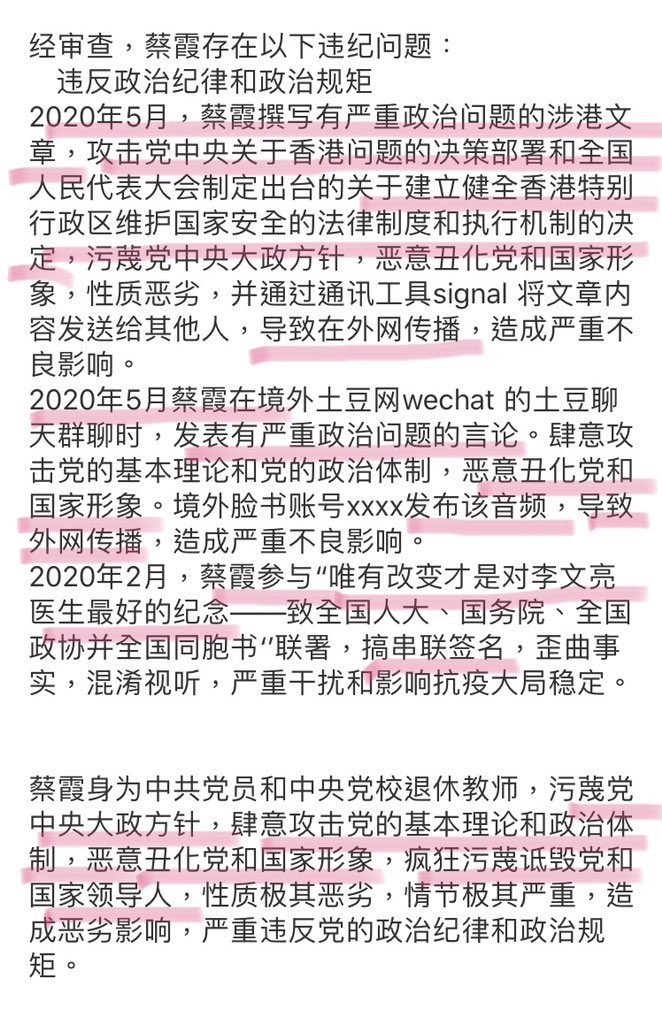
Cai Xia Tweets Three Strikes that Pushed Her Out of the Party

Cai Xia, the outspoken professor emerita of the Central Party School who was recently expelled from the Chinese Communist Party, is now on Twitter @realcaixia. Her first two tweets make public the “relevant passages of the decision to expel Cai Xia from the Party.” There is, of course, the speech she gave in May to a private group online in which she condemned the CCP as a “political zombie.” But Cai’s tweets reveal two other strikes against her: a short piece she wrote about Hong Kong’s National Security Law, and her signature to an open letter calling for political reform titled “Change Is the Only Way to Truly Remember Dr. Li Wenliang: Letter to the National People’s Congress, State Council, and All Fellow Compatriots”:

I’ve been totally cut out of this mafia party! They’ve always been afraid to see the light. When they expelled me, all they said was that I had made very politically problematic statements, but they didn’t say what the problems were, or what exactly I had said. That’s why I have extracted the relevant parts of their official pronouncement of my expulsion. My friends, here it is: (1) I wrote a short piece about the National Security Law in Hong Kong; (2) I talked about “replacing Xi” in a speech I gave that was recorded; (3) I signed a petition for freedom of speech to my compatriots.

Party School of the CCP Central Committee (National Academy of Governance) Deals Severely with Professor Emerita Cai Xia’s Serious Violation of Discipline

Cai Xia, professor emerita of the Party School of the CCP Central Committee (National Academy of Governance), has

made statements that are very politically problematic and damaging to the reputation of the country. Her character is vile, the situation grave. She has seriously violated the Party’s political discipline and the behavioral norms of employees of state institutions. Upon review by the disciplinary commission run jointly by the Disciplinary Inspection Group of the Office of the Central Central Commission for Discipline Inspection at the Organization Department and Party School of the CPC Central Committee (National Academy of Governance), in accordance with the relevant regulations of the Articles of Discipline of the Chinese Communist Party and the Provisional Regulations on Discipline of Personnel of State Institutions, the Committee of the Party School of the CCP Central Committee (National Academy of Governance) has decided to revoke Cai Xia’s membership in the Communist Party of China and her related retirement benefits.

The investigation found that Cai Xia violated discipline in the following ways:

Violation of Political Discipline and Political Regulation

In May 2020, Cai Xia wrote an article touching on Hong Kong that contained serious political problems, attacking the CPC Central Committee’s policy deployment regarding the Hong Kong problem and the system of laws and mechanisms of implementation determined by the National People’s Congress in order to establish and strengthen the defense of national security in the Hong Kong Special Administrative Region. She slandered the Central Committee’s basic policy and maliciously smeared the image of the Party and the country. In addition, she used the communication tool Signal to share the contents of her article with others, resulting in the article’s dissemination on the foreign internet (外网) and creating adverse effects.

In May 2020, Cai Xia again visited the overseas website Potato’s wechat [sic] Potato Chat group, where she made statements that had serious political problems. She wantonly attacked the fundamental theory and political system of the Party, maliciously smearing the image of the Party and the country. Account xxxx on the foreign [website] Facebook posted the audio of this speech, resulting in its dissemination on the foreign internet and creating adverse effects.

In February 2020, Cai Xia added her signature to the petition titled “Change Is the Only Way to Truly Remember Dr. Li Wenliang: Letter to the National People’s Congress, State Council, and All Fellow Compatriots,” distorting the facts, confusing the public, and seriously interfering with and impacting the stability of the epidemic situation.

Cai Xia, professor emerita of the Central Party School of the CCP, has slandered the Central Committee’s basic policy, wantonly attacked the basic theory and political system of the Party, maliciously smeared the image of the Party and the country, and vilified Party and state leaders with abandon. Her character is extremely vile and the circumstances extremely serious, resulting in adverse effects and seriously violating the Party’s political discipline and political rules.

Over the past several years, Cai Xia has made erroneous statements on a number of occasions, in defiance of strict organizational criticism and education. She is incorrigible and impenitent. During the investigation, Cai Xia had a poor attitude. She did not at all regret her erroneous statements and refused to acknowledge her mistakes. She has refused to return to China for organizational examination, and she has refused to provide any information regarding relevant personnel with whom she discussed her erroneous statements. She has already lost her qualifications to be a member of the Communist Party.

The campus committee has decided, in accordance with the disciplinary measures of the CCP… to punish Cai Xia by revoking her Party membership, effective July 31, 2020.

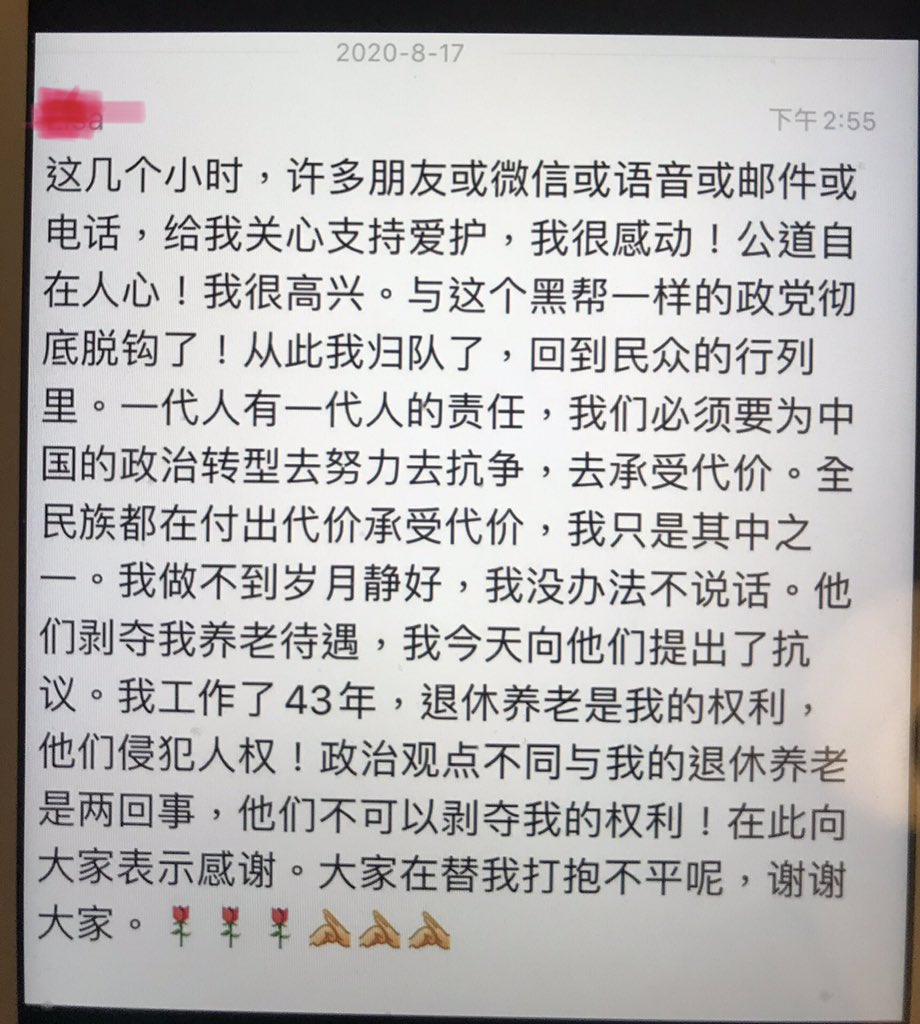
Cai Xia also tweeted that her WeChat account had been shut down because of her posts to a private group:

I have so many friends to thank for their care and support. Below [sic] is a message I posted to a WeChat group about 10 hours ago, which an enthusiastic friend helped me to share. I’ll borrow their results first, since I’m not too familiar with Twitter. Because of my post, the CCP’s internet administrators shut down my WeChat again. Mainland WeChat users can’t see my messages anymore, whether I posted them to a group or sent them privately.

So many friends have shared their love and support in the last few hours, whether by WeChat, voice message, email, or phone. I’m so moved! Justice and freedom! I’m so happy. That mafia political party has completely cut me off! I have rejoined the ranks of the masses. Each person of a generation carries the responsibility of that generation. We must throw ourselves into the resistance for the political transformation of China. We must accept the price. The whole nation is paying the price and taking the cost–I am just one among them. I cannot while away my time quietly. I can do nothing but speak out. They stole my pension. Today, I start my fight against them. I worked for 43 years. My pension is my right. They have violated my human rights! A difference of political opinion has nothing to do with my pension. They cannot take away my rights! I want to thank you all. Thank you for fighting on my behalf.

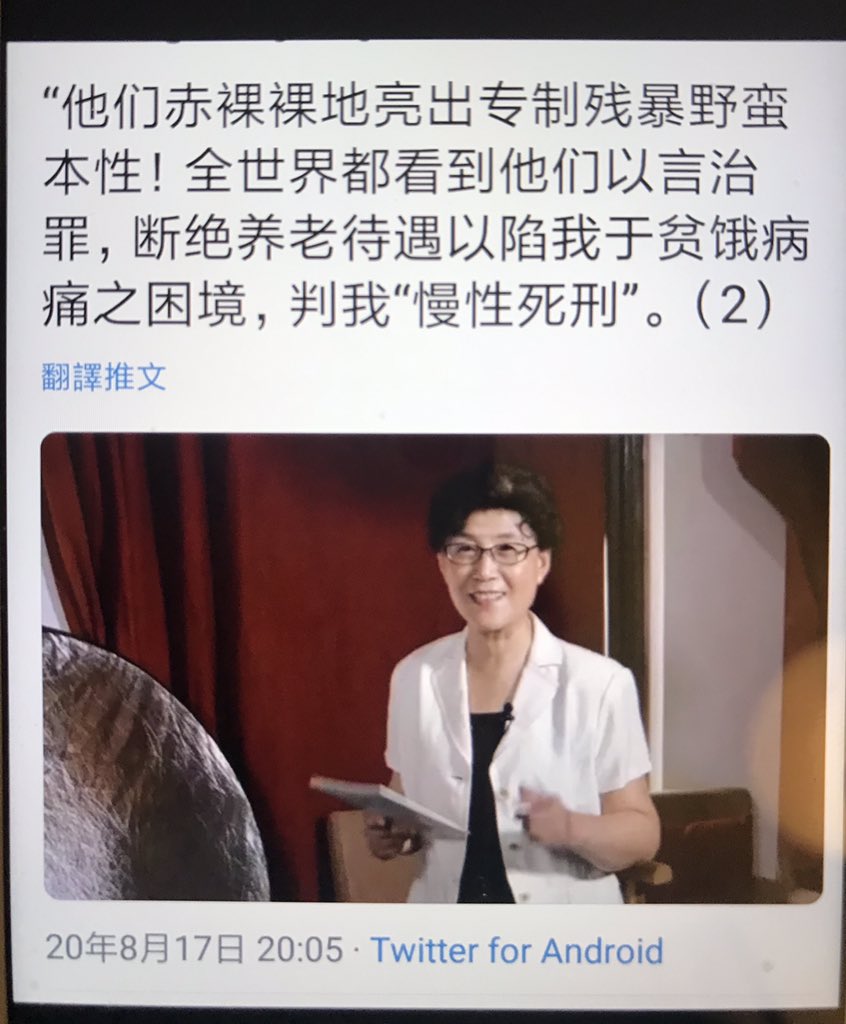
Professor Cai’s “straight talk”:

“I’m not an official, so I couldn’t have ‘taken a bribe’; I’m not an entrepreneur, so I couldn’t have ‘evaded taxes’; I’m not a man, so I couldn’t have ‘solicited a prostitute.’So how could they make me a criminal?! This time there is no excuse. They just have to run naked!” (1)

“They’ve exposed the naked barbarism of autocracy! The whole world can see that they are punishing me for a crime of words. They’ve cut off my retirement pension to plunge me into poverty. They’ve sentenced me to a ‘slow death.'” (2)

Read more from CDT Chinese.


© Anne.Henochowicz for China Digital Times (CDT), get_post_time('Y'). | Permalink | No comment | Add to del.icio.us
Post tags: , , ,

Feed enhanced by Better Feed from Ozh


source https://chinadigitaltimes.net/2020/08/cai-xia-tweets-three-strikes-that-pushed-her-out-of-the-party/

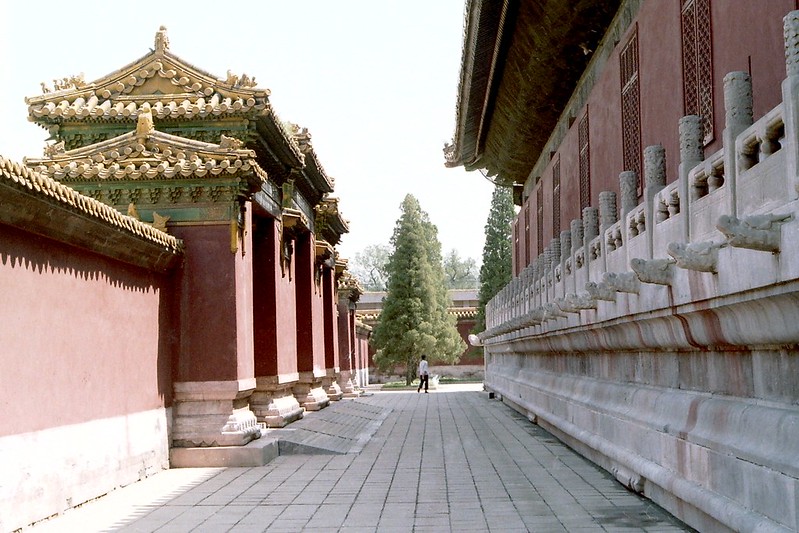
Photo: Forbidden City, by Boudewijn

Forbidden City, by Boudewijn (CC0 1.0)


© Samuel Wade for China Digital Times (CDT), get_post_time('Y'). | Permalink | No comment | Add to del.icio.us
Post tags:

Feed enhanced by Better Feed from Ozh


source https://chinadigitaltimes.net/2020/08/photo-forbidden-city-by-boudewijn/

Report: How and Why Hollywood Self-censors for China

China’s cinemas have begun to recover from an 88%, 30 billion-yuan ticket sales crash triggered by the COVID-19 pandemic. Last month, reopening began in low-risk areas with mandatory masks and temperature checks, a ban on food and drink, a 30% capacity cap, and WeChat-assisted attendance logging for contact tracing. Global Times reported on Sunday that nearly three-quarters of Chinese theaters are now operating again. American movie studios, meanwhile, have repeatedly pushed back premiers or elected to hold them overseas as the pandemic continues to rage across the U.S.

Chinese and U.S. box office takings have vied for global first place in recent years. The University of Virginia’s Aynne Kokas told Marketplace late last month that "in March, it looked like the U.S. was actually poised to dramatically overtake the Chinese film market for 2020. Now it looks like we’re seeing the reverse." China Film Insider’s Sky Canaves commented that China is "really, right now, one of the few avenues that Hollywood has available for its films." China’s quarterly box office revenue passed that of the United States for the first time in 2018. American films had dominated the list of highest-grossing films in China; now they comprise only one of the top ten and seven of the top 25. But the Chinese market remains immensely profitable: recent blockbusters including "Avengers: Endgame," "Spider-Man: Far from Home," and "Fast & Furious Presents: Hobbs & Shaw" have all made more in China than in the U.S., feeding into Hollywood’s growing dependence on Chinese revenue and investment.

A recent PEN America report, "Made in Hollywood, Censored by Beijing," explains how Chinese authorities’ notoriously tight control over access to these financial rewards gives the CCP "major sway over whether a Hollywood movie will be profitable or not—and studio executives know it." Beyond the raw binary of access or denial, report author James Tager explains, Chinese authorities wield an array of more precise levers. They can allow a greater profit share by including a film in the annual quota of 34 foreign releases; exclude it, leaving the option of selling Chinese earning rights for a lower flat fee; or block it entirely. More favorable financial terms are available to filmmakers willing to accept the closer control that comes with a joint production. They can control the timing of a film’s opening relative to its global release, public holidays, or rival pictures. They can restrict, allow, assist, or undermine promotion, not least through favorable or unfavorable attention in state and other media. Underlying all of this is the threat of indefinite, unspoken inclusion on long-rumored blacklists.

Crucially, these carrots and sticks can be deployed not only based on an individual film’s own content, but on that of other productions by the same individuals or studio. The hundreds of millions of dollars of leverage available against a major blockbuster can therefore extend to other productions or more diverse business interests. Though the PEN report does not cover television or online streaming, this point was illustrated elsewhere last year by a Buzzfeed News report that Apple had instructed content producers for its Apple TV+ platform to "avoid portraying China in a poor light." A showrunner not working with Apple told Buzzfeed that this had become standard industry practice: "They all do it. They have to if they want to play in that market. And they all want to play in that market. Who wouldn’t?"

"As a result of all the pressures that Beijing is able to bring to bear," Tager writes, "the CCP’s influence over Hollywood films is significant. Hollywood’s decision-makers are increasingly envisioning the desires of the CCP censor when deciding what film projects to greenlight, what content these films contain, who should work on the films, and what messages the films should implicitly or explicitly contain. […] China is the only country that can effectively wield its economic clout in order to compel substantial cooperation from Hollywood studios." The CCP is therefore increasingly "shaping what is perhaps the world’s most influential artistic and cultural medium," and "in effect, Hollywood’s approach to acceding to Chinese dictates is setting a standard for the rest of the world."

Hollywood is an important bellwether. The Chinese government, under Xi Jinping especially, has heavily emphasized its desire to ensure that Hollywood filmmakers—to use their preferred phrase—“tell China’s story well.” Within the pages of this report, we detail how Hollywood decision-makers and other filmmaking professionals are increasingly making decisions about their films—the content, casting, plot, dialogue, and settings—based on an effort to avoid antagonizing Chinese officials who control whether their films gain access to the booming Chinese market.

[…] Hollywood exercises outsized influence over global society and culture through the power of its creations. Stories shape the way people think, and the stories told by Hollywood reach billions. If the hand of a foreign government is dictating the parameters of what can be told or shown, and if filmmakers are incorporating a made-in-Beijing set of prerequisites as they conceive and produce films, at the very least these dictates should be understood and debated, so that the commercial, artistic, and expressive trade-offs are understood. [Source]

The report highlights some of the China-specific cuts made over the past 15 years based on various political or other sensitivities: the deaths of a Chinese henchman or guard ("Mission: Impossible III" (2006) and "Skyfall" (2012)); underwear on a Shanghai clothesline (Mission: Impossible III); the line "Christ, I miss the Cold War" ("Casino Royale" (2006), changed to "God, I miss the old times"); references to sex work and police brutality ("Skyfall"); and same-sex kisses ("Cloud Atlas" (2013), "Star Trek: Beyond" (2016), "Alien: Covenant" (2017)) and other references to homosexuality ("Bohemian Rhapsody" (2018)). An unusual counterexample is also cited: Quentin Tarantino refused to change the negative portrayal of Bruce Lee in "Once Upon A Time in Hollywood" (2019), leading to its exclusion from Chinese theaters.

Tager also highlights some of the more concrete guidelines that exist, including the 2016 Film Industry Promotion Law’s injunctions against violation of the national constitution, endangerment of national unity or honor, leaking state secrets, stirring ethnic tension, promotion of cults or superstitions, endangerment of social morality, and "other content prohibited by laws or administrative regulations." 2004 regulations on joint productions similarly require "compliance with the Constitution, laws, regulations, and other relevant provisions of China," and contributions to "the brilliant traditional culture of the Chinese people" and "the social stability of China."

Other cited guidelines include a 2011 document from the State Administration of Radio, Film, and Television warning domestic filmmakers against “treating serious history in a frivolous way," and declaring a ban on time travel narratives. (The Party jealously guards its monopoly on altering history.) In 2008, regulators had similarly issued restrictions on "terror, ghosts, and the supernatural." The report notes:

Beijing’s willingness to ban entire tropes of fiction—ghost stories, timetravel stories—demonstrates the breadth of its film censorship, even if Beijing is inconsistent in its implementation of these bans in practice. It is not enough for filmmakers to avoid certain messages or plot points that may reflect poorly on Beijing; they also have to take into account what genres of storytelling the CCP is less likely to approve. [Source]

Another side of this kind of genre-level strategic guidance was illustrated this month by a document aiming to boost homegrown science fiction cinema following the success of "The Wandering Earth" (2019)—the third-highest grossing Chinese production ever—and the books of Liu Cixin, on one of whose shorter stories the film was based. From Rebecca Davis at Variety:

Entitled “Several Opinions on Promoting the Development of Science Fiction Films,” the document highlights how the sci-fi genre fits into the ruling Communist Party’s broader ideological and technological goals. It was released earlier this month by China’s National Film Administration and the China Association for Science and Technology, a professional organization.

[…] To make strong movies, the document claims, the number one priority is to “thoroughly study and implement Xi Jinping Thought.” Based on the Chinese president’s past pronouncements on film work, filmmakers should follow the “correct direction” for the development of sci-fi movies. This includes creating films that “highlight Chinese values, inherit Chinese culture and aesthetics, cultivate contemporary Chinese innovation” as well as “disseminate scientific thought” and “raise the spirit of scientists.” Chinese sci-fi films should thus portray China in a positive light as a technologically advanced nation.

In addition, the document honed in on China’s need to develop and control its own homegrown VFX and digital technologies to support the making of sci-fi content as tensions rise with the West over technology and internet control. [Source]

The PEN report also outlines the institutional structures through which film censorship and associated pressures are channeled. Foremost among these until recently were the aforementioned national regulator SARFT and its successor SAPPRFT (the State Administration of Press, Publication, Radio, Film and Television, created by a merger of SARFT and the General Administration of Press and Publication), although other national organs like the Ministry of Culture can also step in at times. These are supplemented by a "constellation of state-owned enterprises (SOEs) that operate simultaneously as regulators and as business partners for foreign studios," including the distribution duopoly of China Film Group and Huaxia Film Distribution. Joint production partners and freelance consultants can also act as vectors for influence over content.

The PEN report highlights 2018 not only as an inflection point for China’s relative market size, but also for a landmark shift in this regulatory structure. That year, SAPPRFT’s role was turned over to the Central Propaganda Department—a Party, not a state, body. Tager comments:

By moving control of film to a more powerful, more conservative body that is more sensitive to what it perceives as slights against China, the Party is tightening the reins on creative control.

The 2018 announcement made clear that the CPD had a new, more muscular, mandate to bring film in conformance with Party ideology. The Central Committee emphasized that film, specifically, played a “special and crucial” role in “spreading propaganda.” Also, unlike the censors of the Film Bureau who often had experience with filmmaking, these new censors are trained mostly in Communist Party doctrine—a very different lens. The overall result of the change, as both outside analysts and industry insiders who spoke to PEN America affirmed, is a tighter level of political and ideological control over the film censorship process. [Source]

While attention has tended to focus on censors’ demands for post-production cuts, or the active role of Chinese authorities or partners in shaping joint productions, the PEN report warns of the longer shadow cast by efforts to smooth a project’s path by pre-empting overt interference:

Perhaps the greatest issue with the CCP’s censorious effect on Hollywood is how it has instantiated self-censorship from filmmakers aiming to anticipate and preempt Beijing’s objections. This is, of course, exactly how censorship succeeds—others internalize it to the point where the censor actually has to do very little. Over time, writers and creators don’t even conceive of ideas, stories, or characters that would flout the rules, because there is no point in doing so. The orthodoxies press down imperceptibly, and the parameters of the imagination are permanently circumscribed.

[…] Despite the documented and widely suspected examples of studios’ active cooperation with censors, ultimately, Hollywood’s self censorship is impossible to observe or document, because it involves movies that never had the chance to get off the ground in the first place for fear that the film would never enter the Chinese market. Or as Michael Berry, director of the Center for Chinese Studies at UCLA, described it to PEN America: “The big story is not what’s getting changed, but what is not ever even getting greenlit.”

[…] Absent written parameters, film professionals are reliant on rumor and innuendo to determine where the actual boundaries of censorship lie. This lack of regulatory transparency is a feature, not a bug. When people do not know where the lines of censorship lie, they will be extra cautious in self-censoring for fear of crossing an invisible line. [Source]

One topic not addressed in the PEN report is the emergence of algorithmic systems for selecting, shaping, and even conceiving film projects. So-called "predictive policing" systems have been shown to absorb and replicate existing racial and other biases in law enforcement. Similar software applied to filmmaking could help perpetuate anticipation and accommodation of Chinese censorship behind a politically convenient screen of mathematical neutrality.

The report notes several changes to films made not in response to but anticipation of Chinese authorities’ wishes. One recent case is the alteration of Japanese and Taiwanese flags on Tom Cruise’s jacket in forthcoming "Top Gun" sequel "Top Gun: Maverick" (2021), a co-production with China’s Tencent Pictures. Another notorious example is the digital post-production change of occupying forces in the United States from Chinese to North Korean in "Red Dawn" (2012). An originally Tibetan character in Marvel’s "Doctor Strange" (2016) was rewritten as Celtic and played by Tilda Swinton because, according to swiftly downplayed comments by the film’s writer, ‘if you acknowledge that Tibet is a place and that [the character is] Tibetan, you risk alienating one billion people who think that that’s bullshit and risk the Chinese government going, ‘Hey, you know one of the biggest film-watching countries in the world? We’re not going to show your movie because you decided to get political.’" As Tager notes, recasting the role on that basis is also "getting political."

An example that has come to look grimly prophetic amid the ongoing COVID-19 pandemic that of 2013 zombie movie "World War Z." In his original novel, Max Brooks picked China as the origin of his fictional zombifying virus because, he explained in February, "I needed an authoritarian regime with strong control over the press. Smothering public awareness would give my plague time to spread, first along the local population, then into other nations." Paramount cut this plot point from the film in an unsuccessful effort to secure access to Chinese theaters. Although that failed, the cut remains in the version of the film released worldwide. An article on film censorship by Charley Lanyon at South China Morning Post last year noted that, in addition, "a subplot about a disgruntled Chinese officer nuking the Politburo was dropped, and the detail that Lhasa in Tibet was the largest surviving city was – gasp – done away with entirely."

Tager warns that pandering to Chinese audiences, authorities, and investors might undermine progress on Hollywood’s weak record of diversity and inclusion, particularly in terms of broader Asian representation. "By citing the regulatory risk from Beijing censors," he writes, "Hollywood decision-makers can justify the avoidance of portrayals of Asian characters whose Asian identity would require thoughtful and nuanced treatment." There are signs of the new pressures marginalizing other Asian ethnicities, and even in terms of Chinese representation, they have frequently led to no more than fleeting appearances by huaping 花瓶,or "flower vases," a derisive pun playing on the homophony of hua 花 (flower) and Hua 华 (China) to jab at these roles’ tokenistic and decorative nature. The report’s closing recommendations include the following:

[… W]e encourage Hollywood, as a community, to commit to the inclusion and promotion of substantive, three-dimensional Asian and Asian-American characters. There is already a preexisting and obvious need for such enhanced representation within the world of film. Additionally, and more narrowly for this report’s purposes, the dearth of such three-dimensional Asian characters in Hollywood only grants further space for Beijing to insist upon stereotypes and uncritical portrayals of Chinese characters. [Source]

Skeptical reactions to huaping suggest that what may appease China’s censors or investors often fails to satisfy Chinese viewers. Nevertheless, as studio executives are often keen to point out, some changes might be more charitably described as efforts to appeal to, or at least avoid alienating, Chinese audiences, rather than craven complicity with their government. Phoebe Chen discussed this gray area at The Nation in March, arguing that "criticism of China’s censorship from the West […] can sometimes seem to equate literal suppression with the separate problem of content adjustment—that is, pandering."

In capitulating to the Chinese box office, Hollywood blockbusters have dispersed Chinese-branded products and recognizable location shots that pique surface-level interest without real, considered narrative integration. To Western critics, pandering to Chinese audiences is an ethical failure, by which Hollywood kowtows to the demands of a repressive state for profit. (As if the US film industry never sacrificed expressive freedom for big money.) Not only does this account of pandering conflate the values of the state with those of its people, it also suggests that this new market might not be worth breaking into—that Chinese audiences should come around to the terms set by Western values. If pandering is another word for “trying to solicit a new audience,” then its framing as a political offense, in this context, seems like Sinophobia by another name.

It also ignores the fact that Chinese viewers don’t like clumsy pandering either. Chinese audiences rejected the alternate versions of Iron Man 3 and Looper that were made specifically for Chinese distribution, with bizarre, incongruous extra scenes spliced in that featured famous Chinese actors or box-ticking location shots. Not only did the Chinese theatrical version of Iron Man 3 include blatant product placement for Gu Li Duo, a popular milk beverage, it also featured a scene in which Chinese doctors inexplicably perform critical surgery on an acupuncture-needle-studded Tony Stark. As one Chinese viewer said of the scene, “When the Chinese show up in the movie, it’s like suddenly changing the channel.” [Source]

The PEN report notes that Hollywood studios "have not one but three motivations for such pandering: telling more authentically international stories, appealing to Chinese audiences, and staying on the good side of the Chinese government." It warns, though, that "when these motivations are opaque, it becomes very easy for a Hollywood filmmaker to make content decisions that appeal to Beijing, but justify these decisions by saying to others, and perhaps even to themselves, that they were motivated by the desire to appeal to everyday Chinese theatergoers." This and other related issues were discussed in a panel discussion marking the report’s launch, hosted by Clayton Dube at the University of Southern California, and featuring Variety’s Rebecca Davis, the University of Virginia’s Aynne Kokas, USC’s Stanley Rosen, and report author James Tager.

The interests of Chinese investors are yet another factor driving content decisions such as sometimes incongruous product placement. Rui Zhong noted another case of this on Twitter last week, from "Spider-Man: Into the Spider-Verse" (2018):

The report weighs two recent legislative proposals targeting China-driven film censorship. Representative Mike Gallagher has called for a legal requirement for studios to disclose changes made "to fit the demands of the Chinese Communist Party." "The idea has merit," Tager comments, while acknowledging that such disclosures "would only reveal one aspect of Beijing’s censorship, since it would presumably not apply to acts of anticipatory self-censorship from Hollywood studios." Indeed, "it may push Hollywood studios to double down on anticipatory self-censorship as a way of avoiding potential requests from Beijing that it would then need to disclose. Still, PEN America supports the concept of disclosures as a proactive step toward bringing the issue out into the open. Censorship thrives in murky conditions, and transparency is a necessary first step toward any industry response to it."

The report takes a less favorable view of Senator Ted Cruz’s "Stopping Censorship, Restoring Integrity, Protecting Talkies [SCRIPT] Act," which would block Department of Defense and other federal support if studios alter movies for China or engage in joint productions. "Currently, the bill’s attempt to target studios altering content even ‘in anticipation of’ a governmental request is far too broad and extends far too far into the realm of creative choice for filmmaking professionals, failing to comport with the First Amendment and equating genuine appeals to a global audience with political censorship. Further, the bill places Department of Defense officials in the position of essentially evaluating the political messaging of American movies.”

Other prominent Republicans have also challenged Hollywood as part of a more broadly confrontational stance toward China. Attorney General William Barr attacked studios and other U.S. companies as "pawns of Chinese influence" in a speech last month. Secretary of State Michael Pompeo echoed this criticism in another address later in the month, while Republican senator Josh Hawley leveled similar accusations at the NBA.

PEN’s recommendations echo some of those made in its earlier reports on censorship of Chinese editions of foreign books, conditions for foreign journalists in China, and controls on social media content and communication. It calls for "a more honest, public, and transparent conversation about Hollywood’s role and its responsibilities," and "more obvious and proactive action against such censorship," highlighting the contrast between Hollywood’s strong rhetoric on these issues at home and its typically meek compliance in China.

PEN America believes that wholesale withdrawal from the Chinese-film market is neither realistic nor desirable. Hollywood should not wholly forego its opportunity to offer its stories to Chinese theatergoers and nor would it be positive for the Chinese people to be denied all access to American filmmaking. There is still substantial space for Hollywood to offer important, provocative and resonant stories even within the restrictions set by Beijing.

[…] PEN America recommends that all Hollywood studios pledge that, if they comply with anticipated or actual censorship from Beijing, either in response to a direct request from regulators or in an anticipatory effort to self-censor, that they do so only for the version of the film made available within mainland China, not for the film’s global release.

PEN America recommends that Hollywood studios commit to publicly sharing information on all censorship requests received by government regulators for their films.

The issue of Chinese governmental influence in Hollywood will remain under-examined and under-discussed as long as Hollywood decisionmakers continue to discuss it only behind closed doors. Yet, while this outcome may sound ideal to some Hollywood executives, practices in other industries demonstrate the value of transparency both as a good in and of itself and as a means of heading off bad press. Accordingly, PEN America recommends that Hollywood studios commit to publicly sharing information on all censorship requests received by government regulators for their films. Such information would go a long way toward making visible this semivisible phenomenon, illuminating the contours of Beijing’s censorship and giving film professionals and laypeople alike a better understanding of where the redlines truly lie—thus reducing the uncertainty that enables self-censorship. [Source]


© Samuel Wade for China Digital Times (CDT), get_post_time('Y'). | Permalink | No comment | Add to del.icio.us
Post tags: , , , , , , , , , , , , ,

Feed enhanced by Better Feed from Ozh


source https://chinadigitaltimes.net/2020/08/report-how-and-why-hollywood-self-censors-for-china/

Wednesday, 19 August 2020

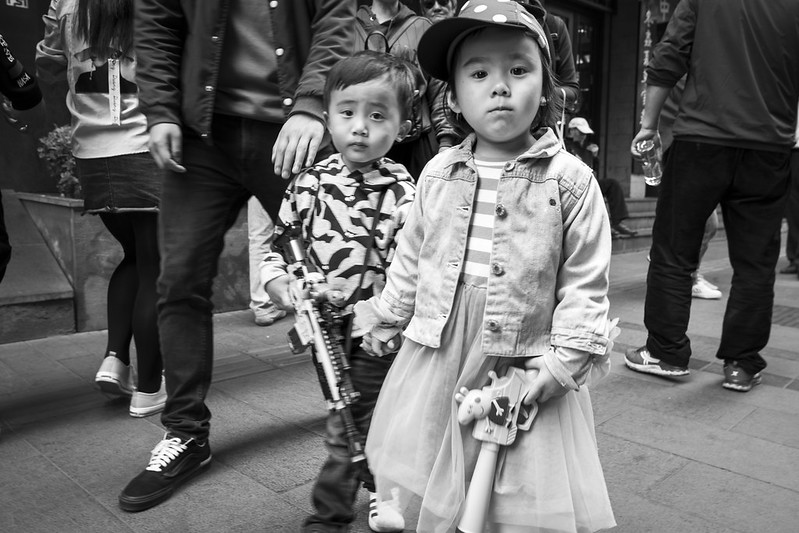
Photo: Children With Toy Guns, Shanghai, by vhines200

Children With Toy Guns, Shanghai, by vhines200 (CC BY-ND 2.0)


© Josh Rudolph for China Digital Times (CDT), get_post_time('Y'). | Permalink | No comment | Add to del.icio.us
Post tags:

Feed enhanced by Better Feed from Ozh


source https://chinadigitaltimes.net/2020/08/photo-children-with-toy-guns-shanghai-by-vhines200/

CDT Censorship Digest, July 2020: “Protecting Freedom is a Shared Mission”

In 2020, CDT Chinese editors launched the CDT Censorship Digest series. The series will collect and quote from news and online speech that was censored by Chinese authorities during the previous month, as well as summarize efforts to preserve and strengthen freedom of speech in Chinese society. When relevant to CDT English readers, we will translate the Chinese series in part or in full. CDT has translated an excerpt from the full CDT Chinese digest for June, adapted to include links to English coverage when available:

CDT Chinese Censorship Digest, July 2020: Protecting Our Freedom From the CCP’s Hands is a Shared Mission

On July 1 the Hong Kong National Security Law was formally implemented. As the first arrests under the new law were being made, Deutsche Welle commentator Chang Ping wrote:

In June of 1963, U.S. President Kennedy gave a speech at the Berlin Wall in Germany. He left behind a famous quote: “Freedom is indivisible, and when one man is enslaved, all are not free.” To many in the West, this is lyricism; in the CCP’s view, this is a fact, and conversely a teaching on how to maintain totalitarian rule: Autocracy is indivisible, and when one man is free, all can’t be enslaved. [Source]

Outspoken property tycoon Ren Zhiqiang went missing and was later revealed to be under investigation after an article attributed to him sharply attacked Beijing’s official handling of the coronavirus outbreak. This month, Ren’s status as a Party member was rescinded. After the news broke, retired CCP Central Party School professor Cai Xia again publicly defended Ren:

The eight years of backsliding under Xi have caused the U.S. government and all sectors of U.S. society to come to a new, more sober understanding of the Chinese Communist Party. They see the Chinese people as separate from the CCP, captured by and under the control of the Xi regime. Their support of the Chinese people and opposition to the CCP is unanimous and bipartisan. I call on the U.S. government and the American people to make one more distinction—to separate the Xi gangsters and hundreds of thousands of evil, totalitarian CCP officials from the 90 million ordinary party members. Support all the forces of change within the party that oppose the Xi gangsters and totalitarianism. Promote the unity and cooperation of reform forces within the CCP and among the Chinese people. Help the Chinese people end the rule of terror of the Xi gangsters and the totalitarian tyranny of the CCP. [Chinese]

In 2016, Cai defended Ren after he was banished from social media for criticizing Xi’s domination of the media, and in May of this year sharply criticized the CCP under Xi’s rule. [Editor’s note: in August 2020, she was expelled from the Party in connection with the May speech.]

What a July. Flood, pandemic, unemployment, the implications of the Hong Kong security law, attacks on free speech, suppression of public grievances, control of the news media, and the arrival of a U.S.-China “cold war.”

This July, China faced crises both domestic and foreign. But, whether the issue was domestic or international, people gradually reached a consensus: freedom is something no one can take away from you. Protecting our freedom from the hands of the CCP is the mission of every single one of us.

There Will Always Be Voices of Dissent

In an article shared on WeChat, Professor Xu Ben wrote:  

People who speak out don’t just instantly become silent, just as the transition from disobedience to obedience isn’t immediate. It’s a step-by-step process. With each step, the next becomes a little bit easier. It’s a depressing, undignified, self-loathing thing, to become slowly aware of your increasing obedience, step-by-step. Most people choose to simply not think about it. Because of this, the road to complete silence and obedience becomes a smoother ride the further you go. Once you’re on this road-of-no-return, your will to preserve and express your own thoughts has already been lost. [Chinese]

Luckily, there will always be voices of dissent to remind us of the value of our ability to think for ourselves and express our own thoughts, to remind us that we do not need to accept the violence of totalitarianism.

According to media reports, suspended Tsinghua Law Professor and outspoken Xi critic Xu Zhangrun was detained by over 20 police officers at his home in Beijing on the morning of July 6. Authorities told his wife that had been arrested for “soliciting prostitutes” while in Chengdu. Those close to Xu believe that his detention was likely related to the sudden American release of “Six Chapters From the Wuxu Year,” a collection of critical essays that Tsinghua ordered he not publish. Xu was released from detention after six days, and was shortly after fired from Tsinghua.

Later in the month, when Ren Zhiqiang’s expulsion from the CCP was announced, Cai Xia immediately spoke out on behalf of both Ren and Xu, and accused the Party of “openly threatening slavery to 92 million CCP members.”

The third person brave enough to speak out this July was Dr. Yan Mengli. Dr. Yan Mengli previously worked at Hong Kong University’s School of Public Health in a WHO reference laboratory. She fled Hong Kong to the U.S. in April of this year. On July 10, in an interview she gave to Fox News, she stated that her reason for fleeing Hong Kong was that she wanted to tell the whole world how the CCP covered up the truth about the novel coronavirus. During the interview, she said:

If I were to tell [this story] in Hong Kong, the moment I start to tell it I will be disappeared and killed. No one can hear me. So, for this purpose, I [wanted] to go to the U.S. to tell the truth of the origins of Covid-19 to the world, to let people understand how terrible, how dangerous it is. This is nothing about politics. This is about whether all the humans in the world can survive. [Editor’s note: taken from the English-language interview, with minor grammar corrections.] [Source]

Dr. Yan Mengli told Fox that after she learned of the emergence of the novel coronavirus in Wuhan late last year, she started a secretive investigation in accordance with and instructed by her supervisor, WHO expert Dr. Leo Poon, and that since Beijing forbid the intervention of overseas scholars—including HK researchers—she turned to her network of friends in the mainland for more information. A friend and colleague shared evidence of human-to-human transmission, she claims, and when she shared that with her superiors, received only a nod. Days later, the WHO put out their statement reiterating Beijing’s claims of no evidence of human-to-human transmission.

The fourth person who dared speak out was Wang Xiaoqi, a blogger who criticized China’s dairy policies. Wang was arrested by Shanghai police on July 18.

The fifth who dared speak in July was Wang Quanzhang, the human rights lawyer who was recently released  and reunited with his family after four years in prison. The lawyer, arrested in the widespread “Black Friday” or “709” crackdown of 2015, published a statement titled “Political and Judicial Persecution Must be Based on Law, and it Must Be Professional and Reasonable — My Self Defense” on WeChat. The article was deleted, but has been translated into English by China Change.

The sixth brave person this July was Lu Yuyu, a citizen journalist who was sentenced to four years in prison for “picking quarrels and provoking trouble” over his documentation of protest in China. In mid-June, he was released from prison, and now lives in Guizhou. In an interview with Deutsche Welle, Lu said that as the overall environment in China continues to worsen, there is little room for continued grassroots engagement in human rights protection in the country, and that they must rely on foreign help to continue. Lu has been posting his prison memoir on Twitter and Matters as “Incorrect Historical Memory,” which CDT continues to translate.

Chinese human rights lawyer Ding Jiaxi was officially arrested in June after being in detention since December. In a July 18 tweet, his wife Luo Shengchun stated that there was reason to believe he was being tortured in jail.

Other July incidents worth remembering include that of Lao Lishi, a Chinese diving champion whose Weibo account was shut down for one year because of opinions she expressed online; lawyer Ma Wanjun who has already been missing for over a month; Jiang Tianyong, who continues to be held under house arrest even after release from prison six months ago; the Wuhan woman who chopped up a city government sign with an axe; or the father who this month was finally able to express his longing to see his son Wuge Jianxiong, an NGO worker who was been in detention for over a year. 

Also this month, July 12 marked the third anniversary of Liu Xiaobo’s death. An essay posted at CDT Chinese asks how we should best remember him and his life’s work:

I believe the correct way to remember him would be to carry on his legacy, to call for more people to participate in formulating a new constitution, to pool our collective thoughts and efforts, to undertake our mission of promoting social change for the people of this land, to let the light of justice and fairness shine upon this land. These would be the wishes of Mr. Liu Xiaobo. He sacrificed his life for us, before he got to see his dreams become reality. In my view, those of us still muddling along must begin to take action. Only then can we remember Mr. Liu Xiaobo properly. [Chinese]

“Flood Aesthetics” and Disappearing Speech

Starting in late May, the China Central Meteorological Observatory issued rainstorm warnings for 40 consecutive days (from June 2 to July 11). In June, flash flooding and water buildup in urban areas occurred in multiple provinces. According to official tallies, more than 17,000 buildings had collapsed due to flooding as of July 3.

Flooding in the south grew increasingly severe over the course of the month, brutalizing virtually the entire region. Yet mainstream media reporting never focused on the floods, nor did the flooding trend on social media. Places like Guangxi and Guangzhou, first hit by the flooding, virtually disappeared from mention in the media. In late June and early July, official media reported the flooding in Japan, while at the same time playing deaf and dumb with regards to the flooding in China’s south.

Starting in July, mainstream media began managing “flood aesthetics”—using “water coverage area” and other “positive” words to report on the flooding, which was actually a gigantic disaster. They even went as far as singing it songs of praise. From WeChat user @东瓯故人董文正:

Compared to the ferocity of the flood, online reporting on the flood from all main outlets appeared reserved and calm.

As news about the floods took over WeChat, Douyin and other social media platforms, follow-up reporting was still absent from mainstream websites. By June 7, the scale of the flood was enormous, having swept away multiple provinces. Yet detailed reporting didn’t happen until later, June 9, in a Caixin report.

Up until June 10, when discussion of the “Jiang Fan Incident” was blocked on Weibo, reporting on the flood still only focused on statistics. Reporting on the anti-flooding efforts and the status of those affected by the flood remained few and far between.

I can verify, when searching for keywords “Xiangjiang River,” “Hunan,” “Jiangxi” on Chinese social media website Weibo, you can only find reports from China News Service. “The Entire Length of the River to Experience This Year’s Largest Flooding.” CCTV’s reporting on the rainfall stopped on July 12, “Lower Xiangjiang to Experience Largest Flood in Fifty Years, 11 Rivers Exceed Warning Levels.”

Many Chinese internet users raged at officials. One sourly wrote: “Wherever there’s a natural disaster, high-level officials travel to the affected area. Even if they’re just there for show, at least it’s still some sort of expression of care for people’s lives. But as for the Jiangxi Ruijin flood, the Hunan Zhuzhou flood, the Guangxi Yangshuo flood, the Hunan Xiangjiang River breach, there’s absolutely no attention or follow-up by high-level officials or the media. They are completely unconcerned with the flooding in all of these places this year. But whenever there’s a tornado or flood in the U.S., CCTV is there very rapidly to report.” [Chinese]

But of course, natural disasters don’t simply disappear if you ignore them. The flooding in the south intensified as July went on. By July 13, there were a total of 433 rivers that had exceeded warning levels. Of those, 109 exceeded safety levels, and 33 rivers were flooded to all time highs. The upper Yangtze River, upper Yellow River, Xijiang and Beijiang in the Pearl River Basin, and Taihu Lake all successively reached “Level One” flooding. Currently, water remains above warning levels in the Yangtze River below Jianli, Dongting Lake, Poyang Lake and Taihu Lake. On June 28, the Three Gorges Dam and the Gezhou Dam released floodwater, and on July 8, Zhejiang’s Xin’an Jiang Reservoir also released water. These caused cities downstream to sustain even greater flooding. Yet mainstream media had nothing to say about this natural disaster except express positivity and delight!

The official WeChat account of Xinhua News published “Report: I am Yangtze Level Two Floodwater,” which discussed and toned down the disaster in positive terms. A post from Poyang County in Jiangxi, which was later deleted, asked, “Can you really say floodwater is an all out bad thing?” Official voices even started using cute language in their descriptions of the flood. From a censored WeChat post archived by CDT Chinese editors:

This kind of “positivity” comes from a place completely unable to recognize negative emotion. People found Xinhua’s anthropomorphic representation of the floodwaters very strange. Because no normal person would find anything “cute” about a flood. And yet, this “positivity” sometimes appears in forms not easily detectable, for example calling flooding an “expansion of water-covered area.”

Han Bingzhe, a philosopher of German descent, calls this a “world without negativity.” He believes the world has already changed, pivoted from an Era of Immunology (looking for the bad) to a “Performance Society” (everything gets converted to measurable growth). His view that the world has said goodbye to the Era of Immunology has proved laughable. However, there is insight to his observation of the world’s current trends. “Negativity” is disappearing. Praise and self-motivation predominate. In social media, beauty and “likes” have become basic etiquette.

However, a flood is a flood. It is not a metaphor. It is not a person. Nor is it “virtual reality.” It is real, it is painful, it is a disaster. [Chinese]

[…]

Translation by Bluegill.


© Josh Rudolph for China Digital Times (CDT), get_post_time('Y'). | Permalink | No comment | Add to del.icio.us
Post tags: , , , , , , , , , ,

Feed enhanced by Better Feed from Ozh


source https://chinadigitaltimes.net/2020/08/cdt-censorship-digest-july-2020-protecting-freedom-is-a-shared-mission/