
Luoyang, by xiquinhosilva (CC BY 2.0)
source https://chinadigitaltimes.net/2021/07/photo-luoyang-by-xiquinhosilva/
At least 33 people have died due to flooding in Henan province. Hundreds of thousands more have been displaced, millions otherwise affected, and many remain missing. 24 inches of rain fell in the provincial capital Zhengzhou on Tuesday, nearly 8 inches of which fell in a single hour. The city’s average annual precipitation total is 25 inches. Horrifying videos on social media showed passengers trapped in subway cars slowly filling with water, people and cars swept away by raging currents, and last-ditch rescue efforts across the city. Preliminary reports indicate rural areas, many of which lost internet during the storm, may have suffered even more damage. CDT Chinese has covered a number of stories related to the flood:
At CNN, Nectar Gan and Zixu Wang reported on the disaster on Line 5 of the Zhengzhou subway, where 12 people lost their lives:
In a post on microblogging site Weibo, a woman said water started to seep into the subway train soon after it came to a stop in between two stations. Subway staff had first instructed passengers to leave the train and evacuate through the tunnel, but they were soon told to turn back because there was too much floodwater ahead.
[…] “We tried to stand on the seats as much as we could, but even then, the water reached our chests in the end,” she wrote. “I was really scared, but the most terrifying thing was not the water, but the diminishing air in the carriage — as many seemed to have trouble breathing.”
[…] Eventually, she fainted due to lack of oxygen, but was later awaken by the vibration of her phone. It was a call from her mother telling her rescue was on the way. At that moment, she heard footsteps on top of the train, and firefighters started to smash open the windows to let in fresh air. She heard more rescuers arriving, and one after another, they were let out — those who fainted were sent out first, followed by women, she wrote. Her post was later deleted. It was not clear why, or by whom — and CNN has been unable to verify her account. [Source]
In this vid a woman can be heard asking if it will be her last wechat message. https://t.co/fCCQKRvAvP
— Matt Knight (@MattCKnight) July 20, 2021
2/3: A woman rescued in flood waters in Zhengzhou, Henan (video from WeChat). pic.twitter.com/6fOblgl5OL
— Bill Birtles (@billbirtles) July 20, 2021
官方报道洪灾已造成郑州市区12人死亡。胡锡进说了,只要不造成严重伤亡就是应对合格。所以不能承认死了很多人,尤其不能超过德国死亡人数。如果不是智能手机时代导致视频上网,那就是一个没死。1975年河南驻马店溃坝造成20多万人死亡,过了很多年官方才承认有这事,但是否认死亡那么多人。 pic.twitter.com/MlFITMq1JA
— 方舟子 (@fangshimin) July 20, 2021
7月22日,郑州市的京广北路隧道。
隘道总长4.3公里,双向六车道。
不知隧道里有多少车辆被水淹了? pic.twitter.com/1N4PS6zV0T— 刘晓原 (@liu_xiaoyuan) July 22, 2021
Anonymous internet users organized ad-hoc rescue efforts on shared documents:
The form was created by a university student by the alias of "Manto", and about 30 of her schoolmates. "Manto" is originally from Henan, and said that her group wanted to help by sorting the most urgent distress information, doing a lot of fact checking and info gap-bridging.
— cd/dc:// (@LichtSpektrum) July 22, 2021
I have been seeing so many publicly shared docs flying around in my WeChat moments since yesterday and here is an example. Everyone is feel to edit and the initiator of each project serves as admins to maintain the docs and mark off the resolved problems pic.twitter.com/O4I7axwtd3
— Caiwei Chen (@CaiweiC) July 22, 2021
#Henan #flood 一个救命文档的24小时 A netizen under pseudonym (manto) created the file to document the missing persons, and it recorded over 500 msgs, 1k+ individuals in 24 hrs as more ppl joined & medics volunteered to help. Manto remained anonymous https://t.co/3VDi3dyfO2
— Ting Microway
(@tingguowrites) July 22, 2021
Other harrowing first-person accounts related how subway passengers—including pregnant women, the elderly, and children—braved high water for hours as their oxygen supply dwindled while they waited for rescue. A statement released by the Zhengzhou subway two days after the tragedy did not offer any explanation for the decision to keep operating during the storm. At The Guardian, Helen Davidson and Vincent Ni reported on how subway officials and local official media misrepresented the progress of rescue operations:
The Henan Business Daily newspaper reported staff at one station told a man all passengers had been evacuated but had to acknowledge that wasn’t true after he started a video call with his wife who was still trapped on board a train. She told her husband the water had almost reached her neck and passengers were struggling to breathe, the report said.
[…] A widely shared WeChat article noted early contradictory statements from local state media, including that no passengers were in danger, while at the same time footage – later blocked from China’s internet – was being shared of dead bodies at Shakoulu station, including by the national state media outlet, Xinhua.
The WeChat article also noted premature declarations that the rescue mission was complete, while trapped passengers continued to post about their predicament. The article – which also questioned whether it was a man-made disaster linked to the blasting of a dam late Tuesday near the city of Luoyang – was later censored for “violating regulations”, according to a Twitter user, Matt Knight, who collected online posts. [Source]
(Knight is a journalist, formerly a China correspondent at AFP.)
Today Sina Weibo joined Tencent Wechat in censoring this article. Long screenshot shows a search for the title earlier today found ten posts. Short screenshot shows a few hours later the same search returns a notice saying no results found. pic.twitter.com/gOAnEe0w2e
— William Farris (@wafarris) July 22, 2021
Hospitals were also affected. The largest hospital in Zhengzhou lost power, sparking an intense effort to evacuate 600 sick patients. At The Washington Post, Pei Lin Wu and Rebecca Tan reported on a hospital in northwest Henan where patients and staff are stranded without provisions:
“The most, most crucial thing is that we don’t have food at the moment. We haven’t eaten since the morning,” said Li Xiqin, chief of the Gongji Hospital of Huixian city, where flooding has left her stranded on the hospital premises with 380 nursing home residents, 150 patients and 150 staff members.
She shared videos of the scene, including one showing employees wheeling bed-bound patients through muddy waters while medical supplies floated by. In another video, about a dozen staff members are shown pushing down a brick wall on the west side of the hospital campus to let water escape.
“Water, electricity and gas have all stopped,” Li said in an interview Thursday afternoon. “We’ve contacted people for materials, but we don’t know when they will arrive.” [Source]
Anxiety and calls for help are mounting in the smaller cities around Zhengzhou as the storm clouds behind Tuesday's deadly downpour shift north. A Xinxiang hospital chief stranded with patients and staff sent @stronghead_yo this video: pic.twitter.com/QCDe8qcdOM
— Rebecca Tan 陈慧珊 (@rebtanhs) July 22, 2021
Difficulties accessing rural areas likely portend serious destruction. Sixth Tone reported bodies on the street in rural Gongyi. Rescue efforts have been stymied by the rubble: “They won’t find my grandfather unless rescuers comb through the rubble. But they can’t even make it (to his house) because the roads are blocked and rescue vehicles can’t enter.” At The New York Times, Keith Bradsher and Steven Lee Myers reported on the flood in Mihe, a rural town outside of Zhengzhou:
In towns and villages on the outskirts of Zhengzhou, the provincial capital at the center of the disaster, residents described still more who remained unaccounted for, like the grocer and his customers. Some residents who fled their homes in Mihe, on the Sishui River and 22 miles west of downtown Zhengzhou, waited on Thursday by the side of a nearby highway for news.
[…] In Xinxiang, a city north of Zhengzhou, about 100 people were stranded on the second floor of an elementary school, according to a post on Weibo, a Chinese social media platform. Many of them were children.
[…] Many homes in Mihe, which is in a flat-bottomed valley with steep slopes of red soil, had been destroyed or badly damaged. Ms. Chen, who survived with her husband and grandchild, had fled to a nearby village.
“Now we have nothing to eat, no water to drink, no home to return to,” she said. “I don’t know what to do.” [Source]
It looks like the toll will go up much higher. Social media is sharing images of long highway tunnels caught in traffic jam that totally annihilated by the flood. We have heard very little from rural areas that are peopled by the elderly and young kids that are defenseless. … https://t.co/8IXiYp1SNI
— Dali L. Yang (@Dali_Yang) July 22, 2021
State-media asserted that this was an unprecedented, hence unforeseeable, natural disaster. But many expressed skepticism that the damage could not have been mitigated. At The Wall Street Journal, Chun Han Wong and Jonathan Cheng reported on the efforts to turn Zhengzhou into a “sponge city”:
In recent years, municipal authorities have been implementing a program to turn Zhengzhou into a “sponge city,” an urban-development concept that focuses on using sustainable infrastructure—such as green spaces and urban wetlands—to help deal with heavy rains, store water and purify it for other uses.
[…] “The floods in Zhengzhou gave the sponge city a slap in the face, and show that man may not be able to triumph over the heavens,” a Weibo user wrote on his verified account.
He Guangwei, a former journalist, said Weibo temporarily disabled his account after he posted a series of posts questioning the government’s response to the floods, including references to Zhengzhou’s “sponge city” project and its costs. [Source]
Climate is creeping into discussions today, but still almost always when discussing extreme weather elsewhere or as a global trend. Here are the party disciplinarians (!) very carefully walking that tightrope: https://t.co/BAKX5wYPBH https://t.co/hFx7YMsGU9
— Christian 马思潭 (@cdcshepherd) July 22, 2021
At China Media Project, David Bandurski noted that Party media prioritized fawning coverage of Xi Jinping over reporting on the floods:
On the front page of the Party’s official People’s Daily newspaper today scenes of flooding were not to be seen at all. Instead, coverage to the right of the masthead focused on the translation into “many languages” of Xi Jinping’s speech to commemorate the 100th anniversary of the Chinese Communist Party. Below the masthead, the focus was on revisions to family planning law to legitimize the three-child policy.
Only on page seven did the CCP’s flagship newspaper finally offer coverage of flooding in Henan, focusing on the all-out effort, the images depicting resolute action. The headline gave nothing away: “Henan Suffers Heavy Precipitation, Departments in Many Areas Take Countermeasures: In Rescue Efforts, All Parties Going All Out” (河南遭遇强降水,多地多部门采取应对措施 抢险救援 各方全力以赴).
[…] At regional Party papers, coverage of the flood was either downplayed (usually, news of Xi’s “important instructions” only) or not visible at all. One might think that the Henan Daily, the official mouthpiece of the CCP leadership in the province most seriously impacted by the flooding, would be right on top of the story. On the paper’s website, however, the top story today was a propaganda piece for the CCP’s centennial called “A Century of Struggle, Setting Sail on a New Journey (奋斗百年路 启航新征程). This was followed by a special on Xi Jinping called “Keeping the Mandate in Mind, Advancing as Guided by the General Secretary” (牢记嘱托 沿着总书记指引的方向前进).
Did coverage of the flooding follow behind these these propaganda set pieces? No, it did not. The story that followed was about China’s first hybrid motorcycle rolling off the line in Luoyang. Next came a story about a ceremony held for the province’s first styrene project. [Source]

Sichuan-Jiuzhaigou and Huanglong, by RykJ (CC BY-SA 2.0)
The Grass-Mud Horse Lexicon is named after an unassuming alpaca who galumphed past the censors in 2009 to become a Chinese internet sensation. In the long decade since, the Lexicon has tracked online resistance discourse in 365 entries and counting. From time to time, we will feature an entry from the Lexicon worth having at the ready.
Today’s selection is not from behind the Great Firewall, but it is a vital element of Sinophone resistance discourse.
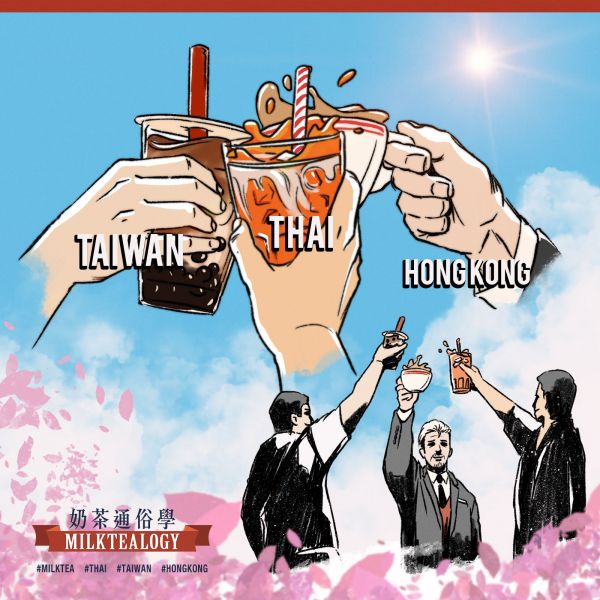
The original Milk Tea Alliance (Milkteaology)
The Milk Tea Alliance is an online solidarity movement between pro-democracy supporters in Hong Kong, Taiwan, Thailand, and Myanmar. It was started in 2020 by activists involved in social movements across East and Southeast Asia, but has since expanded to encompass the netizenry of Nepal, India, and beyond. Well-known youth activists, including Joshua Wong in Hong Kong, Bunkueanun “Francis” Paothong in Thailand, and others have lent their support to the alliance, as have politicians in Taiwan and India.
The name was inspired by the popularity of the drink in each of the countries involved in the alliance. An informal tri-colored Milk Tea Alliance flag represents the color of the different milk tea variants in Thailand, Hong Kong, and Taiwan. Netizens from Myanmar, Nepal, and India, later additions to the alliance, also enjoy their own variants of the popular beverage.
The #MilkTeaAlliance hashtag began its life as a meme in response to the harassment of a young Thai actor and his girlfriend by Chinese nationalists. Vachirawit Chivaaree, the star of a Thai drama popular in China, and his girlfriend Weeraya “Nnevvy” Sukaram were harassed by the Fifty Cent Party and little pinks after they discovered content on the pair’s respective social media that may have suggested Hong Kong and Taiwan were independent countries. Twitter users in Thailand, Taiwan, and Hong Kong defended the couple under the hashtag #nnevvy, before eventually coming together under the #MilkTeaAlliance banner.
The popularity of the hashtag has fluctuated based on political activity in the alliance’s regions. In Thailand, pro-democracy demonstrators chanted have shouted “Free Hong Kong” at their own anti-government protests. Activists in Taipei have gathered to show support for the 2020-2021 Thai protesters. The hashtag trended in June 2020 amid calls to boycott Disney’s “Mulan” over the lead actor’s pro-Hong Kong police stance and the company’s decision to film large parts of the movie in Xinjiang.
In February 2021, the hashtag saw a resurgence on Twitter in response to the Myanmar coup. Solidarity protestors took to the streets in Taipei, Bangkok, Melbourne, and Hong Kong in support of Burmese demonstrators protesting the coup. Netizens celebrated in April 2021 when Twitter created a dedicated emoji for the #MilkTeaAlliance hashtag.
Anyone who has boarded an airplane in the last 20 years knows what stands between arrival at the terminal and waiting at the gate: shoes off, laptops out, water bottles emptied …. In China, similar checkpoints also await railway and subway passengers, among others. In an April WeChat post, translated in full below, Wei Sanhe recalls the personal indignities he has witnessed and suffered himself at security checkpoints, and reflects on the station in life of the ideal security official:
The Curse of the Security Check
Wei Sanhe
1
An officer blocked the young man in front of me at the train station security check. “You have a lot of scissors in your bag,” the officer said. It was “a lot of scissors” that got my attention. I watched as the officer opened his backpack and took out a case. “For cutting hair,” the passenger said.
I stopped to watch the story unfold.
“A lot of scissors.” Actually, there were only two pairs of scissors, one the kind with teeth, you’ve seen them, I couldn’t tell you what they’re called. And there were some other small implements that seemed to have sharp, metal points.
Have you seen the latest hairdressing tools? They’ve really gotten an upgrade, and they fit into those little cases that are bestsellers on Taobao and JD.com.
The frontline security officer brought the tools to another officer who was seated, and together they began their inspection. I was about five meters away. There was an electronic display screen for a rear view, where I watched the officers turning over the hairdressing tools and examining their fine, pointed ends.
I got nervous waiting for the security girl to say something. Would the tools stay or go?
Finally, she pronounced her judgment. “You can’t bring the scissors on the train.”
She turned and escorted the young man and his tools to a counter. She told him he could bring everything else besides the scissors, but he decided to leave the whole kit behind.
Then I witnessed a “humanizing” procedure. The young lady at the counter took out a sealable paper bag, and the young man scanned its QR code. Then the security girl put the tools in the bag and sealed it.
Don’t think too hard about it. This wasn’t for fast delivery of your property to your destination. The QR scan was for leaving stuff behind and arranging when to come back and fetch it.
“When can he pick it up? Or rather, how long will they hold on to your dangerous items?” I asked this out loud.
“Speak Mandarin,” said the security girl. “I don’t understand.”
That threw me off. I thought this work would be the province of a local girl with a few day’s training, at most.
It was actually difficult work. She had to scan every single passenger from head to toe, which meant that for each person she had to raise her head, lower her head, and stoop over. Sitting duty was possibly better. I reckoned they took turns.
It would be hard work for anyone not in their prime. Even so, it couldn’t be easy for any of these women (according to my observations of subways and airports, women comprise more than half of security officers).
And here was a slight young girl who had traveled so far for the sanctuary of this work.
I switched to Sichuanese and asked again, but she didn’t answer. She was too busy. The flow of the security checkpoint depended on her.
2
My onlooking complete, I hurried to catch my train, thinking back on the many checkpoint encounters I had stockpiled in my brain.
At this very same train station, the year before last, an old friend came to visit. There had been an issue with her luggage. She’d been here before, with the same piece of luggage. It had come with her from Europe to China, and in China from Suzhou to Xi’an by high-speed rail, and again from Xi’an to Chengdu through another airport check.
The problem was hair gel.
No matter how good her Chinese, she couldn’t get around the regulations. She had looked at me, hoping I would say something useful. I knew what she was thinking. It’s not surprising that most reactionary Western countries have a weak sense of the enemy—they basically have no security checks on their subways and trains. All I could do was look back at her, at a loss.
Whatever they confiscate they hold onto for just one day, and you have to come back to get it yourself.
I asked if they could hold the hair gel for a few days longer. I remembered that at the Capital Airport I once had a tube of toothpaste over 100 milliliters: When they took it, they said they’d hold onto it for a month.
But the officers at Chengdu East Railway Station thought I was talking nonsense, and they ignored me.
At that point you just have to give up. To console my visitor from far away, I explained that security is a core Chinese value, and the security checkpoint is the strictest place in China. The courtroom can be accommodating, but not here. You must understand.
3
Two years ago, I took my father to Chongqing for medical treatment. I wanted him to ride the subway, something he’d never done before. I also brought him home by high-speed rail. All this amounted to him experiencing the modern security check.
On both the subway and the high-speed rail, the security girls asked my father to take off his hat for inspection.
Both times I said, “This man is in his eighties. Even I wouldn’t take off his hat. How can we get past this?”
As you might expect, they wouldn’t make an exception. My humor didn’t even get me a grudging smile. The security girls were overworked, and they weren’t in the mood to listen to me.
When I took off my father’s hat and handed it to the inspector, I said to myself, This is just strange, and wrong.
At the same time, I understood. In my opinion, those women are the most dedicated workers in China.
4
I am quite the artful dodger at my hometown train station.
I have often wondered, Is it worth it? But I haven’t changed my ways.
Just a few weeks ago, I got into an argument with the security girls there. Objectively, I did lose my temper at them.
I had heard two villagers talking in the waiting lounge. One said his wrench had been confiscated. The other said he’d been lucky, his wrench had slipped through.
It was around the time of the spring equinox, and farm work was picking up, but these two were only now heading out to work. They were bringing along simple tools, most likely for odd jobs. One was a bit younger, while the other seemed to be in his fifties. I imagined what their lives were like, and it got to me.
It sounded like they were heading far north, where it was still cold. Their big backpacks were stuffed with things to keep warm. They looked stupefied, as if they were discussing someone else’s problems. The one whose wrench had been taken was expressionless. The lucky one looked neither happy nor worried.
I knew how they felt. They had one foot at home and the other in an indeterminable future. But they weren’t in the present, and inside they were empty.
I told them, “Wait and see. I’ll have a word with them!” They were a bit surprised. “I’m not going to get it back for you,” I said, “I can’t do that, but I am going to give them a what-for!”
I went up to security. There weren’t many passengers in this train station in the county seat, so they weren’t busy. “You took his wrench,” I said.
“According to regulations,” was her firm, indifferent reply.
“You think it’s easy for him?” I said. “Traveling so far from home at such an advanced age? You could just let it go. So what if it’s a wrench? It’s a work tool, and you took it. Now he’ll have to buy another. Not a good look for you!”
The officers were local recruits, the sons and daughters of farmers, so I tried to appeal to their hometown pride.
I may have been a tad emotional.
The girl holding the scanner was surprised, and annoyed, by my meddling. The girl at the computer said, “If we let him take it on the train, and if a fight broke out…”
“Young lady,” I said, “they’re out to make money, not trouble. Their families are waiting for their safe return. They want everything to go smoothly, more than you do…”
The girl holding the scanner joined in. “But what if…”
I knew we weren’t using the same logic, they and I. They wouldn’t buy my argument. So I just spoke for myself, lobbing it back to them. “What if you…”
To my surprise, they seemed to find my “what if” supremely offensive, and fired back, “What if you…”
Ha ha, it was pretty funny.
But I didn’t have time to talk nonsense with them. I had to check my ticket one last time and get to the platform. I had to change their minds right then and there.
“Police…” the girl half-shouted, half-cursed.
“Yeah, where are they?” I yelled back. “Get them over here and let’s settle this.” Meanwhile, I was thinking how less-than-ideal it would be if the police didn’t let me on the train.
The police came, and I blurted, “This young lady needs to be disciplined. She has no manners.”
That wasn’t the truth. I was the one who had escalated things. I’d been ruder than them. I had made a fuss for one reason: to make sure they remembered this incident, and hopefully, at some point, realized that they had gone too far.
The young policeman heard the story. Then he gritted his teeth and said with a blank face, “So you’re fighting injustice!”
I understood the weight of this statement: It meant I was provoking them. I said, “No, I just tried to reason with them. I mean, they could let a fellow villager keep his wrench. They’re just going to work, after all.”
I hoped that had cooled things down. “I’ve said my piece.”
The two policemen didn’t say anything. They turned off their cameras.
In the end, I escaped the trouble I’d brought upon myself, and possibly some grave consequences.
5
I come from an agricultural community. Train security checks are China’s postmodern art. When villagers from an agricultural community are asked to do “postmodern art,” it’s a train wreck, and there’s nothing you can do about it.
Two years ago, on the morning of March 8, 2019, I bought a train ticket to Beijing. After passing the last hurdle—that is, when I got to the platform—the ticket inspector suddenly shouted to the vast, empty hall, “He’s one bound for Beijing!”
Two uniformed officers ran over and told me to follow them. I asked what the matter was. They said I had to go through security. I said I’d already gone through security. They said I had to do it again.
On the right side of the hall was a small door that also led to the railway platform.
A whole bunch of uniforms were standing around. There was a table. My backpack was placed on the table. One uniform deftly got to work. I still didn’t understand what was going on, but I do remember it was a woman, and that she ripped open the zipper.
I was so bewildered that I just said, “What is it? What is it?” What I meant was, Why not just ask me to open my bag?
They were also confused: This was just how it was done. It never occurred to them that they shouldn’t just randomly open someone’s bag. Hadn’t they been granted the authority?
I quickly realized that there was a second security check if you were going to Beijing at the beginning of March [around the usual time of the Two Sessions political meetings in the capital]. It was like this every year. It wasn’t aimed at anyone in particular. You simply couldn’t go without a second security check. I accepted this, of course.
I said, “I could have opened it for you, but you didn’t ask.”
That was when the trouble started. It was probably the first time they’d encountered someone like me. In the ensuing negotiations, they never got the difference between me opening my own bag, and them doing it.
“I’ll open it, you inspect it,” I said. They played along. But I had deprived them of their sacred rite to go through other people’s belongings. I’d taken the sport out of it. I took my things out one by one and placed them on the table, stealing anxious glances at the platform on the other side of the door, where the train, for now, was waiting…
What did they think, seeing me so nervous? They were in no hurry, and they weren’t even looking at the objects I had scattered before them.
The performance complete, I hurriedly packed up my things. “OK?”
They ordered me to take everything out again. They had to make another pass, because apparently when I’d been checked the first time they’d been testing their equipment.
I was running out of time. I started to sweat.
It was useless for me to worry, though, and impossible for me to get out of it.
“I’ll take it and go back through, OK? I’ll run.” No. Once a passenger has laid a hand on their bag, they have to go through another body scan. And that wasn’t the end of it. I had no choice but to let a uniform carry my bag to the door and put it through the scanner again.
That forty-ish officer, in full uniform, with a baton at his waist and jackboots on his feet, took my bag and walked slowly, leisurely, rocking to the left, swaying to the right, over to the scanner in front of the waiting room.
I watched him, my heart galloping, but I told myself there was nothing for it. I had to calm down.
He put my bag into the machine, and the conveyor belt spat it out. Then he took my bag in one hand, and once more started swaggering back towards me.
I pictured myself snatching my bag and bursting through the door. The train still hadn’t moved.
But he pressed my bag onto the table and said, “There’s metal inside.”
“Didn’t you see it just now?” I cried. “It’s a key!”
Out the “metal” came. Then it was returned to my bag, which was checked again.
The train started to move.
6
I hold no grudge against that jackbooted, baton-wielding uniform. He, on the other hand, holds a grudge against me. He has been given the authority to check people, so of course he resents the people he’s checking. How else to explain his stalling?
I couldn’t keep banging my head against the wall, and I couldn’t grab him and bang both our heads against the wall, either. Not that I didn’t want to, but because he wasn’t him. He was them, and I couldn’t handle them on my own. None of his accomplices objected to him dawdling with my bag. Every one of them was indifferent to my anxious pleas. I don’t know if they’re simply numb in their hearts, or sharing in some vicious pleasure.
I remember there were bystanders trying to get me to calm down. These are the rules, nothing to get upset over, they said. I was on a lonely island. The onlookers, security guards, everyone else who wasn’t getting on that train, they were a community.
Whatever. Back in the waiting room I gave them all a talking-to about “big principles.”
All the inspectors and janitors were folks from the county, mainly farmers who owned nearby land. Here they were in costume. Their real uniforms were waiting for them outside.
Before there was the train station, most of them worked in Guangdong. (80% of the population of our little county gave their best years to Guangdong.) I had also had a taste of Guangzhou railway stations a few decades back. They were hell on earth. Perhaps we had trampled on each other at one of those stations.
Infrastructure is being built up too quickly. Suddenly there’s a high-speed rail in my hometown. Migrant workers who had been tortured by the old trains are now inspectors at these new stations.
I ranted. They said nothing.
I mistakenly thought the security check was controlled by the county public security bureau. I worked my connections (sorry people) and found the chief of public security, wanting to vent my anger and get them to change their ways. When the real uniforms appeared, it turned out they were not under public security. They say that except for foreign affairs, the railway has all the components of state machinery.
The two guys in regular uniforms were both outsiders.
The station master was alarmed. He wasn’t a local, either, but had been assigned here by the railway. A wise sixty-something, he was in no hurry. He asked to see the surveillance video, and then, with great magnanimity, brought me justice. “Our staff made a mistake. When you entered the station, they didn’t tell you you would need to get a second security check to go to Beijing, which cost you another check’s-worth of time.”
But in the end, no one conceded they should have gotten my consent to open my bag. This was our final disagreement.
Two years have passed, but as of last month (as mentioned above), I still “take the initiative to start trouble with security” at my hometown railway station, which just goes to show that I haven’t let this go. But I have decided that after I write this post, I will let go of my prejudice against them.
7
I can’t help but wonder what sort of person makes the ideal security officer. My conclusion is that the grassroots level masses, who have never known respect or power—the poor—are the ideal candidates.
Only poor people can do this work, can bear this hardship. This is understandable. Also, the grassroots masses, who have known neither power nor respect, will run away with any power they can get, automatically wielding it to inconvenience and mistreat others, and they will take pleasure from this, some modicum of psychological compensation for their respect-deficient lives.
The only power available to the downtrodden is the power of a servant.
But it is just this kind of power, the power to serve others, that can also be used to hurt others, to reward those who are as low as they are, or even lower. On top of that, they also take full advantage of “discretionary measures,” amplifying their power until it’s more than they can handle.
This profession came into being at an opportune time. There is a huge job market right now, and this is just the type of work for them. I am sure not one son or daughter of a government official is among their ranks. [Chinese]
Translation by Alicia.
One of Fang Fang’s most outspoken detractors had a change of heart when those she had maligned came to her aid. Li Dan, a 31-year-old woman from Sichuan, used to attack Fang Fang and her supporters incessantly. She was not alone. After Fang Fang began documenting life under lockdown in Wuhan, nationalists across China took to the internet to denounce her as a traitor. One even put up a big-character poster—once used to tragic effect during the Cultural Revolution—announcing, “I will personally use the chivalrous ways of the Chinese people to come and attack and cut you down, Fang Fang.”
Li Dan was swept up in the nationalist tide. A typical post from her read, “Prepare a coffin for the traitor Fang Fang and make sure it’s big—that’s the only way that traitorous sell-out will fit.” She also savaged critics of China’s medical system as “collaborators, traitors, nation-hating maggots, spiritually American, dogs collared by the West” and wrote that intellectuals “stink like cockroaches and flies.” But after being diagnosed with breast cancer in November 2020 and experiencing firsthand the degradations imposed on the poor by China’s medical system, she says she regrets her vitriol. “Now I believe. The iron fist of reality has struck. It hurts. I was a fool to be so protective of my nation,” she wrote. Unable to pay for her care, she started a crowd-funding campaign seeking 100,000 yuan (over $15,000) to cover expenses. Fang Fang’s supporters answered the call en masse, with many suggesting their aid might serve as an impetus for renewed tolerance both from and for those mired in online nationalism. Some of their anonymised comments, translated below, were collected in a WeChat post:
I don’t like pinks, but you deserve help.
Hello, I’m Fang Fang’s fan. I hope that your personal experience will allow you to understand how rare and precious Fang Fang’s appeal is for we struggling masses. That you may truly see good from evil, and truth from lies.
After you’re better, read more good books, see more of this beautiful world, and watch less Douyin and Kuaishou—then you’ll be able to understand the true meaning of life.
I hope you get well soon! I’m someone you used to hate. My sister was also hit by the “iron fist” last year.
Although I hate little pinks, I know we all start off from ignorance. I have but little to offer. I hope that God watches over your recovery.
The harshest rebuke stems from the deepest love. A society needs different voices.
I am a fan of Teacher Fang Fang’s and I am praying for you! Fight on, I hope you get well soon!
I’ve given what little I have. I hope you pass through this crucible soon! I’m also one of those you hate, but I still hope you get well soon.
Working people are also Fang Fang fans. I love this land and I love the ordinary people around me even more. I don’t have more to say at the moment. Get well soon. I’ve donated.
Life is precious. —From the most pernicious of nation-hating maggots, in your words.
I don’t agree with your views, nor do I condone your behavior. But I’ve still chosen to do this because we are different than you. [Chinese]
In a brief essay reflecting on the episode, WeChat public account @小晖原创 expressed hope that the two sides’ recognition of their common humanity might help avoid similar tragedies in the future:
Whether it’s Li Dan or the netizens she fought with, they can now see that their opposites are neither traitors, nor monsters, nor people with ulterior motives. Both sides have value. Their views only diverge on a few issues: Li Dan tends towards nationalism, while those other netizens tend toward criticism.
Life’s real like that—it won’t give you a pass just because you’re a nationalist. What’s coming around the bend comes sooner or later. No matter how loudly you shout slogans, cancer will come in the end, and you’ll still need to ask strangers for help.
That’s when the importance of empathy becomes clear. Empathy does not allow for Schadenfreude. Even if people are on opposite sides of an issue, they’ll still do all they can to help those in need.
Now Li Dan, at 31 years old, has finally awoken to life. Surely this must be her coming of age? Although our views may differ, we must all maintain a basic level of respect for others. I have faith that she will understand this and so be at peace.
I return to that one phrase. People are allowed their own views but they must have empathy and a benevolent heart. Don’t say anything you can’t take back, don’t burn any bridges you can’t rebuild.
Only in this way can we avoid repeating the tragedies of the past. [Chinese]
Nationalism remains ascendant. Many feel they have no choice but to silence themselves in the face of its onslaught. Many LGBTQ groups and feminists have been deemed agents of “foreign forces” and shut down. Nationalists fan boycotts of foreign brands over Xinjiang cotton, with government backing. What’s driving the surge? According to Yuan Yang of The Financial Times, rampaging nationalism is the progeny of government efforts to promote patriotism, and “influencers” desperate for cachet in online spaces:
After Xi Jinping became leader of the Chinese Communist party in 2012, crackdowns on political speech and even celebrity gossip limited what Weibo users were allowed to say. Influencers — who need to keep attracting followers and attention — have the difficult task of creating hot topics without touching political hot potatoes. For many, nationalism is a safe arena.
Influencers often earn their keep by promoting brands, as they do in other countries, and it’s not unusual to find posts promoting washing machines alongside those on who should own the Senkaku Islands in the East China Sea, which are subject to a territorial dispute with Japan and Taiwan. The same people who accuse, say, public intellectuals of “selling out to Japan” often sell Japanese products via sponsored posts.
[…] China’s internet regulator, the Cyberspace Administration, aims to promote patriotic speech. But the line between fervent patriotism and aggressive nationalism is difficult to manage. “Platforms can’t gently direct the influencers, lest they leak our conversations and cause even more trouble,” says the insider. And even if posts are deleted, some controversies become big enough that they still burst into the open. [Source]


