Monday, 10 April 2023

Harsh Prison Sentences for Pioneering Civil Rights Lawyers Xu Zhiyong, Ding Jiaxi

Civil rights lawyers Xu Zhiyong and Ding Jiaxi have been sentenced to 14 and 12 years in prison, respectively, on charges of “subversion of state power” after closed door trials in Linshu County, Shandong. The charges stem from a private gathering they hosted in Xiamen in 2019 to discuss the future of China’s civil rights movement. Xu and Ding have been in custody for over three years, including a period spent in “residential surveillance at a designated location,” detention at a secret location without access to lawyers or family members, during which time both were allegedly tortured. The lengthy sentences shocked observers and highlighted the hard-line position the Party-state has taken against peaceful activism in the Xi Jinping era. At The New York Times, Vivian Wang reported on Xu and Ding’s trials and the reactions from human rights groups, their loved ones, and friends

The lawyers, Xu Zhiyong and Ding Jiaxi, had been charged with subversion for promoting what they called a “New Citizens Movement,” which encouraged ordinary Chinese to exercise the rights such as free speech guaranteed by the country’s Constitution, at least in theory. They had been detained after organizing a gathering of about 20 lawyers and activists in the seaside city of Xiamen in 2019, where they discussed their plans to work toward those goals, and about the future of the human rights movement in China broadly.

[…] Human Rights Watch, the international advocacy group, denounced the latest sentences as “cruelly farcical” and called for the men’s immediate release. Mr. Xu and Mr. Ding were tried in secret, and the sentences handed down by a court in eastern Shandong Province were not publicly announced, but were confirmed by Mr. Ding’s wife, Luo Shengchun, who also goes by Sophie.

[…] “Since it was a secret trial, we knew it wouldn’t be light, but we didn’t think it would be this heavy. Because everything they did was within the scope of free speech and what criminal law permits,” said [Luo Shengchun, Ding Jiaxi’s wife,] who lives in the United States. “More than 10 years shows that this government has absolutely no ability for self-reflection or self-restraint anymore.”

[…] Teng Biao, a lawyer and friend of Mr. Xu and Mr. Ding, said Monday’s sentences showed how rapidly human rights had deteriorated under Mr. Xi. Mr. Teng, who left China in 2012 after being detained himself several times, said that under Mr. Xi’s predecessors, it was “not possible to imagine” that a small-scale private gathering like the one in Xiamen could lead to such lengthy sentences. [Source]

Authorities quickly moved to arrest the participants in the 2019 Xiamen meeting. Ding was arrested in December 2019. Xu Zhiyong managed to escape detention for nearly two months—he was eventually captured in Guangzhou in February 2020. While on the run, Xu penned an open letter to Xi Jinping urging him to retire and detailing Xi’s perceived failures as a leader. Both men have been kept in harsh conditions without regular access to lawyers. In February of this year, Ding told his lawyer, Peng Jian, that he was looking forward to the verdict in the hope that he would have access to pen and paper once he was moved from a detention center to a prison. Peng said that Ding’s beard had turned white, that he was “often unwell,” and had asked for vitamins. At The Washington Post, Christian Shepherd reported on the secrecy surrounding both men’s trials:

Luo, who lives in the United States, accused Chinese authorities of “behaving like gangsters” by refusing to allow her husband’s lawyer to share the final verdict with her, meaning she only knows the basic content of the judgment. “They are worried that I will send the name of the presiding judge to Congress for him to be sanctioned,” she said.

[…] Yaqiu Wang, senior China researcher at Human Rights Watch, said it is unsurprising that authorities decided to make an example of the two activists, in part because they have been imprisoned before and have strong reputations among Chinese rights defenders.

[…] A number of other attendees of the Xiamen event and supporters of Xu and Ding were also rounded up. While some have been released, Xu’s partner, Li Qiaochu, a labor rights and feminist activist, was charged with “inciting subversion” for uploading articles written by Xu. She is awaiting trial. [Source]

In a tweet, human rights lawyer Teng Biao, a friend of both Xu and Ding, reported that Xu said, “It’s almost dawn,” after hearing his sentence, but was not permitted to say more. Teng also noted that Xu’s lawyers were barred from visiting him in the detention center where he was being held after the trial. Anticipating that they would be denied the opportunity to speak in court, both men dictated statements (to be published abroad) detailing their hopes for a democratic China. China Change published and translated their statements. Xu Zhiyong said, “A democratic China must be realized in our time, we cannot saddle the next generation with this duty”:

I abhor a society where power is unrestrained and human nature is distorted, and where a few bureaucrats decide what 1.3 billion people should believe and speak, what news they should listen to, and what movies they should watch. They’ve built a high firewall to isolate China from the civilized world. They’ve kept millions of internet inspectors, police, and commenters to beat down people’s voices. They’ve created an air-tight surveillance network using ubiquitous cameras and big data that renders everyone naked. They’ve also invaded the spiritual world of the people, burning crosses, demolishing Buddhist seminaries, and forcing newer and native religions into exile.

[…] I yearn for a free China where power can not run amok, where our freedom to believe in a religion or an -ism is a personal choice and cannot be interfered with by those in power, and where we have the freedom of speech without large-scale censorship and political restriction, and no one is imprisoned for expressing their political beliefs. In a free China, we have the freedom to participate in public affairs without fake and manipulated elections, without such a thing as “wanton talk” [about the communist leaders]; everyone has the freedom to form a political party or association. In a free China, we are free to live our lives without Big Brother watching over everything we do, and privacy and dignity are not to be trampled by those in power. In a free China, people thrive to bring the rebirth of our ancient civilization in which we live in truth and become the best of ourselves without being bent out of shape by power.

[…] Why is it “subversion” to aspire to be real citizens? Why is it “subversion” for Chinese to exercise their core values and pursue democracy and freedom? Why is it “subversion” for them to sing “Arise! Those who do not want to be slaves,” which is the opening stanza of the national anthem of China? How hypercritical and absurd their regime is! How rotten it is!

I’m proud to suffer for the sake of freedom, justice and love. I do not believe they can build national rejuvenation on the quicksand of lies. I do not believe the Chinese nation is destined to authoritarianism and slavery. I don’t believe freedom can be forever imprisoned behind high walls. And I do not believe the future will forever be a dark night without daybreak. [Source]

Ding Jiaxi vowed to persist in his beliefs and said it is the “historical responsibility” of his generation to “eradicate autocracy”:

It has always been our sincere desire to avoid social turmoil and human suffering during the transformation period. We firmly believe that the most stable model for China’s transformation is one that is peaceful, rational, and non-violent. However many have doubted me, no matter many difficulties and setbacks I’ve encountered, including physical torture that I’ve suffered, I will not part from my steadfast convictions.

All Chinese who care about our country’s future must shoulder the historical responsibility of our generation, which is to eradicate autocracy and build a beautiful China. This demands that we overcome the fear in our hearts, speak loudly for justice, resolutely oppose dictatorship and privileged interest groups, and reject their authoritarian rule. As long as we work as one, the light of freedom, democracy and the rule of law will surely shine on the land of China!

[…] I have always believed that despite all the efforts by the authoritarian regime to reverse the historical current of human civilization’s progress by eliminating 1,000 existential threats to their rule, there will always be the 1001st threat that leads to their collapse. This is the law of history.

Let’s begin the countdown: five, four, three, two, one… [Source]

The lengthy prison sentences shocked many international observers. William Nee, a researcher at Chinese Human Rights Defenders, told The Wall Street Journal: “I’ve been observing the Chinese criminal justice system for well over twenty years, and this is one of the harshest sentences we’ve ever seen.” On Twitter, many prominent experts expressed outrage over the harsh sentences: 


source https://chinadigitaltimes.net/2023/04/harsh-prison-sentences-for-pioneering-civil-rights-lawyers-xu-zhiyong-ding-jiaxi/


Thursday, 6 April 2023

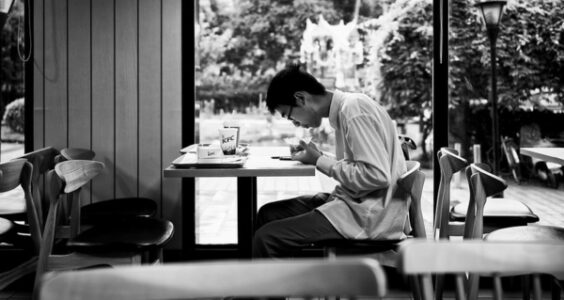
Photo: Untitled (Xiamen), by Baiyu Zhao

The two-story dwellings on either side of a narrow alleyway in Xiamen are adorned with decorative plants and hung with laundry. At the far end of the alleyway is a three-story building with a cheerful pink and turquoise facade and a rooftop balcony with metal railings.

Untitled (Xiamen), by Baiyu Zhao (CC BY-NC-ND 2.0)


source https://chinadigitaltimes.net/2023/04/photo-untitled-xiamen-by-baiyu-zhao/

China’s BRI Bailouts Draw Mixed Reception

Several reports published over the past two weeks shine a light on China’s lending practices abroad, in the context of an ongoing international debt crisis along parts of the BRI. The reports trace the evolution of BRI loans and debt-relief negotiations, and paint a picture of how China is adapting to a new chapter in its financial relationships with overseas partners.

This week, the China-Africa Research Initiative at Johns Hopkins University released a report assessing China’s participation in the G20’s Debt Service Suspension Initiative (DSSI), a multilateral debt-relief mechanism created to help the world’s poorest countries weather the pandemic. The authors of the report, Deborah Brautigam and Yufan Huang, explained that the DSSI offered a unique pathway for China to work with the Paris Club in providing debt relief, and that China’s participation improved the DSSI’s performance:

China fulfilled its role fairly well as a responsible G20 stakeholder implementing the DSSI in the challenging circumstances of the COVID-19 pandemic. In the 46 countries that participated in the DSSI, Chinese creditors accounted for 30 percent of all claims, and contributed 63 percent of debt service suspensions. The perception that other creditors – private and multilateral banks — were free-riding on Chinese suspensions reinforced Chinese banks’ later resistance to providing debt reductions in the Common Framework. On the other hand, Chinese disbursements dropped significantly in countries requesting DSSI relief, but remained steady for other creditors. The terms of the moratorium did not include instructions on how creditors should act in a situation that closely resembled a default. [Source]

The debate around China’s provision of debt relief has continued into the G20’s Common Framework, the successor to the DSSI, where negotiations have stalled. China has been sparring with Western-led multilateral development banks (MDBs) over who should take write-downs on their loans in the process of restructuring debt for countries in fiscal peril. China’s position as the largest state creditor to half of the 38 countries that the World Bank considers at risk of default makes Chinese cooperation essential, but geopolitical rivalries have made compromise difficult. The longer the deadlock lasts, the larger the challenges for both debtors and creditors.

A current snapshot of China’s international lending looks very different from the early years of the BRI. A new report from Aid Data, a research lab at William and Mary College in the U.S., shows that China has dispersed hundreds of billions of dollars worth of bailouts to BRI countries struggling to pay back earlier loans, making China a “lender of last resort.” Jason Douglas from The Wall Street Journal summarized this change and noted that China’s bailouts equaled about one quarter of all financing pledged under the BRI:

The financial assistance, which the authors describe as “bailouts along the Belt and Road,” have steadily grown in recent years as debt problems in low- and middle-income countries have gotten worse. China’s emergency support for borrowers reached $40 billion in 2021—up 32% from 2020 and more than 40 times the amount of similar aid extended in 2011. 

[…] In 2011, China extended $1 billion in rescue financing in the form of loans, loan rollovers and swap agreements, rising to $9 billion by 2014. By 2020, it was $30.7 billion. In all, China extended some $232 billion in emergency help in the 10 years through 2021, the authors found, with $172 billion of that total through People’s Bank of China swap lines and another $60 billion in rescue loans and loan rollovers from Chinese banks. 

The bailouts are equivalent to around a quarter of the roughly $1 trillion of infrastructure financing pledged under the Belt and Road program, and a fifth of the sums the International Monetary Fund lent to troubled countries during the same 10-year period through 2021. [Source]

Those indebted to China are low- and middle-income countries across the globe. Pakistan, Angola, Ethiopia, and Kenya are some of the countries with the largest debts to China. Some BRI countries such as Zambia, Ghana, and Sri Lanka have defaulted on their debt, although each owes varying amounts to China.

Commenting on Aid Data’s report, CNN’s Jessie Yeung described some of the key differences between Chinese and Western lending practices:

For one, China’s loans are far more secretive, with most of its operations and transactions concealed from public view. It reflects the world’s financial system becoming “less institutionalized, less transparent, and more piecemeal,” the study said.

China’s central bank also doesn’t disclose data on loans or currency swap agreements with other foreign central banks; China’s state-owned banks and enterprises do not publish detailed information about their lending to other countries.

[…] China’s bailouts don’t come cheap. The PBOC requires an interest rate of 5%, compared to 2% for IMF rescue loans, the study said. [Source]

Some analysts see China’s new position as a lose-lose tradeoff. “You make friends when you provide loans. You don’t make friends when you insist on full payment, when conditions have changed and full payment is nearly impossible,” Council on Foreign Relations fellow Brad Setser told Foreign Policy, adding, “China has put itself in a difficult position because the financial interests of its key policy banks really do now trade off against its diplomatic interests.” However, China-Global South Project’s Cobus van Staden noted that this dynamic is not entirely negative for China, whose willingness to issue emergency financing may be an “acknowledgement that the belt and road initiative is as much about relationship-building as it is about infrastructure…This lending will cement these relationships and make China even more central to [developing countries’] future economic trajectories.”

With this new phase of China’s international lending, the BRI is taking a new form. Christoph Nedopil Wang, the founding director of the Green Finance & Development Center and associate professor at Fudan University, wrote for Panda Paw Dragon Claw about the BRI’s key takeaways from 2022 and projects for 2023:

For 2023, with China’s COVID-related lockdowns fully lifted, an acceleration of BRI investments and construction contracts seems possible. Chinese developers can again travel to negotiate, plan and implement new projects. There is also a clear need for investments to boost growth in the post-COVID19 world supported by global financial institutions, including developing finance institutions (such as the World Bank, Asian Development Bank, AIIB), from which Chinese contractors can benefit.

We do not expect Chinese BRI engagement to reach levels as in 2018-2019, however. This is also a recognition of the Chinese Ministry of Commerce (MOFCOM), which put a break on fast overseas expansion in its 14th Five-Year Plan (FYP) for 2021 to 2025: it plans for China to invest USD550 billion (that includes non-BRI countries), down 25% from USD740 billion in the 2016-2020 period.

This does not necessarily mean that the deal number is decreasing. As we have been seeing in 2021 and early 2022, many smaller projects have been financed even in more difficult economic circumstances.

Two types of large projects will continue to attract Chinese engagement: strategic engagements (such as in strategic transport infrastructure in the region), and resource-backed deals (such as in mining, oil, gas). [Source]

Local actors along the BRI can chart a sustainable path forwards. W. Gyude Moore argued in his Africa Project blog that African voices such as the African Union can play an important role in establishing a middle ground on the debt-restructuring debate between China and the Western MBDs, using a targeted approach to loan write-downs. As for future Chinese financing of BRI projects, greater collaboration with local actors appears to enhance infrastructure-project success and achieve more sustainable performance, according to a report published this week by Boston University’s Global Development Policy Center. The authors Yangsiyu Lu, Cecilia Springer, and Bjarne Steffen found a positive link between cofinancing and project outcomes in Chinese development finance:

Cofinancing correlates with higher infrastructure project completion rates, as cofinanced projects are 3.3-7.0 percentage points less likely to be canceled or suspended than non-cofinanced ones. 

Cofinancing with certain partners suggests specific benefits: 

  • Cofinancing with partners from the host country is associated with more localized implementation.
  • Cofinancing with international partners has demonstrated improved environmental performance, with a 2.7 percent lower CO2 emissions intensity power generation units and lower biodiversity risk. [Source]


source https://chinadigitaltimes.net/2023/04/chinas-bri-bailouts-draw-mixed-reception/

Tuesday, 4 April 2023

FP – Beijing Doesn’t Know Who to Blame for Gold Mine Murders


source https://foreignpolicy.com/2023/03/30/chimbolo-gold-mine-attack-central-african-republic-china-russia-wagner-group/#new_tab

Li Wenliang’s Wailing Wall, March 2023: “This Society Allows Only One Voice—the Sound of Mutual Applause”

Nearly three years and two months after whistleblower Dr. Li Wenliang’s death from COVID-19, the “Wailing Wall” that emerged in the comments section under his last Weibo post continues to serve as a repository for the hopes, dreams, worries, and opinions of countless Chinese citizens. CDT editors regularly collect and archive Wailing Wall content, including the selection of comments translated below.

During the month of March, some visitors to the Wailing Wall noted the death of SARS whistleblower Dr. Jiang Yanyong (蒋彦永), who passed away from pneumonia in Beijing on March 11, at the age of 91. A military doctor who alerted the world to the true extent of the 2003 SARS outbreak, Dr. Jiang was initially hailed as a truth-teller and national hero, but was later imprisoned and subject to surveillance and house arrest after publishing an open letter calling for a reappraisal of the 1989 Tiananmen student movement and the massacre that ended it. Official media made no note of his death, his small funeral was monitored by plainclothes police, and essays and articles commemorating his life and contributions were censored online. CDT editors have archived a number of such essays, including a now-deleted tribute from WeChat account 旧闻评论 (Jiuwen Pinglun, “Commentary on Past Events”) that noted: “This, too, is Dr. Jiang Yanyong’s legacy to the world—that telling the truth is indispensable to  safeguarding the public interest.” 

Wailing Wall visitors also left comments commemorating International Women’s Day, which took place on March 8. Others mentioned the change of seasons, school exams, personal and family issues, and economic challenges such as finding jobs or internships, paying the bills, or running a business. A number of students mentioned that they had been inspired to visit the Wailing Wall because they had been learning about Dr. Li Wenliang in school.

The following Wailing Wall comments, selected and translated by CDT editors, were originally posted during the week of February 26-March 5, 2023:

陪着你笑啊609:Hello Dr. Li, last night my WeChat Moments got blocked for 18 days. I don’t know if it has anything to do with me posting remembrances of you to my WeChat Moments. I’ll always cherish your memory.

劳局安:Dr. Li, in May I’m taking the next step toward becoming a Party member, and I hope it all goes smoothly! I will definitely do my best to serve the people, speak for the common people, and stay true to the original aspirations of the Party!

亿条会飞的鱼:In our admin class, we talked about the reprimand you were given during [the early days of] COVID. After reading the reprimand letter, I wondered: at the time, did you feel that it was very unfair? I haven’t talked to you in ages. How are you doing over there?

AlbertMa2018:I’m glad to see that so many people have been coming to visit you here. Reading everyone’s messages of hope, complaint, gratitude, and remembrance made me realize that this place is what humanity is all about. Whether you are here or not, thanks for leaving us such a warm and welcoming place.

念然YR:Dr. Li, our teacher mentioned you today in history class, which suddenly made me want to visit your Weibo page. There are actually many, many things I want to say to you, but it’s best to keep it simple: Thank you! Have a good night! May the pandemic recede and the world be at peace!

入世·:Dr. Li, I wrote about you in an essay. At first, I figured that three years into the pandemic, I wouldn’t remember much about you, but as soon as I wrote the word “whistleblower,” your name immediately came to mind. I still remember getting into arguments with people about what happened to you, and how I tried so hard to distinguish right from wrong, and to see myself clearly … Anyway, thank you, Dr. Li. I will remember you always.

末路狂花zz:Dr. Li, I donated a lot of sanitary napkins to a primary school in Yan’an City. Sometimes I worry that donations of money and supplies won’t reach the girls. I wish this world could be a bit kinder to women.

你可以捏我脸:I came here to see you because today in English class my teacher suddenly started talking about you. [Chinese]

Comments from March 6-11, 2023:

没水也疯长的绿萝: Hello, Dr. Li!At 55, I’ve finally decided to learn to drive! Now that I’m getting ready to retire, I realize there are a lot of things I want to do that I haven’t done yet, and learning to drive is one of them. Once I retire, my life will be my own, and I guess I can do whatever I want!

MoonMoonSummer_: Today is International Women’s Day. Women can move mountains. I wish all women eternal happiness!

揪揪小筋: Respect to all working women, and happy holiday to our sisters all over the world!

张张张张张闻芙啊: My father told me that I should first be myself, and only after that, a daughter, wife, or mother.

友人A_7087: Doctor Li, this society allows only one voice—the sound of mutual applause. // [OP responding to their own comment:] Dr. Li, my comment has been deleted again!

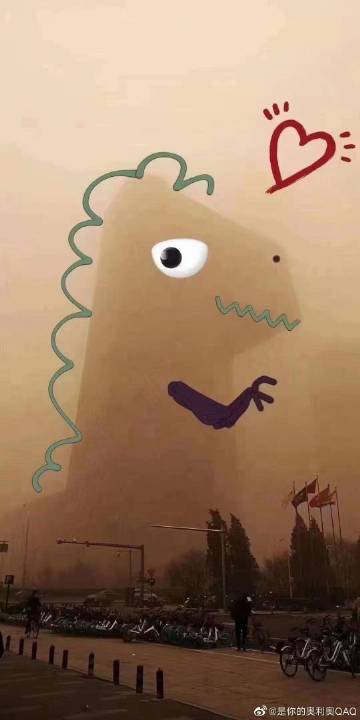
是你的奥利奥QAQ: During today’s sandstorm in Beijing, a cute little monster materialized near the big underpants [nickname for the CCTV headquarters building]:

The OP has transformed this image of CCTV’s Beijing headquarters in a sandstorm into a silhouette of a friendly dinosaur by adding colorful mark-up: a black-and-white eye, a green mouth, some green scales, a tiny black forearm, and a red heart.

The enormous silhouette of CCTV headquarters in Beijing, barely visible amid a sandstorm, is transformed into a friendly monster.

[Chinese]

Comments from March 12-24, 2023:

会魔法的砖头: Dr. Jiang Yanyong passed away.

HuangYinYuan_: Dr. Li, why have honest, hard-working people been reduced to being society’s losers, while speculators have become heroes?

帽菇凉: Many of my relatives and friends are out of work, and the income from my small shop has also decreased. It’s really tough to make a living this year.

MrDou: I’m 27. Everyone wants me to get married, have kids, and support a family, but no one wants me to be happy …

超级杂兵: Hello, Dr. Li. Nowadays, there’s even less freedom of speech than before.

千屿寻荒_: I got a call from the head of the hospital today, saying that one of my former students had been exposed to HIV in the course of his work, and had to take post-exposure prophylaxis (PEP). They asked me to go talk to him, because he’d locked himself in the on-call room and was in there crying, and wouldn’t let anyone in. When I got there, he finally opened the door, and before I could say anything, he hugged me, crying. I didn’t know what to say.

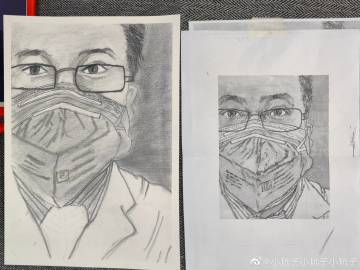
小玩子小玩子小玩子: Dr. Li, my son drew your portrait as part of a competition. Take a look and see if you like it:

Two black-and-white portraits of Dr. Li Wenliang, hand-drawn in pencil, depict the young doctor with kind eyes, rectangular eyeglasses, an N-95 mask, and a white lab coat.

晴岚岚岚_:  Stranger, if things have got you down and you’re feeling depressed, I’m right here to give you a shout of encouragement!

盖内: Dr. Li, it’s been 74 days since we lost my grandfather. Last year, he beat lung cancer. We celebrated his 80th birthday in the fall, but he passed away from COVID in the winter. I still can’t believe he’s gone. When he died, he took a part of me with him.

小米粒儿XSY: Every day, I play at being an emotionally stable adult.

LauK1t: Yesterday I tried to ask a friend if she knew about Dr. Li Wenliang and China’s “Wailing Wall,” but she said she didn’t even know who Li Wenliang was. There wasn’t any point in asking the second question. I feel really sad that she’s living in this false reality that others have created for her. [Chinese]

CDT’s Wailing Wall archive, and selections here, compiled by Tony Hu.


source https://chinadigitaltimes.net/2023/04/li-wenliangs-wailing-wall-march-2023-this-society-allows-only-one-voice-the-sound-of-mutual-applause/