Wednesday, 26 May 2021

Hong Kong Lays Groundwork for “Fake News” Law

Fears of a looming media crackdown are growing in Hong Kong amid escalating efforts by authorities and pro-Beijing media to magnify the issue of “fake news” in the city. In February, Chief Executive Carrie Lam vowed to introduce new laws that would target “doxxing, making hate and discriminatory speech, and disseminating fake news.” Since then, calls for a fake news law have been bolstered by figures including the police chief and pro-Beijing lawmakers and media outlets. But others worry that the introduction of such a law would be accompanied by broader media censorship, especially of newspapers highly critical of the government such as Apple Daily, the tabloid owned by jailed media mogul Jimmy Lai.

On Monday, the issue of fake news was brought to the fore again after a number of pro-Beijing newspapers, including state-owned Wen Wei Po and Ta Kung Pao, published exposés calling into doubt the story of “K”, a first-aider during the 2019 protests who was allegedly blinded by a bean bag round fired by the police. South China Morning Post’s Kanis Leung reported on the controversy:

After her repeated refusal two years ago to reveal her medical records to police who denied being responsible for her injury, pro-establishment media and politicians in Hong Kong have renewed their claims that she could have faked or exaggerated her case, prompting the Hospital Authority on Tuesday to reject accusations it had been involved in any such cover-up.

[…] Protesters claimed she could have been blinded by the incident and used it as an example of alleged police brutality, shouting slogans calling for “an eye for an eye” during a protest at Hong Kong International Airport.

[…] The controversy erupted the day before, when the Oriental Daily News, quoting exclusive sources, said the woman had been spotted leaving for Taiwan on September 30 last year. The report, which carried photographs said to be of K at the city’s international airport, added that her eyes looked “bright” and she appeared “normal”.

[…] Pro-establishment lawmaker Elizabeth Quat, referring to how the injury had deepened protesters’ anger towards the police force and sparked more demonstrations, said the woman’s case had caused far-reaching harm in Hong Kong and called on the government to set up a law to crack down on fake information. [Source]

The story of “K” is just one bugbear for pro-establishment officials in Hong Kong. Others have focused criticism on media coverage of the 8.31 incident, in which police attacked subway commuters in Prince Edward Station. Some protestors believe that civilians were killed in the station that evening, although no evidence has emerged to substantiate the allegation. The police chief also attacked media outlets for “inciting hatred” following negative coverage of the police’s activities on National Security Education Day, during which children were photographed playing with toy police assault rifles and bazookas. Earlier this month, The New York Times’ Austin Ramzy reported on the police force’s public fake news campaign and anxieties among those in the local media business:

The 12-page magazine, distributed on Wednesday to news outlets including The New York Times, described the police’s efforts to push back against misinformation. In one instance, the department countered rumors that officers had attended a banquet with gang members, saying the police had held their own private dinner. In another, it accused a local television station of smearing the police in a parody show.

“Fake news is highly destructive,” read one graphic carrying the hashtag #youarewhatyousend.

[…] “There is no doubt it is the worst of times,” said Chris Yeung, the chairman of the Hong Kong Journalists Association. Mr. Yeung said that the government’s push against what it called fake news was an attempt to avoid accountability for public discontent.

“They will also try to redefine the 2019 protests as something that happened because of misleading information, not because of wrong decisions by the chief executive,” police misconduct or failed policies, he said. [Source]

Most squarely in the crosshairs may be Apple Daily, the pro-democracy newspaper owned by media mogul Jimmy Lai, who is currently in jail for illegal assembly and pending trial for national security charges. Pro-Beijing outlets have repeatedly attacked the newspaper in recent months. Last week, the Hong Kong stock exchange halted trading in the shares of its publisher Next Digital after police froze all of Lai’s assets under the National Security Law, heightening fears about the company’s future. On Sunday, AFP’s Su Xinqi reported on the uncertain future for Apple Daily:

[…] “I am facing the greatest crisis since I took up the post over three years ago,” Apple Daily’s chief editor Ryan Law told AFP, just days before authorities used a new national security law to freeze Lai’s assets, including his media empire shares.

[…] As China’s crackdown gathered pace in the wake of 2019’s huge and often violent democracy protests, mainland authorities made no secret of their desire to see Apple Daily — and its Next Digital parent group — shuttered.

[…] Zoe, a reporter who has been at Apple Daily for more than five years, described a constant weight pressing down on her.

“The morale is rather bad,” she told AFP, asking to use a pseudonym to speak freely.

“It feels like something is approaching us… I worry that some day soon I may not be able to work in the press.” [Source]

But not all newspapers are necessarily under threat. In a sign of how political power has shifted since the passing of the National Security Law, the stories and editorials put out by state-affiliated media outlets in Hong Kong have become increasingly influential. For Hong Kong Free Press, Yuen Chan interviewed Ching Cheong, a former deputy editor at Wen Wei Po, a state-owned newspaper whose recent media campaigns (along with those of fellow state-owned outlet Ta Kung Pao) may indicate the return of influential “mainland mouthpieces” in the city:

Historically, the so-called leftist (pro-Beijing) media in Hong Kong have served two main purposes: to disseminate propaganda and aid united front work. The latter refers to the Chinese Communist Party (CCP) practice of winning over and co-opting individuals, networks and groups both inside and outside of China to extend influence and control.

[…] The publications lost market relevance but they continued to be read by those who needed to keep up with political developments as they often carried the first indications of policy decisions by the central government as they related to Hong Kong. This function has become more pronounced since Beijing strengthened its grip on Hong Kong in recent years, and especially after the implementation of the National Security Law.

[…] These attacks have escalated in recent weeks, with Wen Wei Po and Ta Kung Pao publishing multiple pages decrying the proliferation of “fake news” in Hong Kong by pro-democracy “yellow media”, a trend it says was started by Apple Daily. The dailies have amplified calls for legislation to outlaw “fake news” and a Ta Kung Pao opinion piece written by a senior commentator called for Apple Daily to be banned.

[…] Today, Ching sees Beijing using its Hong Kong proxies to “release test balloons” to gauge public opinion and hint at policies. And officials and politicians are taking notice. “Does that mean people have to adjust their stances based on their editorials? I don’t know. Maybe we haven’t reached that stage yet,” he says. “But what we can say for sure is that their editorials carry much more weight after the NSL [National Security Law] than before.” […] [Source]


source https://chinadigitaltimes.net/2021/05/hong-kong-lays-groundwork-for-fake-news-law/

Translation: “I Hope That This Cry is Loud Enough,” by Xianzi

On May 21, authorities abruptly postponed the second hearing of Zhou Xiaoxuan’s landmark #MeToo case. “We were so shocked. We were already near the courthouse when we received the notice,” Zhou told the South China Morning Post. The night before, Zhou, also known by her online alias Xianzi, had published a lengthy WeChat essay describing the obstacles she faced in- and outside of court, as well as her hopes for the #MeToo movement. CDT has translated portions of her essay below.

In 2018, Zhou published an essay alleging that Zhu Jun, a famous host at state broadcaster CCTV, assaulted her while she was a college intern for his show in 2014. After Zhu sued her for damaging his reputation, she filed a civil suit against him, explicitly framing it as an “experiment” that would test legal protections for victims of sexual assault. After a two year delay, the first hearing in Zhou’s case opened sensationally on December 2, 2020. Over 100 of her supporters gathered outside of Haidian People’s Court, some holding signs demanding “an answer from history.” One supporter tossed Zhou a scroll that read “[I] will win,” the same phrase Japanese journalist Shiori Ito displayed after her victory in one of Japan’s most prominent #MeToo cases. The hearing—which lasted 10 hours and was closed to the public and press—ended inconclusively, and Zhu Jun, the accused, did not appear.

On January 1, 2021 China’s new Civil Code came into effect. The Civil Code codified sexual harassment for the first time, providing #MeToo activists hope that they might find redress in court. Yet just days after the Civil Code came into effect, a court ruled against a #MeToo plaintiff in a similar case—forcing a former college intern to pay a powerful media figure restitution for slandering him. In March, a Shanghai court ruled in favor of the victim in sexual harassment case, but the case seems to be the exception rather than the rule, as victims often face significant legal barriers to proving their claims in court. As Zhou told The New Yorker, “According to the law, only a few sexual-harassment incidents have ever happened in China. Do you believe that?”

In the essay, published the day before the trial’s scheduled date, Xianzi addressed the court’s “illegal and unreasonable” treatment of the case, scurrilous claims made about her by Zhang Yang (a reporter who goes by the Weibo handle @一个有点理想的记者, which Xianzi repeatedly shortens to 理记), and her thoughts on the #MeToo movement’s future. CDT has translated two sections of her essay, “Xianzi: Before the Second Hearing, All That Has Occured In- and Outside of Court.” In the first, Zhou listed the “illegal and unreasonable challenges,” she has faced:

After the first court hearing on December 2, the internet was full of speculation and distortions about the trial and the facts of my sexual harassment case. The best way to clear things up is to tell you the facts. I’ll tell you what happened on Danleng Street at the Haidian Court on that frigid evening, beyond the warmth of the crowd gathered at the court gates. And I’ll tell you about all our efforts, after the first hearing, to secure a second.

First of all, after the December 2 hearing, we informed the public of our request that the three judges recuse themselves and allow a trial with assessors instead. As a result, we encountered various accusations of “disrupting justice and refusing to follow legal procedures.” In fact, the reason why I decided to prosecute in 2018 is because I believe in justice and wanted an open, fair, and just trial. Facing accusations and slander, I had no choice but to make public my reasons for requesting the judges’ recusal so that everyone could judge for themselves how I’ve been treated in court, exactly what sort of trial this is, and whether my appeals deserve an answer.

The trial lasted more than 10 hours, and we encountered a lot of illegal and unreasonable challenges:

1. In January 2019, we applied for the case to be reclassified as a “dispute over liability for damages from sexual harassment,” but it was not until December 2020, at the start of the hearing, that the judges ruled against the change and cited their absurd reasons.

2. After the pre-trial hearing in January 2019, we asked for a new DNA test on the dress I wore on the day of the incident, but it was not until December 2 that it was rejected.

3. After the pre-trial hearing in January 2019, we asked the court to broadcast the surveillance footage from the hallway on June 9, 2014. However, despite the inclusion of multiple surveillance video screenshots in the dossier, Haidian Public Security said “the surveillance video has never been retrieved.” We asked the court to continue to inquire with the police, but the court refused.

4. Both my parents were present to testify that on June 13, 2016, the Haidian Public Security criminal division asked them to sign a document promising not to pursue the case. We asked the police to obtain my parents’ records, but the request was rejected by the court.

5. In notes taken by the defendant’s lawyer, Shang, the classmate who brought me into the dressing room and eventually became Zhu Jun’s witness, stated unequivocally that in June 2014 he was studying in a different city, did not participate in the recording of the program, did not know who I was, had basically never communicated with me, and never brought me into the dressing room. After screenshots of surveillance footage taken from the hallway outside the dressing room proved Shang’s testimony to be untrue, we requested that Shang be brought before the court to explain his perjury and find the facts of the case. The collegial panel rejected the request during the hearing.

6. Over the past two years, we have repeatedly asked the court to summon Zhu Jun to attend in person. The collegial panel ruled it was “not necessary,” but gave neither an explanation of their reasoning nor its legal basis.

7. According to Articles 15 and 16 of the “People’s Assessors Law,” we requested people’s assessors to participate in a seven-person collegial panel.

8. I’ve asked for an open trial but have been consistently refused and can only hold my tongue as the defendant smears me. […]

Her essay concluded with a reflection on the #MeToo movement, sexual assault victims’ place in Chinese society, and the source of her persistence:

Since the first hearing in December, the accusations aimed at me have gone from “she’s a liar” to “she’s attacking the system.” My friends outside Haidian People’s Court, anti-sexual harassment activists there to support victims, have been falsely portrayed as so-called “foreign forces”—and this doesn’t even include the endless distortion and rumor-mongering of 理记, who serves as Zhu Jun’s voice in the public arena.

First of all, my expectation that we would gather in front of the Haidian People’s Court was made public from the very start. I only did this because as an anti-sexual harassment activist myself, I’d previously stood outside courtrooms expressing my support for and belief in victims. I believe that supporting voices can give those trapped in tough spots comfort and courage.

For a long time now, society has used sex-shaming and feminist-slandering to expel women’s voices from the public square—all with the goal of forcing us to turn our backs and retreat into our miserable experiences. #MeToo’s greatest gift to the public hasn’t been the increase in sexual harassment cases or the amendment to the Civil Code, but rather that our collective voices smashed the shame of sex and “failure.” To experience gender violence, to be unable to protect oneself in an unequal power structure, is no longer a form of humiliation. To write of harm, to speak of harm, to see—to treasure!—the bravery that exists alongside harm is, in its very essence, a break with the value judgments of the past.

I hope everybody sees it this way. I hope that everyone’s presence can send a type of strength to those experiencing gender violence and shame at this very moment: your experience is not isolated, your experience is not shameful, this is not your fault.

When we all stood together on Danleng Street, it was an expression of support: support for those who speak out, support for the weak, support for the smashing of shame. I hope that this cry is loud enough. It need not reach the imperial halls, but must ring through the darkest of nights and reach the loneliest of corners.

To remove sexual assault victims’ voices from mainstream narratives actually reinforces the value judgement that women should be ashamed of sexual assault—it even binds women’s chastity to the nation, affirming that a woman’s defilement is the nation’s shame and is thus a reality that should not be spoken of.

#MeToo became a global movement because gender inequality is universal. That it inevitably surges into a call for equality is a sign that the victims are awakening. This is precisely why #MeToo can leap borders and create new narratives told by the victims themselves.

To treat victims’ histories as things that can be casually covered up removes victims of sexual assault from mainstream narratives. Similarly, it removes vulnerable groups’ rights from mainstream narratives. Because power always favors vested interests, as soon as vested interests bind themselves to public symbols, they occupy a place beyond criticism.

Why do 理记 and others repeatedly stress that Zhu Jun hosted the CCTV Spring Festival Gala and other shows? Because once they bind a host to the “grand narrative,” they can get onlookers to believe a bizarre story: A 21-year-old female college student, in order to carry out some conspiracy, took an internship at CCTV. She went to the police to file a sham report before graduating college. She then laid low for four years, coming forward only after Zhu Jun had retired from the Spring Festival Gala. She enticed internet platforms into blocking relevant information and issuing censorship directives. She forced CCTV to ban Zhu Jun before filing a lawsuit to consummate this defamation conspiracy.

This is a sci-fi story. But it can get onlookers to go beyond logic because it riles up emotions. It is extremely difficult for the victim to have her voice heard: I accepted almost every interview request, ranging from establishment media to bloggers. And I have been disappointed once and again as the stories were taken down or prevented from publication by censors.

What Zhu Jun’s lawyers wrote in their brief parrots the public’s attacks against me: that I was seeking the spotlight and using this lawsuit to hype up. But since when can a victim of sexual harassment trade on her identity for fame? Since I came forward in 2018, my identity has been exposed. My family, my partner, my high school classmates, and even people who chat with me on Weibo have all become targets of abuse. In the current atmosphere, is it some kind of personal accomplishment to be the victim of sexual harassment? If it’s possible to capitalize victimhood, then who am I to receive such an honor?

There is a photo of me and Shiori Ito that 理记 used to imply that I took part in feminist activities in China and abroad. The truth is, the photo was taken after Shiori Ito’s book-signing in Beijing. I went up with her, along with other readers, to have my copy signed. Upon learning who I was, she gave me a big hug because she had been paying attention to my case. This is the friendship and support that victims share. I have been speaking up publicly because I want people to pay attention to individual cases. I want to increase the visibility of gender issues and sexual harassment victims. This is volunteer work that exacts a high cost in emotional labor but returns no profit whatsoever. Yet somehow it has been distorted into profit-seeking behavior.

In fact, since 2018, carrying on with two lawsuits has been draining my finances, my emotions, and my time. As for the stigmatizing of victims and attacks on my family and friends? Now that is truly costless. Addressing a ridiculous rumor requires a huge amount of effort. Beyond navigating all the procedural hurdles in court, it is simply impossible to address each and every online attack, scattered across countless platforms and accounts.

I am keenly aware that as the environment for public discourse deteriorates, we will face even more difficulties this time in court. If people show up again to support me, it will be perceived as provocation; if no one shows up, people will say that “their guilty consciences kept my supporters from coming back.”

What they want is to use fear and intimidation to separate us, to force us to stand alone, so that our tearful voices will sound no more echoes and disappear into the void.

My memories from December 2 are bittersweet. Sometimes I even think that I should be standing with everyone outside in the chilly wind instead of sitting in court, unable to eat for more than 10 hours, being driven to the verge of physical and mental breakdown, all while enduring humiliation from the opposing counsel and the unabashed apathy of the court.

But I had to go on. I had to go to a courtroom where the accused never bothered to show up and expose my body’s most shameful memories in front of complete strangers, waiting for them to judge whether I was being truthful enough. I’d always believed that this was my duty to the public: I have to try my best and accept the answer handed down to me.

But none of this is easy. When I filed my case in 2018, I was hopeful I would win. Now, in 2021, I still believe in myself when I walk into the court, but I can only hope for some due process and the basic decency that any human being deserves.

“Do not go gentle into that good night.” I know this poem. What I didn’t know was how you are supposed to feel when you have to go forward like this. Halfway through the lawsuit, I am nearly emotionally numb. I only manage to carry on because it is the reasonable thing to do.

For anyone who has been hurt, the pain will always be there. No matter the result of my case, victims of gender-based violence will still have to deal with their own hardships. And the darker the moment, the more those who are suffering need to be hugged tight.

I will carry on with my lawsuit. I will continue to demand fair treatment. I will move forward with courage, knowing that I was once hugged tight. [Chinese]

To read more of Xianzi’s writing, see this 2018 essay by Xianzi on her conviction that “gentleness does change the world, as long as it’s sharp and persistent.”

Translation by Yakexi, John Chan, and Joseph Brouwer


source https://chinadigitaltimes.net/2021/05/translation-i-hope-that-this-cry-is-loud-enough-by-xianzi/

Monday, 24 May 2021

Photo: Beijing, China (2009), by Lei Han

Beijing, China (2009), by Lei Han (CC BY-NC-ND 2.0)


source https://chinadigitaltimes.net/2021/05/photo-beijing-china-2009-by-lei-han/

Beijing Mourns “Father of Hybrid Rice” Yuan Longping as it Censors Critical Remarks

This weekend, the Chinese public mourned the passing of Yuan Longping, the Chinese agronomist whose scientific breakthroughs in rice development helped to usher in the Green Revolution that ended famine in large parts of the world. Yuan, who was awarded China’s highest official honor in 2019, passed away on Saturday in Changsha at the age of 90. Throngs of citizens and public officials mourned his passing and celebrated his achievements, but authorities were also quick to censor criticism and arrest individuals who insulted him online. The New York Times’ Keith Bradsher and Chris Buckley reported Yuan’s obituary:

Mr. Yuan’s research made him a national hero and a symbol of dogged scientific pursuit in China. His death triggered messages of grief across the country, where Mr. Yuan — slight, elfin-featured and wizened in old age — was a celebrity. Hundreds left flowers at the funeral home where his body was being kept.

Mr. Yuan made two major discoveries in hybrid rice cultivation, said Jauhar Ali, the senior scientist for hybrid rice breeding at the International Rice Research Institute in Los Baños, the Philippines. Those discoveries, in the early 1970s — together with breakthroughs in wheat cultivation in the ’50s and ’60s by Norman Borlaug, an American plant scientist — helped create the Green Revolution of steeply rising harvests and an end to famine in most of the world.

[…] Mr. Yuan chose to specialize in crop genetics at a time when the subject was an ideological minefield in China. Mao Zedong had embraced the doctrines of Soviet scientists who rejected modern genetics and maintained that genes could be directly rewired by altering environmental conditions, such as the temperature. They claimed this would open the way to dramatic rises in crop yields.

[…] His commitment to the field took on greater urgency from the late 1950s, when Mao’s so-called Great Leap Forward — his frenzied effort to collectivize agriculture and jump-start steel production — plunged China into the worst famine of modern times, killing tens of millions. Mr. Yuan said he saw the bodies of at least five people who had died of starvation by the roadside or in fields.

[…] Unusually for such a prominent figure, though, Mr. Yuan never joined the Chinese Communist Party. “I don’t understand politics,” he told a Chinese magazine in 2013. [Source]

South China Morning Post’s Holly Chik reported on the swell of tributes to Yuan across China:

In the city of Changsha where Yuan, “the father of hybrid rice”, was hospitalised before his death, traffic police had to disperse crowds at the Mingyangshan funeral home, where a memorial service will be held for Yuan on Monday morning, according to local media reports.

[…] President Xi Jinping sent his condolences to Yuan’s family through the Communist Party branch in Hunan province, lauding Yuan’s contribution to China’s food security, state news agency Xinhua reported on Sunday.

Xinhua also ran a rare commentary on Saturday suggesting the country fly the national flag at half-mast to honour the scientist.

The online Chinese world, including major news websites and social media platforms from Weibo to WeChat, were filled with tributes to Yuan in a rare spontaneous nationwide expression of sorrow – a phenomenon usually only seen with the death of a political heavyweight such as former premier Zhou Enlai and former paramount leader Deng Xiaoping.

The United Nations praised Yuan for helping improve food security and eliminating poverty in China. [Source]

But amid the outpouring of support for Yuan, messages and tributes from the public were closely scrutinized by authorities. At least one interview with Yuan, where he was spoke critically of the Cultural Revolution, was reportedly censored on social media. Chinese state-affiliated tabloid Global Times reported that several people were arrested for insulting Yuan online:

At least three netizens were detained for defaming Yuan Longping, revered as the “Father of Hybrid Rice” in China, who passed away on Saturday, as the whole nation mourns his death at the age of 91.

Sina Weibo also decided to shut down permanently the accounts of 68 users who were found to have “reported false information” or “spread rumors, insults and attacks” on Yuan, according to a statement made by Weibo on Monday.

Two netizens, one in Beijing and another in North China’s Tianjin Municipality, were both found to have posted a number of insulting remarks about Yuan on Wechat on Saturday, which were reported to police. [Source]

But it was not only netizens’ comments that were being closely scrutinized. A fumble by state broadcaster CCTV that saw Yuan’s obituary prematurely published on social media led to a large public outcry. CCTV later retracted the report and issued an apology, but not before the obituary was reposted by dozens of media outlets. This generated confusion and harsh criticism on Chinese social media, with some netizens going so far as to accuse the broadcaster of being beholden to “foreign forces“—a catch-all scapegoat that, in this case, raised eyebrows for being directed at one of China’s most official media organs.

Nationalistic anger focused at state-affiliated media has been a persistent issue recently–most significantly with the public backlash against Global Times editor-in-chief Hu Xijin after he defended an underling who denounced an offensive post by an official media account–leading some to reflect on the readiness of netizens to turn against others in the name of nationalism. Author and commentator Mr. Shen Maohua (better known as his pen name Wei Zhou), wrote in Chinese about why people rush to blame “foreign forces” after the state-media’s fumble. CDT has translated an excerpt:

Such plot-twists have become all too familiar. What’s intriguing, though, is how people reacted after the misinformation was debunked: Instead of questioning the journalistic standards, many suspected that the “spread of rumor” was a destructive act launched by “foreign forces.” “Did CGTN take money from the Americans?” people asked in ridicule. Some even used phrases like “the imperialists will never stop trying to annihilate us.”

Since all destructive powers are or belong to “foreign forces,” the implicit logic goes like this: those “inside” China must remain united. Any dissent or resistance, in one way or another, can be seen as “passing ammunition (to the enemies)” and helping the enemies “divide and dismember us from within.” Such emotions, once elicited, are so effective that they become the ultimate weapon to immediately shut people up.

Many people don’t even realize the these so-called “foreign forces” are also a conspiracy theory. It creates this illusion that might make the majority happy: There is no division among “us.” All dissenting voices, in one way or another, are results of manipulation by foreign enemies. Thus, painful self-reflection is avoided. [Chinese]

Translation by Yakexi.


source https://chinadigitaltimes.net/2021/05/china-mourns-father-of-hybrid-rice-yuan-longping-as-it-censors-critical-remarks/

Friday, 21 May 2021

E.U. Puts Investment Deal with China On Hold as Beijing Refuses to Back Down on Sanctions

Members of the European Parliament voted overwhelmingly in favor of suspending talks on a landmark investment agreement with China, effectively putting ratification of the agreement on indefinite hold. The Comprehensive Agreement on Investment (CAI) was hailed by Beijing as a major diplomatic victory when it was signed in December 2020, but the rapid deterioration in E.U.-China relations following a tit-for-tat sanctions battle in March quickly extinguished enthusiasm for its ratification. Politico Europe’s Stuart Lau reported on the vote to pause ratification talks on Thursday:

The motion was passed by 599 MEPs, with 30 votes against and 58 abstentions, dealing a blow to the fate of the pact, officially known as the Comprehensive Agreement on Investment (CAI).

According to the motion, the Parliament took the position that “any consideration of the EU-China Comprehensive Agreement on Investment, as well as any discussion on ratification by the European Parliament, have justifiably been frozen because the Chinese sanctions are in place.”

It also demands that “China lift the sanctions before dealing with CAI, without prejudice to the final outcome of the CAI ratification process,” and says MEPs expect the European Commission “to consult with Parliament before taking any steps towards the conclusion and signature of the CAI.”

Beijing previously said it expected MEPs to “reflect deeply” and to ratify the deal as soon as possible. There are no signs from Beijing yet that it’s planning to remove the sanctions, which it has called “necessary, legitimate and just.” [Source]

European officials had been debating putting the CAI on ice earlier this month. On May 4, the E.U. trade commissioner announced a pause in efforts to ratify the trade deal, but that announcement was later walked back by an E.U. spokesperson. But MPs from across Europe have loudly voiced their opposition to the agreement, citing China’s human rights offenses and aggressive counter sanctions against European officials, diplomats, and academics. Bloomberg News reported that Beijing has stood firm on their sanctions, even as it has become evident that they have become a key sticking point in the E.U.-China relationship:

China is standing firm on retaliatory sanctions that led Europe to freeze a landmark investment deal, in the latest sign that Beijing is willing to sacrifice economic opportunities to protect its “core” interests.

[…] “China’s decision to take countermeasures is a legitimate response to the EU’s unilateral sanctions and confrontation,” a spokesperson for China’s mission to the EU said. “The China-EU investment agreement is a balanced agreement that benefits both sides. It is not a gift given by one side to the other.”

[…] Wang Yiwei, director of Renmin University’s Center for European Studies and a former Chinese diplomat in Brussels, dismissed the European freeze as an “emotional response” and predicted the bloc would eventually return to the table. The retaliation had successfully deterred Europe from making more moves against China regarding Hong Kong and Taiwan, he said.

“The Chinese retaliation came as a surprise to the Europeans as they didn’t expect the escalation,” Wang said. “The EU needs some time to cool down their emotions to realize how significant the CAI is to them, because what’s been agreed — after Xi’s personal involvement — is something they have been dreaming of.” [Source]

One country within the bloc that has continued to reliably support Beijing is Hungary, and in particular Viktor Orban’s Fidesz party. It has continued to support the CAI, while vetoing other E.U. measures to criticize China such as a fairly milquetoast bloc statement criticizing Beijing for cracking down on democracy in Hong Kong. South China Morning Post’s Finbarr Bermingham reported on opposition to the CAI pause from Hungary’s ruling party, despite overwhelming support from most of the rest of the European Parliament:

The motion gained the support of all the major parties in the European Parliament, including the European People’s Party, Socialists and Democrats, European Conservatives and Reformists, Renew Group and the Green Party – a sign of how Beijing’s sanctions helped unite the political spectrum.

“The Chinese side wants the CAI deal badly, but they miscalculated and now continue to underestimate the determination of the European Parliament to defend European interests and values,” said German MEP Reinhard Buetikofer, who was one of those targeted by Beijing.

[…] The EU’s efforts to introduce new actions on Hong Kong over Beijing’s crackdown on the city, for instance, have been stymied by Hungary’s power of veto for the past two months. [Source]

Amid the politicking over the future of the CAI deal, academics have waded into the debate about the merits of the agreement itself. In December 2020, European proponents hailed the deal as a boon for E.U. businesses, giving them increased market access in China, as well as a human rights victory, as it contained language that for the first time strengthened China’s commitment to observing international standards on forced labor. But academics have criticized the limited enforceability of many of the deal’s clauses. For the Observer Research Foundation (ORF), a policy think tank based in Delhi, Damian Wnukowski analyzed the political and economic merits of the CAI:

However, there are several provisions that, if genuinely implemented, could be beneficial for European companies, namely a prohibition on forced technology transfer, more transparency regarding subsidies (though only in services and not manufacturing, which is crucial from the EU’s perspective), and the broader definition of state-owned enterprise to embrace provincial entities. There could also be wider access to the Chinese market for EU businesses in such sectors as electric cars (but only for the biggest entities that can afford to invest more than €1 billion), digital consulting and cloud services, or health, as eight cities and Hainan Island are poised to be opened to foreign-owned clinics. On the other hand, CAI sustains wide access to the EU market for Chinese companies (though such instruments as the screening mechanism are still in place) and in some sectors, such as renewable energy, there are further concessions. Overall, the CAI can be perceived as a good result for China and not much of a success in terms of creating a level playing field between the sides.

Taking all this into account, the crucial issue concerning CAI is its limited effectiveness and enforceability. First, there is lack of an investment protection section. Without it, existing bilateral investment treaties between China and particular EU Member States will be used, which means a diversified level of protection. Both sides decided to continue talks for two more years to finalise the investment protection chapter, but there are no significant incentives to complete it (e.g., by making the CAI’s implementation dependent on that issue). Second, the dispute settlement system on a state-to-state level is incoherent, as provisions on sustainable development have a separate mechanism and can result only in recommendations. Thus, it does not guarantee comprehensive implementation of the agreement. Third, high-level consultations embraced in the CAI may prove beneficial but only if there is enough goodwill on China’s side.

Whether China can be trusted to really adjust to the legal framework of the CAI is problematic. This is connected with its record on adhering to international law, as well as the mixed effects of structural reforms (where the state plays a central role in the economy), or compliance with WTO dispute rulings, and violations of economic agreements, such as the free trade deal with Australia. Therefore, the timing and content of the CAI can be perceived as sub-optimal. In fact, increasing the Chinese Communist Party’s grip on the economy, which was visible in the case of the blocking of AntGroup’s IPO last year, might even increase the unpredictability of doing business in China. [Source]


source https://chinadigitaltimes.net/2021/05/e-u-puts-investment-deal-with-china-on-hold-as-beijing-refuses-to-back-down-on-sanctions/

Translation: How One Man Goes on Living After His Daughter Jumped to Her Death

The sudden cancellation on Friday of the second hearing in China’s biggest #MeToo case shows just how arduous the legal journey is for women who have been subjected to sexual harassment and exploitation. While Xianzi defies the trolls and continues her fight for legal action against her harasser, many other Chinese women have been sucked into the vortex of an indifferent legal system and a hateful public.

On June 20, 2018, a teenager in Gansu Province jumped from an eighth-story window, to the cheers of the crowd below and on the livestreaming app Kuaishou. Nineteen-year-old Li Yiyi had struggled to go on living after her teacher sexually assaulted her in September 2016. Plagued by depression and PTSD, she spent the years after the attack out of school, criss-crossing the country with her father seeking treatment. When the court dismissed her case, Li’s father tried to shield her from the news. But his daughter found out, and days later was sitting on the ledge of a department store in Qingyang City with onlookers egging her on and posting comments on social media asking her to hurry up and jump. Four hours later, Li declined a firefighter’s outstretched hand and leapt.

Despite the outrage immediately following her death, Li’s family today feels forgotten. The criminal case against her assaulter, Wu Yonghou, was reopened thanks largely to Li’s father, but the court ultimately ruled that the teacher’s “obscene behavior” had not been the sole cause of Li’s suicide. The family did win compensation from Wu and the school in a civil case, concluded in January 2021, but not even enough to pay off the debt accumulated over two years of their daughter’s medical treatment. Wu’s assault devastated not only Li, but her entire family, now financially and emotionally drained by their struggles to save their daughter and bring her teacher to justice.

In this longform report for Sohu News WeChat account @media-fox (极昼工作室), translated in full by CDT below, Cai Jiaxin conducts extensive interviews with Li Yiyi’s family, focusing on her father, and brings this tragedy back out of the shadows:

His Daughter Jumped to Her Death. How One Man Goes on Living
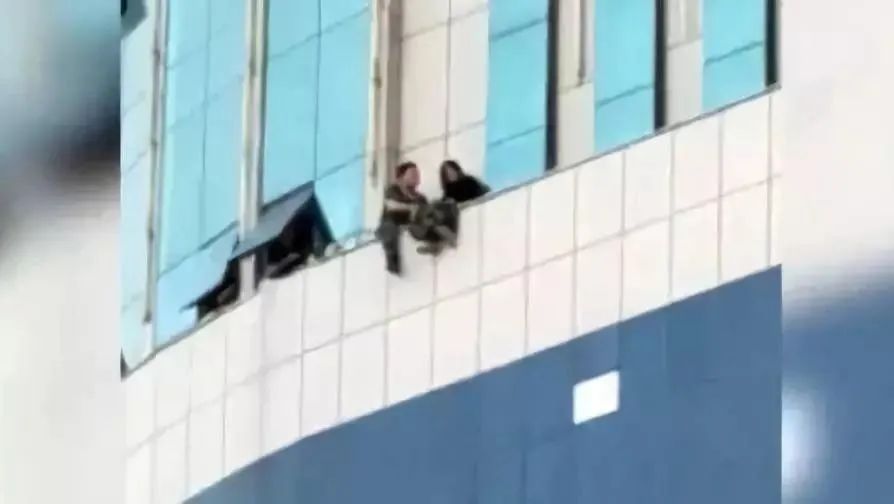
A firefighter tries to save Li Yiyi (online photo)

A firefighter tries to save Li Yiyi (online photo)

Dreams

Li Wenjun’s daughter had come back. The grape vines in the courtyard had all withered for the season. She was sweeping up the sawdust on the ground. His daughter looked as she did at 14 or 15—youthful, cute, clever. The weather had already cooled off. Wenjun squatted in front of the furnace room, tidying up the kindling.

These last two years, Li Wenjun often has vivid dreams like this one. At night, when he closes his eyes, scene after scene of his daughter floats to the surface of his mind: sometimes, he’s up on a windowsill wiping down the glass, his daughter by his side wringing out the rags; other times, he’s preparing vegetables with his daughter busily cooking beside him.

More often than not, he’s haunted by nightmares: he’s walking along a wide, flat road, with no one else around, when suddenly the road begins to collapse in front of him. He wakes up in a panic, yet he dares not make any sudden movements, for fear of waking up his 14-year-old son, who sleeps head-to-head with him on an L-shaped sofa. The boy has nightmares, too. He sometimes jumps up out of sleep or starts screaming. Wenjun springs up and soothes him, gently calming his confused son.

In the next room, Xiao Xuemei hears these midnight disturbances as clear as day. It’s cold at night; her hands and feet ache. She tosses and turns. Sometimes she picks up her phone and scrolls through pictures of her daughter from when she was 1, 5, 10… up until the year she left.

In 2016, Li Wenjun and Xiao Xuemei’s daughter, Li Yiyi, a student at Qingyang No. 6 Secondary School, was molested by her homeroom teacher, Wu Yonghou. She was subsequently diagnosed with post-traumatic stress disorder. On June 20, 2018, after two excruciating years, 19-year-old Yiyi jumped from the eighth floor of a commercial building in Qingyang City, Gansu Province. Even since that day, restful nights have been hard to come by.

By day, they seem like an ordinary family. Freshly-made meals appear on the table like clockwork. They eat together, listening to their son fill them in on his schoolwork and day-to-day life. Xiao Xuemei keeps an aloe plant to help treat their son’s acne. Next to it she has a lucky bamboo plant growing out of a glass of water. Li Wenjun’s 80-year-old father sits with them, eating quietly. No one has told him the real reason why Yiyi passed away. “Maybe he knows,” Wenjun says. “We probably won’t say.”

The days pass uneventfully in their less-than-80-square-meter apartment. This is the life Li Wenjun has rebuilt for himself. After his daughter’s death, he reunited with his former wife. He rented a two-bedroom apartment in the city so they could live with their son while he attended secondary school. He fell in love with the apartment as soon as he laid eyes on it—the huge window in the living room, the snow-white walls and floor tiles. He made sure to bring the white sofa, coffee table, and television stand from his old place. Rent is 830 yuan a month—not a trivial expense. But “the light is really good. My son and the old man will be happier here,” Wenjun explains.

When their son goes off to school, the cheerful facade disintegrates. Xiao Xuemei hides in her room, painstakingly recalling every detail of her daughter’s life. When Li Yiyi was 10 she learned to make steamed bread. One time, she snuck into the kitchen and rolled out a batch of dough while her mother was busy washing clothes. The pair loved buying matching mother-daughter outfits. But no matter how much she agonizes over these memories, her daughter remains forever out of reach. In moments like these, all she can do is open up the dresser drawer with her daughter’s old clothes and pinch the fabric between her fingers, just to feel it. The outfits she used to wear, her old khaki jacket—“I miss her so much.”

When Li Wenjun needs to clear his mind, he goes out alone. It’s springtime now. Green buds sprout from the willows lining the streets of Qingyang. But under the willows, he looks like a withered old tree. Though only 49, his posture is slightly stooped, he moves slowly, and frosty white hair covers his temples. He’s lost over 15 kilograms over the past two years. His eyes appear sunken and filled with sorrow, unable to focus.

In April 2020, Wu Yonghou was sentenced to two years in prison for the crime of forcing another person into an obscene act. The court took into account the time he had already served, and Wu was released in August. Li Wenjun heard nothing more about him for over half a year. The ruling in the civil case came out in January 2021: Wu and Qingyang No. 6 were to pay 67,000 RMB and 16,000 RMB, respectively, in compensation to the Li family.

It seemed the case would end there. The tower Yiyi jumped from stands less than a kilometer away from the family apartment. That strip of road had been under construction over the last two years, and it looks almost completely different now. There is an underground shopping center and a large department store. The shops lining the street bustle as before. It feels as if the city has moved on—the fate of that 19-year-old-girl has faded into the past.

Only the Li family is stuck. Whenever Wenjun drives by that building, he turns his head away so that he doesn’t see it. The evening sunlight gleams across his face. The mole below his right eye makes him look even more bereaved, this father who has lost his daughter.

Wenjun still wants to fight for justice for his daughter and his family, but “I don’t know what I should do next.” They’re still tens of thousands of yuan in debt for their daughter’s medical treatment. The settlement money, less than 85,000 yuan, fell far short of paying it off. Now their daughter is gone, their son is still young, and both Wenjun and Xiao Xuemei are plagued by illness. He wants to file a lawsuit, but he can’t find a lawyer willing to take the case.

Just like Xiao Xuemei facing the cliffs in her nightmares, “There’s nowhere to go,” Li says.

“There’s Nothing Daddy Can Do”

When he is alone, Li Wenjun often takes out the court documents—looking them over, circling things, taking notes—before carefully placing them back into their see-through plastic folder. His hands shaking, he makes sure all the pages lay flat, so as to not ruffle the corners. Like his despair, the legal documents keep piling up.

He feels he’s already done everything a father could possibly do. The first time he noticed something amiss with his daughter was September 6, 2016. That day, Yiyi’s face was all red when she got home from school. She sweated profusely the whole night, soaking her hair. Wenjun assumed she was feeling pressured by her studies. Still, he went down to the school to talk with her teacher, Wu Yonghou, whom he found at the teachers’ residence on campus. “What happened to my daughter?” he asked him,. Wu turned his back to Wenjun and faced the wall. “Nothing at all. She’s fine,” Wu said sullenly.

Over a month later, his daughter finally told him what had happened. On the evening of September 5, during study hall, Yiyi’s stomach began to hurt, so she went to rest alone at the teachers’ residence. Wu Yonghou seized the opportunity: he grabbed her and held her down. He touched her back, then tore her clothing, kissing her forehead, cheeks, ears, lips and other areas.

Wenjun’s first reaction was to rush to take revenge. But his daughter stopped him. “Don’t be angry, don’t be impulsive, don’t leave me.”

Xiao Xuemei was working in Shanghai at the time. They didn’t immediately tell her about the situation because Yiyi was concerned over Xuemei’s health. Everything fell on Wenjun’s shoulders. He had no idea what was happening, but he promised his daughter, “You just focus on getting better. Everything else, you leave up to Dad.”

Thanks to Wenjun’s persistence, the police finally opened a case. The Xifeng Branch of the Qingyang Public Security Bureau placed Wu Yonghou in administrative detention for ten days in May 2017. Yiyi did not approve. “They’re basically just giving him a ten-day vacation,” she said coldly to her father.

Wenjun then went to the juvenile division of the public prosecutor’s office. A few months later, he received formal notice they had decided against prosecution. He didn’t know how he could face his daughter with this news. He hid the notice. But Yiyi eventually came across it. “Dad, just drop it,” she told him, disheartened.

Those words remain knotted in Wenjun’s heart. This was the first time he felt so helpless as a father.

He worried that his daughter would commit suicide. She attempted many times. She took sleeping pills, jumped from buildings, turned on the gas, hid pesticides… From Qingyang to Xi’an, Shanghai, and Beijing, Wenjun ran all over working on the case and taking his daughter to different hospitals.

The doctors insisted that someone had to monitor her 24 hours a day. At night, while Yiyi was in her room, Wenjun sat on the living room sofa, smoking cigarettes and drinking coffee to stay awake. Worried he’d fall asleep, he didn’t dare lay down. He stayed sitting upright until morning broke.

The doctors also recommended that he try to give his daughter everything she needed, even if it meant spending a little more money. He did as they asked. Because of the medication she had been taking, Yiyi was quickly gaining weight. He kept buying her new clothes, only to have to throw them away soon after. The stuffed animals and dolls he brought home would soon be cast aside.

Wenjun tried to understand this illness—one he had never heard of before. He always said: She can’t control herself. She doesn’t drop things on purpose. She has double vision. She just doesn’t get a good grip on things, and they drop to the floor.

The most gratifying moments came when his daughter asked him for something. Normally, she didn’t express interest in anything in particular. On trips to Beijing, all she wanted to do was lay down in the hotel room. Wenjun encouraged her to get out and have a look around: Shichahai, the Great Wall, the Forbidden City, the Temple of Heaven… Once, she said she wanted to go to Sanlitun to see Black Swan Cake. The father-daughter duo stood outside the display window, shocked at the price tag—over 300,000 yuan for a multi-layered cake! He cherished these moments taking his daughter out shopping. He spent 120 yuan on a white short-sleeved shirt for her that day.

Wenjun ran himself ragged. His body was aging rapidly. Waiting to see his daughter in a crowded hospital hallway one day, he suddenly began experiencing heart palpitations. His chest tightened up and he broke out in a cold sweat. He was sent to the emergency room.

Two tough years went by. Treatment, shopping, normal household expenses—hundreds of thousands of yuan in savings quickly evaporated. Wenjun began asking people to lend him money. Despite it all, he still had hope. “I always thought, as long as I put in the work, my daughter will get better.”

After learning about the debt her family was in, Yiyi told her father that she wanted to get a job. She was spending her days at home, having suspended her studies. Her head physician agreed. But Wenjun was worried. He followed behind her as she walked to her job and brought her food and medicine at set times and locations each day.

In May 2018, Wenjun took his daughter to Beijing for treatment, and made plans with the doctors for her to spend time at the hospital in July. Around that time, Yiyi started reposting information about the college entrance exams. She also started having severe mood swings. On June 19, out of the blue, she told her father that she wanted to go to college, that it was her dream to study media in Shanghai—her previous dream. The next day, she jumped from the eighth floor of a commercial building in downtown Qingyang.

“All I wanted, with my whole heart, was to protect my daughter. In the end, I couldn’t. All these years of effort—all for nothing,” Wenjun said.

“My Daughter”

A few spells of springtime rain passed over Qingyang. Some moisture still remained in the March air as Wenjun went back to his ancestral village, Tielichuancun. The family home there still retained some traces of his daughter—her clothes and books sat untouched. “If nothing had happened, my daughter would’ve been graduating and looking for a job this year,” Wenjun remarked softly as we walked through the village. He paused, then let out a sigh.

Tielichuancun lies 30 kilometers outside of central Qingyang. His daughter was born there in 1999. They named her Yiyi, “meaning beautiful and graceful,” Wenjun explained.

Wenjun still talks about “my daughter” out of habit. Signs of his daughter’s presence abound throughout the village. “My daughter used to take her easel and musical instruments down to the river to play with her friends.” In spring wildflowers covered the hillside, and “my daughter used to always bring a bouquet back to the house and arrange them in a bottle with water.” Passing by Malian Bridge, he pointed to a tree growing out of a gap in one of the supports. “My daughter said you have to be strong, like this tree.”

Now that they are separated by death, these scenes sting.

Wenjun stood atop a 20-meter-high cliff. The spring wind blew all around. Dust and grass swept up in the wind made him squint, blurring his vision. He didn’t seem to notice the wind as he pointed to a mud-brick hut in the distance. “That’s where my daughter grew up.” The topic of conversation changed once again. One time, his daughter was sitting on the cliff, yelling, “Don’t come over! Don’t come over!” The dried grass and mud under his feet were loose and soft. Worried and afraid, he cried, “Yiyi, you come over here first, alright?”

“Dad, don’t save me. It hurts too much,” Yiyi cried during those two years of illness. It takes Wenjun’s breath away every time he recalls those words.

He misses how she was before she was sick. The first time she made sushi, Wenjun bought her a bamboo mat and seaweed sheets. His son barred the door while his daughter messed around in the kitchen, shouting, “I want to surprise you, Dad!” Another time, they were at a restaurant and his daughter discovered the secret ingredient for delicious red-braised pork—honey, instead of white sugar. She whipped up a batch for her Dad as soon as they got home. Her Grandpa has dentures, so Yiyi used to carefully pick out all the bones from fish for him.

Wenjun pampered her, too. He called his chef friend when Yiyi needed help with confusing recipes. When he was working in Shanghai, before 2010, he bought her gifts every time he had a day off. If he couldn’t fit all the gifts in his bag, he’d take his clean change of clothes out to make room.

In 2014, they built a new two-story house back in the village. Wenjun decided to get a crystal chandelier that Yiyi liked for the living room, even though he knew it would be difficult to keep clean. It took four workers an entire day to install the huge fixture, which had over ten thousand little parts. After Wenjun and Xiao Xuemei divorced in 2013, Xiao Xuemei moved to Shanghai to find work, and Wenjun volunteered to take custody of the two children. “The kids need a hot meal when they get home,” he says.

Yiyi’s classmate Liu Chen will never forget the figure of Li Wenjun, the man who always appeared in the doorway to their classroom with hot water or hot food for Yiyi whenever she was having abdominal pain, a common occurrence. “He was a really responsible guy. He took really good care of her,” Liu says.

Yiyi’s homeroom was the next door down from Liu’s. He remembers her as hard-working and quiet, the first to arrive at school virtually every day. She didn’t wander around much between classes. Together, there were over 100 students in the two homerooms. They had physics together. One day, Liu was having difficulty understanding the lecture. Yiyi, sitting next to him, saw him furrowing his brow. “I’ll explain it to you,” she offered. After that, they often worked on physics together. Yiyi was a scrupulous student, always able to recognize key points. Sometimes Liu wasn’t willing to admit that she caught things faster than he did: “That’s what I thought, too, just now,” he would say. She would just smile. “She never called me out on it.”

Liu later heard that Yiyi was going through mental health issues. He occasionally saw her around school with an absent-minded look about her. He didn’t think much about it; it was right before college entrance exams. He was in a university chemistry class when he heard about Yiyi’s fall. Liu’s chemistry grades were poor in high school. Wu Yonghou used to call him up to solve problems at the blackboard. If he got it wrong, Wu would pat him on the head. What Wu did to Yiyi, Liu found “inconceivable.”

After her passing, visions of Yiyi flashed before Liu’s eyes every time physics came up. He’s already a college freshman, waking up at 6:00 a.m. to prepare for the CET-4 and graduate school exams. He has even become the top playmaker on the school basketball team.

It was the kind of future Yiyi had wanted for herself. She had served on the class art committee at Qingyang No. 6. Her English and physics grades were top-notch. At home on the weekends, she was always pushing her brother to do his homework—the two of them would race to see who could finish the fastest.

In 2017, struggling with mental illness, she dropped out of school. “I just had never considered not going to college,” she told her father in tears.

It became a needle in her heart. She once invited an old classmate on break from college to dinner at the Li household in Tielichuancun. Wenjun prepared a table full of dishes. But right before they were supposed to meet, Yiyi’s mood suddenly became unstable and she got on a bus straight back to Qingyang. Wenjun rushed after her. When he returned to Tielichuancun days later, all the food on the table had grown fuzzy with mold.

Searching

Li Wenjun never gave up appealing the case. More than two months after his daughter’s passing, the Gansu Province Prosecutor reopened an investigation.

Was Yiyi suffering from depression or in a depressed state before she was molested? This was the focus of the trial, the question that would determine how much responsibility Wu Yonghou bore for Yiyi’s death.

Beijing Anding Hospital issued its final diagnosis: post-traumatic stress disorder. Wenjun looked it up online: suicidal behavior may be exhibited in the month following a trauma. She was molested on September 5 and first attempted suicide at home on October 7. “The timing checks out,” Wenjun said. This made him even more sure that Wu had directly caused his daughter’s illness.

Wenjun began searching all over for Yiyi’s high school classmates to help prove that his daughter had not been depressed before the incident.

But he failed to connect with even a single person. He called every number on his list. Only one answered the phone, but after listening to Wenjun, the person on the other line simply told him they didn’t know. Wenjun and his lawyer once even drove to a university 100 kilometers away to meet with a group of Yiyi’s former classmates. The students were accompanied by school advisors, who all sat to one side of the room. None of the students said a word. Wenjun had no choice but to give up. The mother of one of Yiyi’s classmates even blocked Wenjun outside their door, begging him to stop bothering her kid.

Unbeknownst to Wenjun for a long time after the incident, Yiyi’s physics teacher, Mr. Luo, was a key witness. Luo’s daughter and Yiyi had been classmates. On the day of the incident, Luo had his daughter take Yiyi back to the teachers’ residence to rest. At about 9:00 p.m., Luo returned and saw “Li Yiyi laying on the bed. Wu Yonghou was sitting at an angle, facing Yiyi. The electricity was out at the time; the room was really dark.” He noticed that “Yiyi’s hair was a little messy, and she sounded a bit as if she was sobbing when she responded to me.”

Luo has always been an upfront guy. His wife, Chen Qingyang, complains, “Whatever he knows, he just says it—low EQ.” When Luo got home that night, he asked his wife, “Did Yiyi have her hair in a braid today?” He felt something was wrong. “Yes,” his wife replied. Luo told her what he saw, pointing out that Yiyi’s hair was loose. Chen shook her hands, dismissing his suspicions. “No way. Mr. Wu is such an introvert. And he’s so old, too.”

Chen remembers Yiyi as “really good-looking. Her teeth weren’t straight, but it was very cute.” Yiyi used to come to their home to get help on physics from Luo. She would hop down the stairs, stick her head in the door, and ask, “Is Teacher Luo home?” She spoke bashfully but cheerfully. Later, some time after the incident, Chen saw Yiyi on a public bus, sitting next to the window in the back row. Yiyi had her head resting in her hand, her hair covering both sides of her face. “She was like a completely different person.”

Chen couldn’t understand how Yiyi suddenly became so ill. “Depression’s something that develops over a long time,” she thought. “How could she get sick just like that?” Recently, when she heard Yiyi’s diagnosis, she was dumbfounded. “So it really was that incident?”

Wenjun tried getting in touch with Luo to learn what he knew about what happened, but was told not to pursue him. The Luo family was going through enough trouble over the incident, someone familiar with the situation told Wenjun. Thinking back, Chen wasn’t willing to talk much about it, either. She just shakes her head. “Don’t even bring up how difficult those two years were for us.” Eventually, Wenjun had to give up on them. He understood the situation Luo was in, and he never blamed Luo for having Yiyi go rest in the teacher’s break room. He even thanked him for looking out for his daughter.

But key information for the case didn’t break for a long time, and Wenjun fell into isolation and helplessness. The reality of the situation pressed on, step by step. His son’s fourth grade essay, “Elder Sister, I Love You,” was submitted as evidence in court.

“Because Sister was under a lot of pressure in her second year of high school, she couldn’t take it, and she became very sick in the last half of the school year. Exactly what illness she had, I’m not sure. From then on, her temper became really bad,” the essay reads. “Sometimes she got so sick the doctors didn’t even know what to do. I was really worried. What could I do? I felt really hurt because you got sick. I was sad because you were going through a lot of pain.”

Brother and sister were seven years apart, but they had been close. Wenjun used to bring them candy from Shanghai, giving half of the haul to each of them. His son would quickly eat his. Yiyi would tease him: “Call me ‘Elder Sister,’ and I’ll give you my candy.” His son would end up eating it all. When they were out shopping and he got tired, she let him sit on her feet and lean back on her legs to rest.

Wenjun knew Yiyi was still working hard at her studies during winter break of that year. There’s no way she was that sick then—his son must have mixed up the time. But the appeals court did not admit this opinion to the court. The official criminal ruling stated that although the brother was a minor, his essay constituted a clear and objective narration of the facts and his feelings regarding the matter. Therefore, they “could not rule out that the individual, surnamed Li, had not already been suffering from depression or had been in a depressive state before the incident.”

“Although Wu Yonghou’s obscene behavior towards Li contributed causal force,” the ruling concluded, “it was not the only reason for her suicide.”

Furious, Wenjun kept shouting the last line of the ruling. “Contributed causal force—what’s that supposed to mean?”

To him, this meant there were other reasons his daughter became ill, like her family situation. People commenting online said she was affected by her parents’ divorce. But Wenjun thinks there isn’t much of a connection. He and his wife rarely fought in front of the kids. When Yiyi learned her parents were divorcing, she said: These are adult matters. I respect your choices.

Wenjun still hasn’t told his son about Wu’s role. But he’s growing older by the day, and wants to know the truth. “I’m definitely not going to let him think that his sister’s illness was because of me, as a father.”

He continued to appeal.

Good Dreams Don’t Last

Yiyi’s ashes were scattered on the hillside, blown away by the wind. According to local custom, unmarried girls who pass away cannot have headstones. Wenjun was also worried her remains might be stolen for a ghost marriage. For everyone else who had been caught in the vortex of this saga, life returned to normal.

Later on, Wenjun ran into two of Yiyi’s classmates. The winter of the year his daughter passed away, a classmate came to visit Wenjun with her parents. He really wanted to talk with her for longer that day, but with her parents around, it wasn’t so easy. Another time, a girl came up to him at the mall, calling him “uncle.” He recognized her: she used to come over to cook and do homework with his daughter. He really looked forward to encountering Yiyi’s classmates, but it was always so hurried when he did. There was so much he wanted to say, but he always held back.

Zhu Yonghai, the principal of Qingyang No. 6, was promoted and named the new principal of Qingyang No. 1 Secondary School, a key school in the city. Mr. Luo is still teaching physics at Qingyang No. 6. According to Chen Qingyang, her husband once ran into Wu Yonghou after he was released from prison. “He was walking down the street. He looked really dejected.” Wu even said hello to Luo. “Be careful on the road, especially at night,” Wu told him.

Only the Li family fell into a hidden abyss, left to swallow their pain. For a long time, Li Wenjun and Xiao Xuemei didn’t feel as if their daughter was really gone. They always heard her voice, sometimes her laughter, sometimes her voice calling “Dad” and “Mom”… it seemed uncannily real. But though they looked up and down their apartment, no trace of their daughter was ever to be found.

Wenjun holds a lot of regret. Before she fell ill, his daughter liked to whisper in his ear about the “misty regions south of the Yangtze.” When he took her to Shanghai for treatment, he rushed back to Qingyang. He didn’t think about it until after she was gone—he should have taken her to see Suzhou and Shaoxing.

He stopped talking to friends and to his neighbors down the hall. Their front door usually stayed shut tight, and the entire apartment smelled of Chinese medicine. Not long ago, Wenjun’s father had a stroke and was hospitalized. Wenjun rushed around taking care of his father, ultimately landing himself in the hospital with exhaustion. A year ago he was diagnosed with diabetes, and now his nerve endings are deteriorating. Scabs appear one after another on his lower legs. He has stared so long at his phone that his eyes are uncontrollably watery and sore.

When Wenjun was in the hospital, his son couldn’t sleep. Two “Combat Continent” comic books and a stuffed animal sat at the head of his bed every night. The events of the past few years have left their mark on him. When his sister overdosed, the then-ten-year-old boy stood staring blankly outside the door to the emergency room. The day his sister died, Wenjun told his son that his sister had gone to a far away place and would never come back.

The following day, Xiao Xuemei saw her son sitting alone, “not crying, not smiling.” Sometimes, out of nowhere, he’ll mention that he misses his sister.

Li Wenjun’s relationship with his son has gradually returned to normal. They had previously been very close. Back when he was taking Yiyi for treatment, if his son had a cold or a fever he had no choice but to leave him in the care of relatives. His son wasn’t able to understand at the time. “He must have thought his dad and sister were off doing something without him.” Over the last two years, Wenjun has explained to his son, “When your sister was sick, she didn’t have control over herself. I worried it would affect your studies, so I left before dinner every day to go out looking for her.”

“Dad, you should have told me sooner,” his son replied. “That way I’d understand that Sister wasn’t mad at me.”

This was a rare moment of relief for Wenjun. He felt he owed a great debt to his son, and so gave him his undivided attention. There was a period when his son became moody and agitated, taking much longer than usual to complete his school work. Wenjun went right to his teacher. They had just begun studying geometry, his teacher explained, and his son hadn’t made the mental adjustment yet. It’s OK, Wenjun explained to his son, everybody goes through challenges. Then they went to buy workbooks.

Now 14, his son has grown into a polite and mature young man. When a guest recently visited their home, he greeted them with a nod before going to the kitchen to chat with his mom. Later, at dinner, the topic of college came up. He glanced at his mother, then said, “No matter where I go, I’ll be sure to bring Mom and Dad with me.”

Wenjun thought about taking his son out of Qingyang, but it just wasn’t a viable option. In 2019, Wenjun worked for a time as a guest room manager at a local hotel, but his health began declining after just four months, and his doctor made him stop. Xiao Xuemei was in a similar situation. In Qingyang, jobs other than menial cooking and cleaning were hard to come by for someone of her age and in her condition. She went to work in a restaurant, where she made 70 RMB for ten hours a day. After one month, her wrists hurt so much that she couldn’t lift her hands.

A few months later, rent came due, and Wenjun didn’t know how he’d cobble the money together. He used to believe that “as long as you work hard, there will always be a way.” Before the incident, Wenjun was a hotel business contractor. He had some money in savings and planned to buy a home in the city. But after his daughter fell ill, he lost his business and his contacts.

Xiao Xuemei worked in Hangzhou during the two years of Yiyi’s illness. The two of them video-chatted every few days. Xiao had plans for her daughter. After she got better, she wanted Yiyi to come study baking in Hangzhou. In their last phone conversation, Yiyi expressed concern for her mother, working so hard away from home. She reminded her mother to make sure she got enough rest. Xiao wired Yiyi 200 RMB and told her to buy herself a dress and waited patiently for her daughter in Hangzhou. In the end, the only thing that came to her was the news of her daughter’s passing.

“Perhaps it’s fate,” says Xiao. She had hoped her daughter could have a tombstone, “Somewhere I could go visit when I wanted.” But there was nothing she could do. Now, the only place she can meet with her daughter is in her dreams.

She once dreamed she saw her daughter lying in bed. She asked Yiyi, “Where have you been? I’ve been looking for you for so long.”

“Mom, after I jumped, someone saved me,” Yiyi replied. “They did some experiments on me, and it worked. I’m back now.”

Xiao woke with a start. She shook her head, tears welling up in her eyes. Good dreams don’t last, she told herself.

To protect the privacy of individuals interviewed for this story, the following are pseudonyms: Li Wenjun, Xiao Xuemei, Chen Qingyang, and Liu Chen. [Chinese]

Translation by Little Bluegill.


source https://chinadigitaltimes.net/2021/05/translation-how-one-man-goes-on-living-after-his-daughter-jumped-to-her-death/