Wednesday, 7 September 2022

Use of House Arrest Expands Dramatically During Xi Era

Chinese police have dramatically increased their use of house arrest during Xi Jinping’s ten years in power according to the new report “Home as Prison: The Increasing use of House Arrest in China” by Safeguard Defenders. Residential Surveillance (RS), the legal term for house arrest, is a form of detention prescribed in China’s Criminal Procedural Law for individuals under investigation, awaiting criminal proceedings, or identified as a threat to national security. Formally, it may last up to six months. Through searching the official Chinese database on verdicts and court decisions, China Judgement Online, Safeguard Defenders identified 270,000 instances of RS since 2013 but estimated that the real number of people subject to legal RS is far higher, between 560,000 to 860,000. The conditions under which people are held vary widely. While some maintain a degree of freedom under RS, others have found their homes turned into veritable prisons with police installing a barred gate accessible only by a fingerprint reader used by guards. In the excerpts below, the report details how the expansion of lawful RS has led to abuses that likely violate the Chinese constitution and international norms governing criminal detentions:

Activist Shen Aibin in Wuxi City, Jiangsu Province, has been placed under RS several times, often during the investigation and while awaiting criminal proceedings. On 3 September 2019, the Liangxi Public Security Branch Bureau decided to put Shen under RS for six months while investigating his case. Shen was accused of “picking quarrels and provoking trouble”, a vaguely-defined crime used widely against journalists, activists, and lawyers as well as ordinary citizens to limit freedom of speech. Prior to the RS decision, Wuxi City police had summoned him and seized his mobile phone on 2 September. Under RS, Shen was monitored by cameras and guarded 24 hours a day by several people, and he was unable to leave or communicate freely with the outside world without approval of the enforcement authorities. In May 2020, during China’s National People’s Congress and Chinese People’s Political Consultative Congress, the Liangxi Public Security Branch Bureau, summoned Shen when he was about to take his train to Beijing and, again, placed him under RS for “picking quarrels and provoking trouble”. In addition to monitoring Shen by camera, the Liangxi Public Security Branch Bureau set up a guard post at his residence entry so that police officers could be stationed there 24 hours a day.

[…] On 22 July 2019, activist Shi Minglei and her husband Cheng Yuan, co-founder of Changsha Funeng, were both taken by the Changsha City State Security Bureau for ‘subversion of state power”. Shi was hooded, cuffed, and then taken to a local community office to be interrogated untilthe next morning at around 3 AM. On 23 July in the afternoon, Changsha City State Security Bureau finally announced that it was more appropriate to place her under residential surveillance for the needs of the case. Her phone, computer, ID card, passport, and Hong Kong/Macao Travel Permit were seized. Meanwhile, the authority also froze her bank account. She was given a phone that could only make and receive calls or text messages and had a new SIM card to allow the authority to monitor her communications.

[…] Following [Shi Minglei’s complaint to the Changsha City Procuratorate on 3 August against the Changsha City State Security Bureau’s case officers for abuse of power, favouritism, and criminal handling of the case], on 13 August, two police officers from the Changsha City State Security Bureau came to intimidate Shi by showing videos of her husband, Cheng Yuan, begging the police not to harm Shi. On 29 September, Shi was visited by two police officers of the Shenzhen State Security Bureau who warned her of having violated the RS restrictions, adding that the authorities could arrest her anytime if she did not obey. Shi asked one police officer, “I am under residential surveillance because I am accused of subverting state power, so how did I subvert? What did I do to constitute subversion? Where are the facts and evidence?” One police officer replied, “Don’t talk about the law with me. You have touched politics, so don’t talk about the law now.” On 15 January 2020, Shi Minglei was finally released from RS, but her complaint against the Changsha City State Security Bureau was never addressed. [Source]

Beyond the above instances of lawful RS, the true number of unlawful or arbitrary house arrests is impossible to verify. A number of prominent human rights activists and legal practitioners have been held under illegal house arrest. Lawyer Wang Quanzhang was released from prison in 2020 only to be placed under house arrest, a form of “non-release ‘release’” used to silence critics of the state. Nobel Peace Prize laureate Liu Xiaobo’s widow Liu Xia was held under extralegal house arrest from 2010 until 2018, when she was given permission to leave to Berlin. In 2021, businesswoman Duan Weihong briefly “resurfaced” from house arrest to warn her ex-husband against publishing a memoir on corruption among the CCP elite. At The Washington Post, Christian Shepherd and Alicia Chen reported on authorities’ motives behind embracing RS, and interviewed a man who claims to have been living under unlawful house arrest for the past decade :

Chinese human rights lawyer Tang Jingling sees the increased use of house arrests as another piece of the expanding security state that can be turned on activists at any time. “To surmise the purpose, it is to eliminate any kind of civil resistance,” he said. “There is basically no space to challenge authorities once you are confined.”

[…] Xu Wu, a former employee of Wuhan Iron and Steel Corporation who repeatedly sued the company over wage cuts, said in an interview that he has been under house arrest since he was released from a psychiatric hospital over a decade ago, with a dozen security cameras and a group of security officials guarding his sixth-floor apartment.

“I have been living in this small prison since 2011,” he said. “There is no lawful notice saying that I am under house arrest. They still say nobody is watching me.” [Source]

Ascertaining the true number of house arrests is difficult because of the opaque Chinese legal system. Last year, vast troves of judgements published on China Judgements Online were summarily taken down, ostensibly due to “technical reasons.” A researcher tracking the missing judgments, however, found that the removals corresponded to the presence of keywords such as “Twitter,” “Weibo,” “false information,” “national leaders,” and “picking quarrels and provoking trouble,” regardless of the true sensitivity of the case. At The Atlantic, Richard McGregor reported on the history of China excising legal records in an effort to preserve political security, thus creating a culture of “radical secrecy”:

Glenn Tiffert, a historian of modern China at the Hoover Institution, made a remarkable discovery about a decade ago when researching the legal debates in China in the 1950s over issues such as judicial independence and the ascendancy of the law over politics and class. By comparing the original journals in his possession that aired these usually savage debates with their digital editions, Tiffert noticed that scores of articles had been excised from the online records. Any historian fresh to the issue and without access to the scarce hard copies could never have known that China had conducted such debates at all.

The doctoring of the records was designed to buttress the party’s vehement opposition to Western legal concepts. “The more faithful scholars are to this adulterated source base and the sanitized reality it projects, the more they may unwittingly promote the agendas of the censors,” Tiffert wrote. [Source]


source https://chinadigitaltimes.net/2022/09/house-arrests-expand-dramatically-during-xi-era/

Tuesday, 6 September 2022

Photo: The Chinese Tiangong Space Station passes through the Cygnus constellation, by Giuseppe Donatiello

A wide-field image of stars with a white coordinate line illustrates the position of the low Earth orbit Tiangong Space Station.

The Chinese Tiangong Space Station passes through the Cygnus constellation, by Giuseppe Donatiello (CC0 1.0)


source https://chinadigitaltimes.net/2022/09/photo-the-chinese-tiangong-space-station-passes-through-the-cygnus-constellation-by-giuseppe-donatiello/

“Only One Person Per Household Can Flee?” Earthquake Evacuation Barred as Breach of COVID Rules

Some efforts to flee an earthquake in Sichuan on Tuesday were thwarted by an even weightier power than tectonic plates: China’s zero-COVID policy. Viral videos and screenshots show that some residents of locked-down buildings in Chengdu were prevented from leaving their homes by building managers and pandemic control personnel in white hazmat suits who claimed that evacuation would violate COVID-containment rules. The magnitude 6.8 earthquake killed scores and necessitated the evacuation of tens of thousands more—more than a dozen people remain missing. Chengdu is one of 33 cities across China, including seven provincial capitals, currently under complete or partial lockdown, according to Caixin. It was placed under lockdown last Thursday, with residents instructed not to leave the city unless strictly necessary and restricted to one-person-per-household-per-day allowed out to buy essential supplies. Schools have shifted classes online while the city conducts rounds of rapid testing.

The effort to keep people inside their homes during a deadly earthquake echoes previous instances of overzealous pandemic policy enforcement, such as the asthma death of a Shanghai nurse who was denied treatment at her own hospital because she lacked proof of a recent negative COVID test. On Weibo, netizens expressed outrage at the policy while maintaining a sense of wry humor about the occasional absurdities of China’s pandemic policy

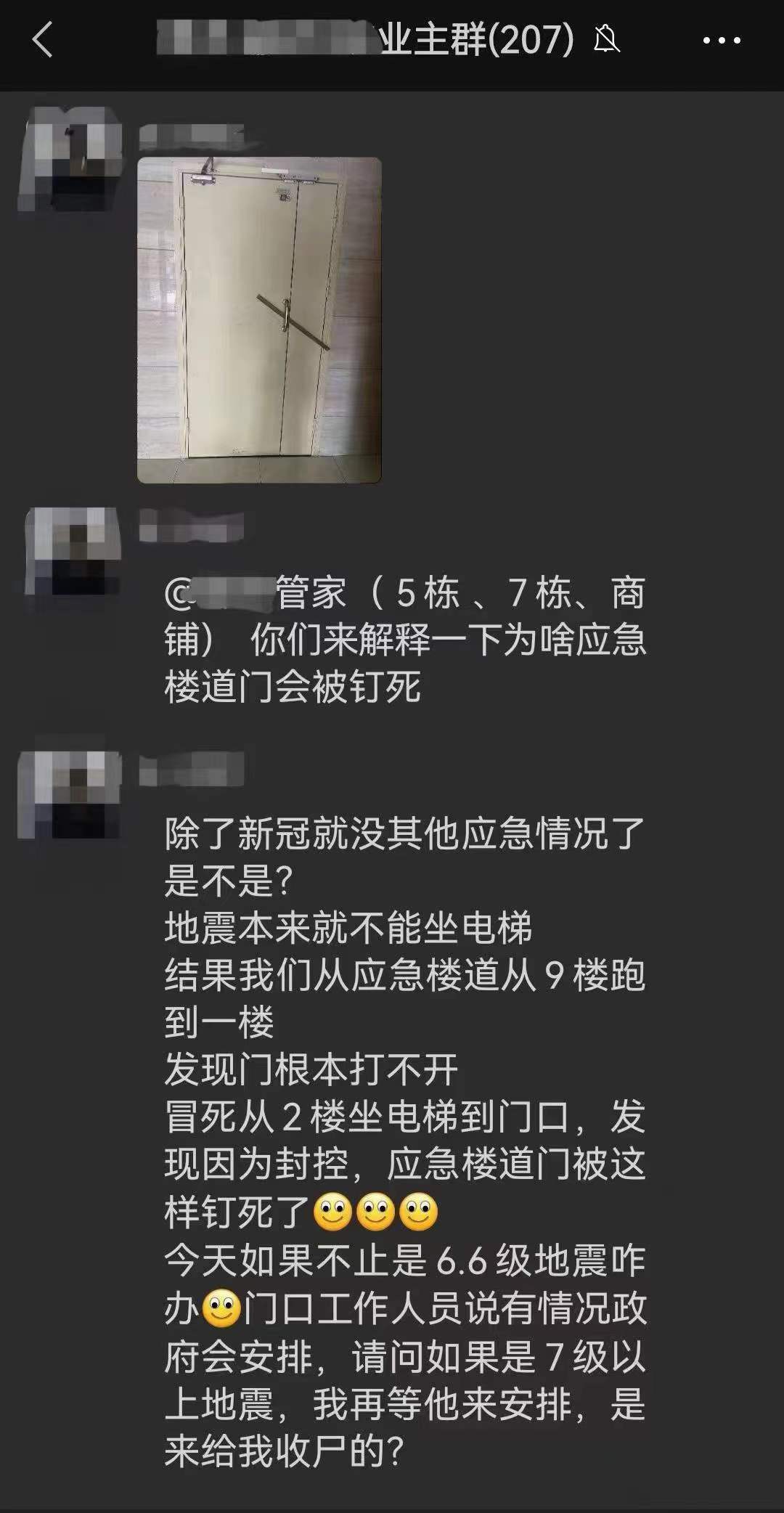
img
A photograph showing a building’s emergency exit barred shut, with one resident commenting: “There are no emergencies other than COVID, is that it?”

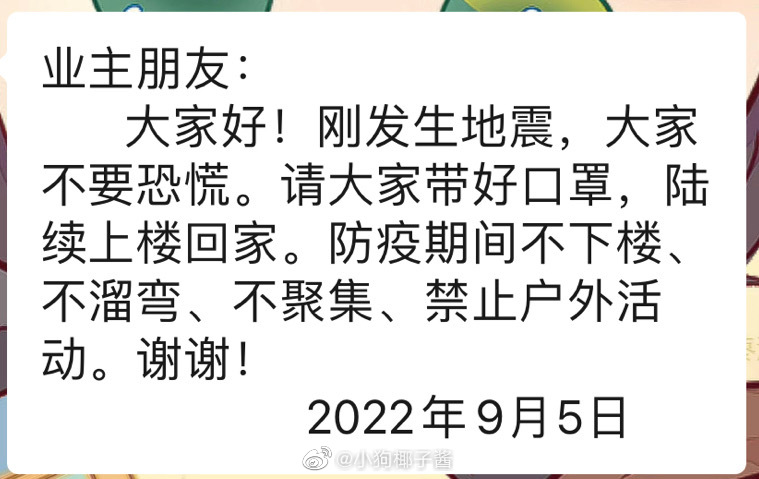
img

Homeowners:

Hello everyone! There has just been an earthquake. There is no need to panic. Everyone should put on their masks and make their way back inside their homes in an orderly manner. During this pandemic prevention period, you must not go downstairs, stroll around, or gather in groups. Outdoor activities are forbidden. Thank you!

我的命运只是追求幻影:A decades-long mortgage to buy a prison cell. 

也无兴趣认识你:Malicious earthquaking. Arrest the epicenter to eradicate earthquakes!

你有期待可能性吗:Premise one: the benefits of fleeing an emergency cannot outweigh the sacrifices made in doing so. Premise two:  pandemic policy is an order from on high; “pandemic prevention and control” is a duty; maintain a firm political stance. The logical conclusion: you cannot flee from danger at this time, as pandemic prevention work outweighs all other considerations.

影君子德尼罗:Only one person per household can flee?

双引擎:Please read these words carefully: “unless strictly necessary.”

D0hcireb:There’s an official announcement forthcoming, duh. 

貓貓朋克:Once the “Land of Plenty,” [Sichuan] is now a test site for the apocalypse. 

一道浮川:What a joke, disaster is on the doorstep but humanity needs proof of a negative COVID test within 48 hours before admission to heaven. [Chinese]

No deaths have been linked to the policy, but a number of social media posts capture the terror of residents who found themselves locked inside during the earthquake. More video, screenshots, and commentary on the incident: 

A glimpse of life in Chengdu posted to Twitter by People’s Daily over the weekend, meanwhile, omitted any mention of the city’s ongoing lockdown, favoring big black-and-whites over “big whites“:


source https://chinadigitaltimes.net/2022/09/only-one-person-per-household-can-flee-earthquake-evacuation-barred-as-breach-of-covid-rules/

Friday, 2 September 2022

Netizen Voices: Officials in Chengde Backtrack on Multi-generational Punishment for COVID Scofflaws

On August 30, the Chengde High-Tech Industry Development Zone in Hebei province announced a range of detailed and draconian punishments for anyone violating local pandemic prevention measures. Most extraordinarily, the punishments would also apply to family members of the violators, calling to mind the multi-generational, collective punishments meted out during past political campaigns or during China’s earlier dynastic history.

The announcement, which touched off a public outcry and elicited mockery online, was deleted just twelve hours after it appeared. Some netizens joked that punishing individuals for the behavior of their relatives would make people think twice about having children, thus truly forcing them to become China’s “last generation.” The phrase became a rallying cry in May, when a Shanghai man met a police officer’s warning that non-compliance would negatively impact his descendants with the retort “We’re the last generation, thanks!”

An article from WeChat account 旧闻评论 described the uniquely tailored “sticks and carrots” offered to three classes of individuals affected by the announcement (namely: cadres, entrepreneurs, and ordinary citizens), and speculated on the reasons why the announcement was so abruptly deleted:

The August 30 announcement […] listed incentives and penalties for different categories of persons who attempt to conceal their travel itineraries or refuse to cooperate with pandemic control personnel. The sticks and carrots include the following: Those demonstrating a good attitude will receive free medical treatment in the unlikely event that they become infected, whereas those with a bad attitude must pay for their own treatment. Party members, cadres, and leaders will be held politically responsible for “poor management” of their relatives if these relatives do not abide by pandemic policies. Entrepreneurs who do not abide by pandemic policies will be placed on a blacklist, and will be ineligible for any kind of business loans. Ordinary citizens who do not abide by pandemic policies will, along with three generations of their blood relatives, be prohibited from enlisting in the military, joining the Party, or taking the civil service examination.

[…] It cannot be said that public opinion had no effect, but public opinion was likely not the driving force behind the revocation of the decree. The real impetus may have been that this sort of short-lived pandemic prevention decree puts Party members, especially leading cadres, directly in the ​​”line of fire.” Asking people within the system to be held politically accountable for the actions of their relatives during the pandemic is stern stuff indeed. [Chinese]

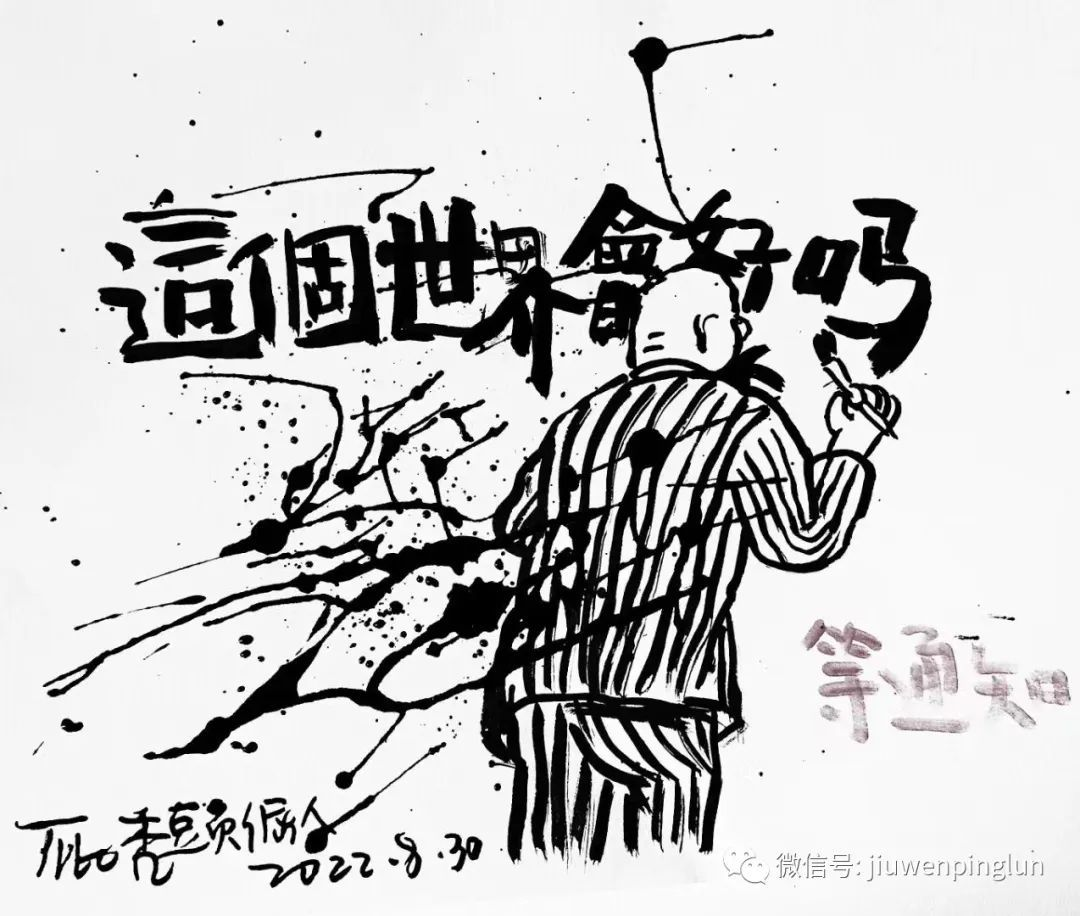
A black-and-white comic that references a viral photo of a question and answer scrawled on a wall. In this illustration, a man in prison stripes paints the question “Will this world get any better?” on a wall. At bottom left are the words: “Official announcement forthcoming.”

Top center: “Will this world get any better?” Bottom right: “Official announcement forthcoming.” Bottom left: August 30, 2022, Tutou Jueren [“Stubborn bald man,” the signature of artist Li Xiaoqiang]

A number of commentators have sounded the alarm about administrative overreach during the pandemic period. A recent post from WeChat account 桃花潭李白 notes that onerous requirements from higher-ups have a tendency to ratchet up the pressure on grassroots cadres, resulting in perverse incentives and overly harsh measures at the local level. The author urges an investigation into the Chengde decree, in order to deter other localities from similar overreach:

Such a policy far exceeds the scope of their administrative authority. It’s illegal governance.

Such a policy will not make pandemic-prevention work go any more smoothly. All it will do is place everyone in danger. 

[…] Little did they know that onerous requirements from the top skew implementation at the grassroots, and this skewing in turn exacts an unnecessary cost.

The Chengde High-Tech Industry Development Zone farce should be thoroughly investigated, as a warning to others. [Chinese]

CDT editors have collected and translated a selection of online comments about the announcement. Although some praised Chengde officials for retracting the policy so promptly, others wondered how it got through in the first place, and what the incident might bode for future pandemic policy measures:

文森特YD:Make no mistake, this is essentially the uncontrolled abuse of government power. It’s what comes from a culture of venerating officials …

[…] 梦与执念画在一起:Any manner of strange decree, provided it hits the trending topics list and attracts a lot of attention, will be revoked immediately. But if no one is paying attention, it might end up being implemented in secret. For the government, maintaining its self-proclaimed “stature” far outweighs maintaining the public’s trust.

[…] 安塔瑞斯_: You don’t seriously think that “punishing three generations” is an effective deterrent, do you? Take a look at birthrates first, and then you can talk. Just because a lot of bureaucrats are having kids doesn’t mean that non-bureaucrats would dare to reproduce.

渔火kkw:As a student of history, I look at the heap of books and materials on my desk, and don’t know whether to laugh or cry. I suddenly feel like this academic discipline I’ve loved for the greater part of my life is completely dispensable. After all, if the goal of conducting painstaking research into history is to propel our modern society forward, why even bother with it now? Why go to the trouble of tracing back our history? For thousands and thousands of years, we’ve just been spinning in place.

[…] 达少游:I was so shocked, I had to check my phone to be sure what era we’re living in.

[…] sourlemondream:It’s already begun—the prototypical politics of coercion. If you don’t obey, they’ll threaten you. Bravo, my country.

[…] xxh:I find it kind of funny when you talk about government credibility.jpg [reference to a .jpg meme: “I find it kind of funny when you talk about rule of law.”]

邓凡业:Experts recommend exterminating the entire family and confiscating their property.

[…] 一二三:Looking at the severity of the punishments, wouldn’t you think the crimes were murder or arson or something?

[…] Ning16320323:We’re going in reverse, regressing to medieval times, complete with collective punishment.

Henry29242442:A warning to the final generation. [Chinese]


source https://chinadigitaltimes.net/2022/09/netizen-voices-officials-in-chengde-backtrack-on-multi-generational-punishment-for-covid-scofflaws/

UN Report: “Serious Human Rights Violations” in Xinjiang May Constitute Crimes Against Humanity

With about ten minutes to midnight on her last day as UN High Commissioner for Human Rights, Michelle Bachelet finally released her long-overdue report on Xinjiang. The 46-page report concluded that the Chinese government has committed “serious human rights violations” against Uyghurs and other ethnic groups that “may constitute […] crimes against humanity.” Human Rights Watch described some of the contents of Bachelet’s report:

In the report, the high commissioner details widespread abuses, including targeting of cultural and religious practices, family separation, arbitrary arrests and detention, rape, torture, and enforced disappearances, across Xinjiang. The report concludes that “[t]he extent of arbitrary and discriminatory detention of members of Uyghur and other predominantly Muslim groups, pursuant to law and policy, in context of restrictions and deprivation more generally of fundamental rights enjoyed individually and collectively, may constitute international crimes, in particular crimes against humanity.”

Detainees interviewed for the report described conditions in so-called “vocational training centres” that would amount to torture or other forms of ill-treatment, including “being beaten with batons, including electric batons while strapped in a so-called “tiger chair”; being subjected to interrogation with water being poured in their faces; prolonged solitary confinement; and being forced to sit motionless on small stools for prolonged periods of time.”

The report noted that Chinese authorities continue to openly criticize victims and their relatives now living abroad for speaking about their experiences in Xinjiang, engaging in acts of intimidation, threats, and reprisals. In the words of one interviewee: “We had to sign a document to remain silent about the camp. Otherwise, we would be kept for longer and there would be punishment for the whole family.” [Source]

There was widespread uncertainty over whether Bachelet would ultimately publish the report before the end of her tenure. In her final press conference on Tuesday, she acknowledged that her office had been under “tremendous pressure to publish or not to publish.” The Chinese government had publicly called on her to withhold the report and rallied over 40 countries to sign a letter backing its call, while human rights groups and government officials beseeched her to release it. Part of the delay was due to final-hour delivery of an official response by the Chinese government, in which names and pictures of individuals had to be blacked out for privacy reasons before the document could be attached in the annex. (Some of the names are still legible, however.)

The report described the abuses as stemming from a system of antiterrorism laws “that is deeply problematic from the perspective of international human rights norms and standards,” discriminately targeting groups for religious practice. It also determined that labor schemes from the internment camps were discriminatory and coercive. This echoed the report from two weeks ago by the UN Special Rapporteur on Contemporary Forms of Slavery, who found it “reasonable to conclude” that there is forced labor in Xinjiang, some instances of which “may amount to enslavement as a crime against humanity.” 

For Uyghurs around the world, the report’s release provided some relief after years of waiting for Bachelet’s final judgment of the human rights situation in Xinjiang. “It was a long-awaited recognition of the suffering of my brother and millions like him,” said Rayhan Asat, a Uyghur lawyer in Washington whose brother, Ekpar, was imprisoned in Xinjiang. In a joint statement by 63 Uyghur organizations around the world, many leading Uyghur voices described the importance of the UN document in adding momentum towards accountability:

“This UN report is extremely important. It paves the way for meaningful and tangible action by member states, UN bodies, and the business community,” said World Uyghur Congress President Dolkun Isa. “Accountability starts now.”

“This is a game-changer for the international response to the Uyghur crisis,” said Uyghur Human Rights Project Executive Director Omer Kanat. “Despite the Chinese government’s strenuous denials, the UN has now officially recognized that horrific crimes are occurring.” 

[…] “The Office of the High Commissioner for Human Rights has waited far too long to deliver its report. The truth of China’s atrocities has once again been documented, and there can be no shying away from the obligation to act. Stopping genocide was a foundational purpose of the UN, and it must be upheld now,” said Campaign for Uyghurs Executive Director Rushan Abbas.

‘’Now that the leading UN office on human rights has spoken, there are no more excuses for failure to hold the Chinese government accountable,” said Elfidar Iltebir, Uyghur American Association President. [Source]

While celebrating this crucial step by the UN, human rights organizations also called for more serious action by the international community, now that many of the accusations of abuses have been supported by such an authoritative body. Some activists also noted that there is still a long way to go before the hundreds of thousands of arbitrarily detained Uyghurs may be released. In a press release on Wednesday, Amnesty International General Secretary Agnès Callamard called for new investigative mechanisms within the UN to follow up on the report:

“Now that the OHCHR has finally made its findings public, it is time for the UN Human Rights Council to set up an independent international mechanism to investigate these crimes under international law and other serious human rights violations in Xinjiang.  

“All member states have a moral obligation to support proposals to discuss the report and establish an investigatory mechanism, or else be left on the wrong side of history. There must be accountability for the Chinese government’s crimes against humanity, including through the identification and eventual prosecution of those individuals suspected of responsibility. [Source]

Other international actors welcomed the UN report and highlighted its gravity. UN Secretary General Antonio Guterres said he was “concerned” by the contents of the report and urged China to follow the report’s recommendations. EU foreign affairs chief Josep Borrell stated that the report “requires urgent action” by the UN and international community. Chair of the European Parliament’s China delegation Reinhard Bütikofer stated: “The topic of the oppression of Uyghurs and other Muslim minorities in Xinjiang should be raised in every official contact between European institutions and member states’ governments with the Beijing government.” Calling the report “very substantial,” the German ambassador to China stated that “[f]ighting terrorism cannot excuse #humanrights violations,” and her embassy was among those which tried to share the report on Weibo. 

The Chinese government attached to Bachelet’s report a three-page critical response, along with a 121-page document attempting to refute Bachelet’s findings. Government officials strongly criticized the report, in sharp contrast to their praise for Bachelet upon her visit to Xinjiang in May, when they declared that she was able to see the “real Xinjiang” and hoped that she would tell “the truth” to those in the West. Online, Chinese diplomats, embassies, and propaganda figures expressed their opposition in Twitter tirades. The director of European Affairs at the Chinese Ministry of Foreign Affairs tweeted that the report “is not mandated by #UNHRC; it smears and slanders #China and interferes in 🇨🇳 internal affairs; it seriously violates the purposes & principles of the🇺🇳#UN Charter.” However, two days after the report was published, the UN OHCHR’s website and report were still accessible from within China. Finbarr Bermingham from the South China Morning Post reported on the language used by Chinese officials to try to denigrate the report:

In a statement published on Thursday, Liu Yuyin, a spokesman for the Chinese mission at the UN, said the UN body report was “pure farce” and a “politicised document” plotted by anti-China forces who used human rights as a political tool to smear and slander the country.

“The so-called ‘assessment’, based on presumption of guilt, uses disinformation and lies fabricated by anti-China forces as its main sources,” the statement said.

Liu said the report maliciously distorted China’s laws and policies as well as its counterterrorism efforts while exposing deep-rooted bias against, and ignorance of, China.

[…] At a regular press briefing on Thursday, foreign ministry spokesman Wang Wenbin said the report had been“planned and manufactured first hand by the US and some Western forces” and “is wholly illegal and invalid”.

[…] Wang said the UN rights office had “sunk to [becoming] the thug and accomplice of the US and the West against the vast majority of developing countries”. [Source]

Despite the slight relief from activists and fierce opposition by Beijing, Bachelet’s report received criticism from some analysts who argued that it did not go far enough. While pointing to “crimes against humanity,” the report did not comment on whether the human rights violations in Xinjiang might constitute genocide, which was the conclusion of the European Parliament and governments of the U.S., Canada, U.K., Netherlands, France, Belgium, Lithuania, and the Czech Republic. The Uyghur Tribunal made its judgment of genocide on the basis of birth prevention. As Adrian Zenz and Nathan Ruser noted, the report’s section on reproductive rights violations was comparably weak, and according to Politico, that section had been watered down during the final hours, leaving some to believe that political considerations may have interfered with the office’s original assessment.

Bachelet ended her term in controversy, stained by a “failed” visit to Xinjiang and the delayed publication of the final UN report that left many activists disappointed up until the last minute, if not to this day. Describing Bachelet’s fall from grace for The Diplomat, Mark Cogan stated that her inaction over the Chinese government’s abuses in Xinjiang would define her legacy and permanently damage tarnish the UN office

Likewise, Bachelet played into Chinese hands by being surprisingly attentive to Xi Jinping’s propaganda efforts, listening to him lecture her on human rights, when he said there was “no need for ‘preachers’ to boss [China] around” or “interfere in other countries’ internal affairs.” She was photographed with a copy of Xi’s new book, inappropriately titled “Xi Jinping’s Excerpts on Respecting and Protecting Human Rights.” Her planned trip, under close scrutiny by international observers, was a catastrophe that furthered China’s propaganda aims and subordinated her office to the demands of her Chinese hosts. Bachelet even used Chinese terminology, describing internment camps as educational and vocational training centers. There was little evidence to support the idea her trip was in any way independent or critical, as Bachelet readily admitted she did not visit any prison in Xinjiang where so many accused of alleged terrorism or political crimes are held. She was also not free to speak candidly with the Uyghur population. [Source]


source https://chinadigitaltimes.net/2022/09/un-report-serious-human-rights-violations-in-xinjiang-may-constitute-crimes-against-humanity/

Thursday, 1 September 2022

Photo: Untitled (Mingyue’an, Sichuan), by Jason

Mist cloaks a stone-paved path leading up to a temple at the edge of a cliff.

Untitled (Mingyue’an, Sichuan), by Jason (CC BY 2.0)


source https://chinadigitaltimes.net/2022/09/photo-untitled-mingyuean-sichuan-by-jason/

Chinese Censors Fillet “Minions,” Shrink “Big Bang Theory”

Discontented with the ending of “Minions: The Rise of Gru,” during which the titular supervillain Gru and his partner-in-crime Wild Knuckles escape arrest alongside three yellow bean-shaped minions, China’s censors gave it a new one. Audiences were instead treated to a slideshow in which Gru renounced world domination in favor of the joys of fatherhood (to his three daughters, in line with the new “Three-Child Policy) and Wild Knuckles was sentenced to 20 years in prison, during which time he embraced his love of acting:

Before its release, “Minions” was considered unlikely to fall afoul of censors’ red lines. It was approved for release over other Hollywood offerings such as “Spider-Man: No Way Home,” rejected after Sony Films refused to cut scenes showing the Statue of Liberty, and “Lightyear,” unapproved due to a scene depicting a kiss between a female astronaut and her female partner. Michael Berry, a UCLA professor and scholar of Chinese film, told Fortune that censors were likely to view Minions 2 as “less of a threat, politically…as a film aimed at much younger audiences.” Nonetheless, censors felt compelled to edit the film. At The New York Times, Tiffany May reported on public reaction to the censorship, which some were able to stomach as the price of access to Western films but others found infantilizing:

Bai Xiaochuan, a 21-year-old university student in Guangxi Province, called the conclusion cringeworthy and ill suited to a gleefully unruly animated comedy. Still, she was happy to be able to see the film at all.

“A lot of movies I was looking forward to watching could not be released in theaters,” she said. “I personally think that the addition of these ‘special endings’ is still acceptable, though just barely.”

[…] A popular film blog, “Du Sir,” said the altered plots in the “Minions” movie, which runs a minute longer in Chinese theaters, and other films were condescending to Chinese audiences.

“Why doesn’t the rest of the world need this extra minute?” a writer of the blog wrote on Saturday. “And why are we the only ones who need special guidance and protection, lest a cartoon has the power to corrupt?” [Source]

Earlier this year, Tencent’s streaming version of “Fight Club” ended with “all criminals” arrested or confined to psychiatric institutes. The cuts were later reversed after public outrage. Nonetheless, the list of films and shows subject to similar censorship is lengthy—“Naked Ambition” and “Lord of War” are but two examples. Censors also routinely excise content they deem unfit for audiences. Gay scenes in “Bohemian Rhapsody” and references to sex and homosexual relationships in the sitcom “Friends” were deleted upon their release in China. Censors also cut cameos by Lady Gaga, Justin Bieber, and BTS from a “Friends” reunion episode due to various past faux-pas: Gaga’s 2014 meeting with the Dalai Lama, Bieber’s 2016 visit to Yasukuni Shrine, and a 2020 incident in which BTS neglected to mention the sacrifices made by Chinese troops while commemorating the Korean War. China’s censorship regime is now being enforced in Hong Kong, where a screening of “Losing Sight of a Longed Place,” a film about a gay man’s struggles in the city, was cancelled after Hong Kong’s Office for Film, Newspaper, and Article Administration demanded filmmakers excise a scene touching on the 2014 Umbrella Movement. American film studios often self-censor for access to China, notably by censoring any mention of Tibet. “World War Z” deleted a mention of Lhasa and “Doctor Strange” recast a Tibetan character as Celtic woman in proactive measures to comply with likely censorship demands. A 2020 PEN America report analyzed Hollywood self-censorship in depth. China’s censors are still unhappy with American filmmakers. In August, the vice minister of propaganda told a news conference that American filmmakers need to show more respect for Chinese culture, customs, and audience habits—even as audiences ridicule the censorship, as reported by The Washington Post’s Lyric Li:  

A senior Chinese official this month told U.S. filmmakers to show more cultural respect, in a rare public remark about censorship after China recently shunned a series of American blockbusters, including the latest Spider-Man film and “Shang-Chi and the Legend of the Ten Rings.

“We hope America can continue to improve the quality of its films on the basis of respecting our culture, customs and audience habits,” Sun Yeli, a Chinese Communist Party vice minister of propaganda, said at a news briefing last Thursday. “We will import from whichever countries that make better films and titles that [better] fit the taste of Chinese audiences.”

[…] The [Minions 2] edit unleashed a torrent of mockery online, with a Weibo post that compiled ridicule of the ending getting some 60,000 likes in 24 hours. Another WeChat blog post received more than 100,000 views before being removed. Film reviewers recognized the attempt to please China — which became the world’s largest movie market by box office revenue during the pandemic — by including Chinese elements such as a dragon dance and acupuncture. But they lamented that the version they got to watch was “condescending.” [Source]

Despite its censored ending, “Minions 2” chalked up the biggest box office opening night for a Hollywood film in China since the onset of the pandemic in 2020, a fact Chinese film industry officials asserted would “increase Chinese filmmakers’ confidence in the fast recovery of the industry.” The Global Times even used the movie as an instructional tool in its “Learning Chinese” section, which featured Chinese translations of such iconic lines as, “​​Who are these tiny tater tots? And where did they get so much denim?”

A deep dive into the mechanics of China’s film and television censorship, from digital publication The Pudding, uncovered broad themes of censored content and revealed double standards in enforcement. By analyzing deleted scenes from the series “The Big Bang Theory,” Manyun Zou, Russell Goldenberg, and Rob Smith found six major categories of censored content, listed in descending frequency: sex, LGBTQ+ themes, disrespect towards China or allies such as North Korea or Russia, illegal activities, religion, and addiction. The analysis also found double standards applied to foreign media. For example, a six-second kissing scene was cut from “The Big Bang Theory,” whereas a 42-second kissing scene in the Chinese drama “Because of Love” somehow passed muster. Similar inconsistencies were found regarding censors’ reactions to depictions of naked backs or the killing of animals. Notably, the cuts to the show were retroactive: “The Big Bang Theory” originally streamed in China without major cuts. The principal author of the report, Manyun Zou, only noticed the changes upon a rewatch in 2022. The authors of the report also explained the most likely reason for these censorship inconsistencies: 

Since China hasn’t built a video rating system, the removal of such content is always justified by reasons involving children — children shall be exposed to “main melody” so that they can grow up in a healthy way. “Main melody” is an informal name for productions that fit into patriotic or pro-Communist Party themes.

[…] Such unequal treatment is bizarre. According to the governmental guidelines, imported productions have only one more forbidden content category to consider than national ones — the imported productions must not show anything that would do harm to minors’ physical and mental health. The remaining forbidden content types, including nudity, violence, and promoting the negative parts of society, are the same for national and imported productions.

As there are no legal roots, this may come down to self-policing by Chinese companies, who actually make the cuts and seek official approval before releasing the show. The self-policing can be rather relaxed, but that may result in multiple rounds of months-long scrutiny. [Source]


source https://chinadigitaltimes.net/2022/09/chinese-censors-fillet-minions-shrink-big-bang-theory/