Thursday, 4 November 2021

Fearing for their Personal Safety, 14 Independent Candidates Drop Out of Local Elections

A slate of independent candidates for Beijing’s district-level People’s Congress have announced that they are suspending their grassroots campaign due to fears for their personal safety in the wake of police threats and intimidation. The announcement comes just two weeks after the 14 candidates—some of them relatives of civil rights lawyers detained in 2015’s “Black Friday” crackdown—published a manifesto promising constituents better access to and more accountability from their local elected representatives.

A campaign poster for the 14 candidates includes their names, districts, neighborhoods and personal telephone numbers.

Initial attempts by the Chinese authorities to interfere with the grassroots campaign were merely annoying, or even amusing—for example, sending out brigades of street sweepers to inconvenience the candidates as they tried to campaign around their neighborhoods, as the videos below illustrate: 

But this mild interference soon escalated into intense surveillance, late-night visits, detentions and serious threats, as reported by Cheng Yut Yiu for RFA:

[J]ust four days ahead of the poll, would-be candidates including Li Wenzu, Wang Qiaoling, and Ye Jinghuan issued a joint statement saying that all 14 are withdrawing, citing fears for their personal safety.

Since they went public about their candidacy, around 10 activists have been placed under round-the-clock police surveillance, while some have been summoned to their local police station for a “chat,” and others forced to leave town under police escort and wait out the election at a tourist resort, the statement said.

[…] “We have been a bit terrified by [the authorities’ response to] this election,” it added.

Others had been threatened with eviction by their local government, and many of the 14 were forced to call a halt to campaign activities, as police told them that to proceed would be “dangerous” at the current time. [Source]

A joint statement from the candidates detailed the harassment they had encountered, and laid out their reasons for withdrawing from the campaign:

Some of us were taken to the police station “for tea” with the police; some of us were prevented from leaving the neighborhoods in which we live; some of us were taken from our homes late at night by the police and “forcibly vacationed”; some of us had our homes threatened with demolition by the local government; and some of us had our freedom of movement restricted by the police.

[…] We also received warnings from police officers from the Sanjianfang, Shabalidian and Jingshan police substations.

The 14 of us have weathered the 1998 Xinguoda case [a futures scam involving Xinguoda Futures Brokerage that resulted in mass public protests], the 2011 forced demolitions case, and the July 9, 2015 “Black Friday” crackdown on civil rights lawyers; our experiences defending civil rights have brought us together. We have always defended our rights according to the law, and have been through countless litigation proceedings, yet none of our appeals have been resolved. That is why we began to seek out our People’s Congress representatives, in the hope that they might help communicate our concerns to the government and relevant parties, but our People’s Congress representatives were nowhere to be found. This is what inspired us to want to become People’s Congress representatives ourselves—so that our neighbors, community members and voters would be able to come to us at any time with their problems, knowing that we would always be willing to speak for, and work for, ordinary citizens.

Although this third attempt by a slate of independent candidates to run for election is different from the first attempt in 2011, which was violently suppressed by the police, and the second attempt in 2016, which was violently suppressed by mobs of people, never did we imagine that we would feel so terrified…

Given the current level of fear and pressure, for the sake of our personal liberty and physical safety, we 14 candidates announce that we are suspending our independent election campaign. [Chinese]

Most observers agree that China’s periodic elections are only superficially democratic, but this does not deter some grassroots candidates from campaigning, either in earnest or simply to make a point. Writing for The New York Times, Javier C. Hernández described the massive scope of China’s local elections:

Every five years, the government encourages citizens over the age of 18 without a criminal record — about 900 million people this year — to choose representatives for local People’s Congresses, the lowest level of the Chinese Legislature. The elections are staggered, and by the end of the year, about 2.5 million such representatives will be selected across China.

But the elections are democratic in name only. The party picks its preferred candidates and leaves no room for an upset. Even after a candidate is elected, his or her powers are severely restricted, given the centralized nature of decision-making in China. The Legislature is widely considered to be a rubber stamp of Mr. Xi and the Communist Party.

In recent years, activists and scholars have urged the government to allow more competition in local elections to give people a way to voice their frustrations.

Hu Xingdou, an economics professor at the Beijing Institute of Technology, said having a genuine legislative process in which all qualified citizens were allowed to run for office was crucial to maintaining stability in China.

“Improving the People’s Congress system is a necessary step toward reform,” he said. “If this route is blocked, then it could prove hard to achieve social stability in the future.” [Source]

Past grassroots campaigns for local office have generally failed, with candidates being subjected to government and police harassment, surveillance, threats, disqualification over minor technicalities, detention, eviction or expulsion. China Digital Times has extensive past coverage of the official pushback against grassroots candidates in Chengdu, Beijing and other Chinese cities during elections in 2011 and 2016, as well as posts about Wukan’s failed democratic experiment and Hubei electoral rights campaigner Yao Lifa, whose persistent independent campaigns finally won him a local election in 1998, but earned him the lasting enmity of the Chinese police and public security forces. China Change also features an excellent essay by civil rights attorney Teng Biao, detailing some independent candidates and their campaigns for the People’s Congress.

A recent tweet from Bao Tong, former political secretary to the late CCP Secretary-General Zhao Ziyang, lamented the end of this latest grassroots campaign effort and articulated the frustration that many Chinese progressives share:

“First, [a group of] citizens announce their candidacy; then the authorities restrict their campaign activities and warn voters not to have any contact with the candidates; finally, the candidates are forced to announce that they are suspending their campaign—this, then, is the process, the whole process of democracy in China.” [Chinese]


source https://chinadigitaltimes.net/2021/11/fearing-for-their-personal-safety-14-independent-candidates-drop-out-of-local-elections/

Tuesday, 2 November 2021

Language Learning App Emphasizing Linguistic Diversity Deletes Tibetan and Uyghur Languages

Minority languages in China are increasingly under threat. Over the past week, the language learning app Talkmate and the online video streaming site Bilibili appeared to remove Tibetan and Uyghur languages from their platforms as a result of government policy, while continuing to allow Mandarin Chinese and numerous foreign languages. The move reflects the CCP’s shift toward a more assimilationist stance on linguistic and ethnic diversity.

On Friday, Talkmate’s Weibo account announced that Tibetan and Uyghur courses were indefinitely removed due to “government policies.” By Monday, the post itself was no longer available. Ironically, Talkmate prides itself on having been “selected by UNESCO to become the only application platform of World Atlas of Languages to promote […] multilingualism and linguistic diversity worldwide.” Its partnership, which dates back to 2016, was updated ahead of the 2019 Year of Indigenous Languages. A UNESCO news brief on the partnership described Talkmate’s commitments and goals:

The joint partnership between UNESCO and Talkmate on the World Atlas of Languages aims at developing an innovative and scalable ICT-supported platform to access data on linguistic diversity around the world. This partnership is not only contribute to the promotion of languages learning via the cyberspace, but also encouraging the collaboration of stakeholders to raise awareness on the importance of multilingualism by the effective application of ICTs, which are vital educational and communicational tools that help communities and organizations to access education, share information, provide services and goods, to which citizens are entitled in the context of open, pluralistic, participatory, sustainable and inclusive knowledge societies. 

In a long-term the partnership will contribute to fulfil the 2030 Agenda for Sustainable Development as a whole, to ensure a multilingual cyberspace by the effective application of ICTs, which are vital educational and communicational tools that help communities and organizations to access education, share information, provide services and goods, to which citizens are entitled in the context of open, pluralistic, participatory, sustainable and inclusive knowledge societies. 

UNESCO, together with Talkmate, is committed to safeguard the world´s diverse linguistic, cultural and documentary heritage. [Source]

Bilibili revealed similar signs of censorship. On Monday, users appeared unable to comment on videos using Tibetan or Uyghur script, while languages such as Hebrew, Russian, Thai, Korean, Japanese, and Vietnamese were permitted. When one user tried to use Tibetan or Uyghur, the resulting error message read “评论内容包含敏感信息” (“Comment content contains sensitive information”), which commonly refers to politically-sensitive content. Bilibili’s previous history of censorship includes suppressing certain LGBTQ+ content deemed “inappropriate” in 2018, after sharp criticism from regulators for hosting “vulgar content.”  

CDT translated several netizen reactions to the bans on Reddit:

Lubiaoyang: We respect minority cultures. Derp.

True-Pension5772: Come on, we printed those minority languages on the yuan, didn’t we? /s

Madazuo: Why don’t you look at how America wiped out its indigenous peoples? Which is more humane: killing them or erasing their languages?

Accomplished-Cat8996: Why don’t you look at how humans wiped out mammoths? [Chinese]

The suppression of China’s minority languages is the result of increasingly assimilationist government policies. In January, Shen Chunyao, head of the National People’s Congress’ Legislative Affairs Commission, stated that the use of minority languages in classrooms was “incompatible with the Chinese Constitution,” despite article four of the constitution guaranteeing all ethnic groups the “freedom to use and develop their own spoken and written languages.” In September, the National Ethnic Affairs Commission’s childhood development policy draft omitted that guarantee of language freedom and replaced it with the phrase “promoting the common national language.” Assimilationist policy changes regarding minority languages demonstrate the arrival of “second-generation ethnic policies,” which promote ethnic unity over diversity and are being formally rolled out on a nationwide level. 

In this tightening political climate, use of the Uyghur language has been particularly dangerous, as the CCP campaign against the “three evils of terrorism, separatism, and religious extremism” conflates linguistic and cultural expression with national security threats. In the network of mass internment camps that have reportedly housed over one million Uyghurs, detainees are forced to undergo intensive Mandarin language classes. Authorities have targeted and detained numerous Uyghur writers, translators, poets, and intellectuals in these camps, where some have subsequently died. In some cases, Uyghur books have been blacklisted and removed from bookstores, and Uyghur textbooks have been banned and their authors arrested for inciting terrorism. Authorities have banned the Uyghur language in certain Xinjiang schools and sent an estimated 500,000 Uyghur children to state-run educational institutions, where some children have faced physical abuse for speaking Uyghur instead of Mandarin.

Despite heavy censorship, some internet users still find ways to share their experience of the current state of ethnic languages in China. A Han Chinese tourist who traveled to Xinjiang earlier this year noticed the lack of indigenous scripts in some regions:

Outside Kashgar, you can hardly see traces of indigenous culture on the storefronts. When we arrived in Ghulja, our travel buddy from Tieling [a city in Northeast China] made a joke: “Welcome to the melting pot of Sichuan and Dongbei.” Sichuanese restaurants were everywhere; so were the grayish or yellowish buildings that looked similar to those in Dongbei. There were rows upon rows of chain stores such as Dicos, Miniso, Chabaidao and other knock-off brands.

Upon entering a tea shop, I tried to crack a joke with a Han Chinese shop assistant and asked why there were no Kazakh characters on the store sign. The staffer suddenly became serious and answered me in a raised voice: “We are all Chinese people. Why should we use two different languages?” I was taken aback and not sure how to respond. [Chinese]

The Tibetan language has also suffered under state policy. The growth of bilingual education has sidelined Tibetan in favor of Mandarin and raised concerns at the UN. Public signs and banners have officially imposed Chinese characters above Tibetan script, reversing a norm dating back to the 1980s. In 2015, Tibetan language-rights activist Tashi Wangchuk was arrested on charges of separatism, allegedly tortured during his two-year pre-trial detention, and remains under official surveillance since his release in February 2021.

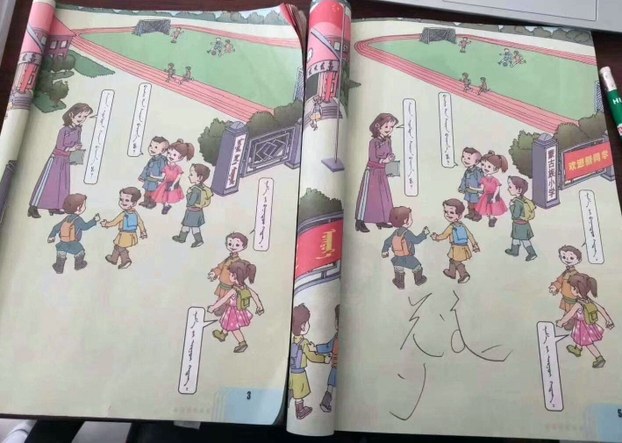
Mongolian is another minority language under threat. Authorities cracked down on a wave of protests across Inner Mongolia in late 2020 over proposed language education reforms that would gradually replace Mongolian with Mandarin. To silence the popular unrest, local governments shut down over 70 Mongolian WeChat groups, suspended Mongolian-language online social networks, detained at least 23 people, and offered rewards for identifying suspected protesters. In early 2021, state media allegedly began replacing Mongolian content with Han Chinese cultural content in a campaign whose official slogan is “Learn Chinese and become a civilized person.” CDT Chinese has published numerous examples of how increasingly restrictive language education policies in Inner Mongolia are gradually transforming the materials used in classrooms:

Caption: In the original textbook (at left), the signs on the school gate were written in Mongolian script. In the new textbook, the signs on the school gate are written in Chinese script. (Source material: from volunteers / Editor: Qiao Long)

Caption: Mongolian textbooks deleted nationalist poems about Mongolian people’s love of their hometowns, culture and mother tongue. (Twitter screenshot provided by Qiao Long.) [Source]

Alex Yu contributed to this post.


source https://chinadigitaltimes.net/2021/11/language-learning-app-emphasizing-linguistic-diversity-deletes-tibetan-and-uyghur-languages/

Photo: Shanghai, China, by Lei Han

Urban skyline with buildings from different periods layered like geological strata

Shanghai, China, by Lei Han (CC BY-NC-ND 2.0)


source https://chinadigitaltimes.net/2021/11/photo-shanghai-china-by-lei-han/

Yahoo, Fortnite Leave China

Yahoo has withdrawn from China, making it the latest in a host of foreign companies that has abandoned the country. Yahoo attributed its decision to the “increasingly challenging business and legal environment” in China. The language of that statement mirrored one that LinkedIn issued to announce its partial withdrawal in October, which it blamed on “a significantly more challenging operating environment and greater compliance requirements.” At The Wall Street Journal, Liza Lin reported on Yahoo’s decision to end its businesses in China:

Yahoo’s China departure was largely symbolic, as the company had already begun shutting down its main services such as email, news and community services in China starting in 2013. Still, Yahoo’s exit is a reminder of the increasing challenges foreign companies face in operating in China, including tighter data security and privacy regulation, geopolitical tensions and tough Covid-19-related rules.

[…] On Tuesday, Chinese internet users browsing websites run by Yahoo such as AOL.com, and media outlets TechCrunch and Engadget, were told that Yahoo’s services will no longer be accessible from mainland China. Chinese users of apps such as Yahoo Weather also received prompts beginning in October that the apps would be discontinued from Monday.

In addition, Applecensorship.com, a website run by anonymous anticensorship activist group GreatFire, showed other Yahoo apps such as Yahoo Finance and Yahoo Mail had been unavailable on Apple’s China app store as early as Oct 14. The company’s platforms aren’t widely used by regular Chinese citizens. [Source]

State media outlet Global Times interviewed Chinese experts, who universally attributed the company’s withdrawal to its poor performance in the Chinese market:

Liu Dingding, a Beijing-based independent tech analyst, told the Global Times on Tuesday that Yahoo’s influence and market share had been reduced to “negligible levels” even five years ago.

“Now, what happened to the internet services provider is no longer important,” Liu said.

[…] Li Junhui, a professor at the China University of Political Science and Law, told the Global Times on Tuesday the more complete legal framework in China governing internet services will mean more stringent requirements for internet services providers, but Yahoo’s demise in China “is more likely the natural consequence of its business failure.” [Source]

Left unspoken in the above commentary is the possibility that China’s stringent censorship requirements may have rendered Yahoo’s search engine’s comparative advantages moot.

A further consideration might have been a new data protection law which came into force on Monday, reports The Guardian’s Vincent Ni:

The timing of the pullout coincided with the implementation of China’s new data protection law, which came into effect on Monday. The legislation, which was years in the making, was likened by some to the Chinese equivalent to the stringent GDPR in Europe.

The law limits the conditions under which companies can gather personal information and sets rules for how it is used. Chinese laws also stipulate that companies operating in the country must hand over data if requested by authorities, making it difficult for international firms to operate in China as they may face pressure at home over giving in to Beijing’s demands. [Source]

Yahoo’s time in China was loaded with controversy. In 2005, Chinese journalist Shi Tao was sentenced to 10 years in prison for “sharing state secrets” after Yahoo divulged his personal data to Beijing police. Approximately 60 others were similarly prosecuted after Yahoo shared their personal information with Chinese police. In 2007, it came to light that Yahoo knew the police were investigating “state secrets” even though Yahoo executives had testified before the United States Congress that they were unaware of the nature of the investigation. After criticism from Congress, Yahoo set up a fund to support the dissidents it had endangered—only to later be sued by said dissidents for mismanaging the funds.

Despite its irrelevance and missteps, Yahoo’s departure is indicative of the increasingly adverse environment for foreign businesses in China. The massively popular video game Fortnite announced its withdrawal from China on the same day Yahoo did. The game’s local test version was pulled on the heels of severe new restrictions put on minors’ video game hours and the introduction of potential legal repercussions for the parents of video game-addicted children. In 2014, Tencent invested $330 million into Epic Games, the maker of Fortnite. Disney has also had recent trouble releasing movies in China. “Eternals” and “Shang-Chi and the Legend of the Ten Rings,” both Marvel films directed by or starring prominent people of Chinese ethnicity, have not yet been approved for release in China. Even expat businessmen, once assiduously cultivated by the Party, are finding it difficult to remain in the country. Over 70% of the Shanghai chapter of the American Chamber of Commerce’s constituent businesses report difficulties “attracting and retaining” overseas talent.


source https://chinadigitaltimes.net/2021/11/yahoo-fortnite-leave-china/

Monday, 1 November 2021

Photo: Dongfeng 153 [Taxkorgan, Kashgar, Xinjiang Region, China], by hans-johnson

A yellow bulldozer and blue-and-white municipal water tank truck with hoses form a stark contrast with the white sandy soil, brilliant blue sky and distant snow-covered peaks of the Taxkorgan Pass in Taxkorgan Tajik Autonomous County, Kashgar, near the border between Xinjiang and Tajikistan.

Dongfeng 153 [Taxkorgan, Kashgar, Xinjiang Region, China], by hans-johnson (CC BY-ND 2.0)


source https://chinadigitaltimes.net/2021/11/photo-dongfeng-153-taxkorgan-kashgar-xinjiang-region-china-by-hans-johnson/

China Expands Security Presence in Central Asia Through Tajikistan Bases

China is growing its security presence in Central Asia through strategic military bases located in Tajikistan, a central Asian republic bordered on the south by Afghanistan, and on the east by China’s Xinjiang Uyghur Autonomous Region (XUAR.) Recent reports shed new light on a military base populated by Chinese personnel and a separate military base that the Tajik government has allowed the Chinese government to finance. China’s increased security activity is ostensibly a response to the threat of terrorism in the wake of the Taliban takeover of Afghanistan, but others suggest it risks entrenching China in long-term commitments that disrupt regional security dynamics and challenge China’s principle of noninterference. 

Despite denials of its existence by the Chinese and Tajik governments, satellite images reveal a Chinese military base that has taken root near Shaymak, a small village in southwest Tajikistan near the Wakhan Corridor, where the borders of China, Tajikistan, and Afghanistan meet. Reid Standish provided new updates on the activity at the Chinese military base for Gandhara, a subset of Radio Free Europe/Radio Liberty:

Next to an old Soviet outpost and believed to have existed for at least five years, a collection of strategically located buildings and lookout towers controlled by Chinese troops are part of Beijing’s nascent but growing hard-power footprint in the region focused on security in neighboring Afghanistan.

[…] Details about the Chinese military site, such as its funding and ownership, are unclear, as is the exact nature of China’s mission along the Tajik-Afghan border.

[…] Two locals who had visited the facilities on multiple occasions and spoke to RFE/RL under condition of anonymity said the site consisted of Chinese, Afghan, and Tajik personnel and that an arrangement allowed for information to be gathered and shared among all three parties.

[…] According to the [anonymous Tajik government] official, the Afghan contingent has not been replaced since the fall of the Western-backed government in Kabul on August 15. Afghan troops had previously rotated out every two months, he said, but the facilities now only consist of Chinese and Tajik personnel. [Source]

The Wall Street Journal previously quoted a Tajik official who revealed that, in 2015 or 2016, China signed a secret agreement with Tajik authorities allowing Beijing to refurbish or expand 30-40 military guard posts on the Tajik side of the country’s border with Afghanistan. The official stated that in some areas, Chinese troops had completely taken over border control from the Tajiks and begun patrolling on their own, in Chinese vehicles. A Washington Post investigation into the Shaymak military base revealed that in 2016, German mountaineers were stopped by Chinese paramilitaries with armored vehicles in the Wakhan Corridor near the Tajik border, corroborating accounts of the secret security agreement. 

Recent reports also show that China has agreed to finance the construction of a separate military base in Tajikistan, in a village called Vakhon, on the western edge of the Wakhan Corridor. Catherine Putz from the Diplomat described the agreement regarding this new military base:

On October 13, the Tajik news site Asia-Plus ran a story citing an “exchange of letters” between China and Tajikistan in which the Chinese side agreed to provide 55 million renminbi (around $8.5 million) for the construction of a paramilitary base under the Tajik Ministry of Internal Affairs. The letters had been sent to the Tajik parliament for approval. They reportedly outlined the project, to include 12 buildings. The Chinese side, the report said, would undertake responsibility for the survey and design, providing equipment (including office furniture and computers) and direction to engineering and technical personnel. Asia-Plus did not report on the planned location of the base.

A new report from RFE/RL’s Tajik Service picks up the thread from there. On October 27,  First Deputy Minister of Internal Affairs of Tajikistan Abdurahmon Alamshozoda announced in parliament that the facility would be constructed in Ishkashim district in Gorno-Badakhshan Autonomous Province (GBAO), Tajikistan. Tolibkhon Azimzoda, a deputy in the parliament’s lower house, said the base would belong to Tajikistan’s Ministry of Internal Affairs and all equipment and machinery imported from China for it would be exempt from customs duties. [Source]

Attacks on Chinese targets in the region have fueled Beijing’s desire for a more extensive Chinese security presence. In 2016, Kyrgyz state security attributed a suicide bombing of the Chinese Embassy in Kyrgyzstan to a Uyghur militant financed by Al-Qaeda’s Nusra Front. In 2017, the Islamic State, or ISIS, kidnapped and killed two Chinese teachers in Pakistan. The security vacuum left by the U.S. departure from Afghanistan and the potential for the country to become a safe haven for militant groups under the Taliban has heightened the stakes. Just last month, ISIS detonated a suicide bomb at a mosque in northern Afghanistan; it claimed the attack was carried out by a Uyghur militant as retribution for the Taliban’s proclaimed cooperation with Beijing. More attacks are likely as ISIS positions itself as a protector of Uyghurs in the face of the Chinese government’s campaign against Uyghurs in Xinjiang and around the world.

Tajikistan plays an important role in China’s counterterrorism strategy. In numerous speeches regarding Xinjiang, President Xi Jinping has expressed concern that Uyghur militants could pass through Tajikistan to attack China, a scenario that has spurred the two countries to coordinate their security efforts more closely. Their first joint counterterrorism exercise took place in 2006; since then, China has held many other exercises with Tajikistan, either bilaterally or through the Shanghai Cooperation Organization. Most recently, in August, the two nations held a “Counterterrorism Cooperation 2021” joint exercise. 

Tajik police have also actively cooperated with Chinese public security to deport nearly 3,000 Uyghurs—85-90 percent of Tajikistan’s Uyghur population—to China. Using reports of deportations dating back to 2016 as evidence, lawyers filed a case with the International Criminal Court to shed light on the human rights abuses in Xinjiang and Tajikistan’s complicity in them. 

Several factors may explain why Tajik President Emomali Rahmon appears content to support China’s security initiatives. Tajikistan’s public debt is equivalent to 45 percent of its GDP; 80 percent of this debt is external, and much of it is owed to China. The Tajik government owes the Export-Import Bank of China, its largest creditor, more than twice as much as it does its second-largest creditor. Tajikistan’s economy is completely dependent on foreign investment, which it has welcomed from China through the Belt and Road Initiative. The Chinese government has also given Tajikistan over 300 million U.S. dollars to build its parliament and government complex. Moreover, Rahmon is concerned about the Tajik Taliban, Tajik militants in Afghanistan who over the past decade have attempted to overthrow the Tajik government in Dushanbe. Beijing’s shared concern about cross-border terrorism and its superior military resources makes China a valuable partner for Rahmon.

However, China’s military involvement in Tajikistan might prove disruptive in the long term. Military affairs in Central Asia have traditionally fallen within Russia’s sphere of influence, and while Moscow seems to have tacitly accepted Beijing’s involvement in Tajikistan, it also seeks to limit Chinese military expansion. In an article for War on the Rocks, Bradley Jardine and Edward Lemon explained the changing security dynamics between China and Russia in Central Asia: 

At present, Russia and China do not appear to be competing in Central Asia. But this will be tested as China’s rise in the region continues during the early post-American era. China may not be eating into Russia’s share of the arms market at present, but it may start to do so as China’s domestic arms industry develops and continues to seek export markets. 

Although China has largely been deferential to Russia and is likely to remain so in the near term, there are signs that it is considering its own approach to this strategic part of the world. Increasingly, China has developed its own initiatives without Russia. It organized its first exercise outside of the auspices of the Shanghai Cooperation Organization in 2014, and established its own multilateral mechanisms such as the China+Central Asia meeting of foreign ministers, launched in 2020, and the counter-terrorism  with Pakistan, Tajikistan, and Afghanistan, established in 2016.

As China’s economic and security interests continue to grow in the region, the current Sino-Russian framework of cooperation may be folded within a broader Pax Sinica in which Beijing increasingly calls the shots. [Source]

Another major issue is the permanency of Chinese military presence. The more active China becomes in the region, the more difficult it will be to maintain a coherent principle of nonintervention and noninterference in other countries’ domestic affairs. Thus far, the type of Chinese personnel based in Tajikistan hint at less expansionist goals: personnel reportedly seen at the Shaymak base are part of the People’s Armed Police, and the agency tasked with building the new Vakhon base is under the Ministry of Public Security; both are domestic security forces separate from the People’s Liberation Army. A Tajik parliamentary spokesperson also claimed that no Chinese troops would be stationed at the Vakhon base after its construction, and Chinese officials have so far denied the existence of both bases.

On the other hand, critics have not easily forgotten the historical precedents of China’s perceived military overreach in economically fragile countries. While accusations of “debt-trap diplomacy” have been dismissed by some experts, China’s economic engagements in the ports of Djibouti and Sri Lanka nonetheless led to asset acquisitions that serve Beijing’s strategic military interests. Tajikistan follows a similar storyline: in 2011, it ceded 1,158 square kilometers of land to China in exchange for China agreeing to write off the country’s debt. Bob Rehorst and Wouter Kuijl described in The Diplomat how Tajikistan’s endemic corruption and reliance on foreign investment make it vulnerable to greater Chinese “capture”:

In order to overcome damages and stimulate development, foreign direct investments (FDI) appears to be the only viable solution. However, any FDI made in Tajikistan will almost inevitably end up in the pockets of Rahmon and his inner circle. As such, the economic outlook of the nation is bleak at best, while its debts to China continue to rise.

When we understand the gloom surrounding these developments, the Tajik position resembles a catch-22: FDI is both a lifeline and a threat to Tajikistan’s sovereignty and its stability. Governments such as Rahmon’s may try for the easy way out and continue to request unpayable loans from China’s policy banks and state-owned enterprises. While it is assumed that the Chinese military base in Badakhshan is already part of some deal struck between Dushanbe and Beijing, it is not entirely unthinkable that the pattern of handing over territorial integrity to Chinese interests may continue to threaten Tajik sovereignty. If weak national sovereignty is followed by internal instability, one might only guess at China’s next move. [Source]


source https://chinadigitaltimes.net/2021/11/china-expands-security-presence-in-central-asia-through-tajikistan-bases/