Thursday, 14 October 2021

Former Journalist Luo Changping Detained for Defaming “Heroes and Martyrs”

Former journalist and anti-corruption crusader Luo Changping was detained by police on Hainan Island on October 7, a day after his personal Weibo account was deleted over a post questioning the justification for China’s involvement in the Korean War and mocking an ill-fated Chinese military unit depicted in a recent big-budget propaganda film.

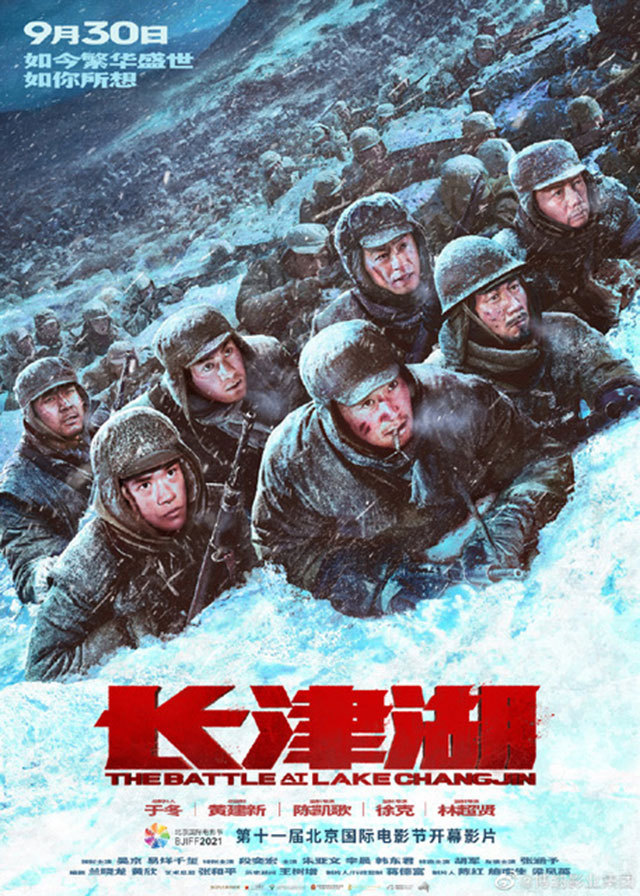
The nationalistic blockbuster “The Battle at Lake Changjin” dominated Chinese theaters during the October 1 Chinese National Day holiday week, reportedly earning over 3 billion yuan [460 million U.S. dollars] in a single week, but reviews were mixed, and the most critical reviews were summarily deleted from social media. The film tells the story of the Battle of Chosin Reservoir, in which China’s People’s Volunteer Army (PVA) troops forced a much larger American, British and South Korean force to retreat, but at tremendous cost: the PVA suffered nearly 20 thousand combat casualties, and nearly 30 thousand deaths from starvation and cold

Publicity poster for the film “The Battle at Lake Changjin,” depicting Chinese volunteer soldiers braving heavy snows.

Publicity poster for the film “The Battle at Lake Changjin,” depicting Chinese volunteer soldiers braving heavy snows.

The text of the Weibo post that caused Luo Changping so much trouble was brief: 

“Half a century later, our countrymen rarely reflect on the justification for the war, much as those soldiers in ‘Sand Sculpture [idiot] Company’ never doubted the ‘wise decisions’ of their higher-ups.” [Chinese]

Luo’s reference to the soldiers in that ill-fated company (a small military unit with between a few dozen to two hundred soldiers) is a play on words: by replacing the flattering moniker “Ice Sculpture Company” with “Sand Sculpture Company,” he is using current internet slang to suggest that the volunteer soldiers in that company were idiots for following orders that led to certain death.

This is not the first time that Luo Changping has found himself in the crosshairs for speaking his mind. The former head of the investigations department at the Beijing News and deputy editor of Caijing magazine, he authored hard-hitting exposés of official corruption until he was demoted and forced out of journalism in 2014. Prior to that, his personal Wechat account was deleted in a broader crackdown targeting the social media accounts of many other prominent online commentators and journalists. In 2013, Luo was awarded the Integrity Award by Transparency International for his journalistic work in exposing and battling corruption. 

In a 2013 joint interview with the Chinese edition of GQ and Southern Weekly (now censored, but archived at CDT’s China Digital Space), Luo Changping articulated his views on China’s future and the importance of free speech. His use of the term 折腾 (zhēteng, translated here as “political turmoil”) evokes the turbulent top-down political campaigns of the Maoist era, as well as Hu Jintao’s signature political phrase “free from turmoil.”

Interviewer: What is your greatest worry about China?

Luo: Chaos, and political turmoil.

Interviewer: What is your “China Dream”?

Luo: My own “China Dream” is the hope that everyone will be able to express themselves freely. [Chinese]

Legal notices from the local police and procuratorate indicate that Luo Changping will be charged under a law, first adopted in 2018 and put into effect in March of this year, that allows civil and/or criminal penalties for those who insult or defame national heroes and martyrs. In January of 2021, popular blogger Qiu Ziming was charged under this same law, and sentenced to eight months in jail for a social media post in which he suggested that Chinese casualties in the previous year’s border clash with India might have been higher than reported. Some journalists and observers fear that Luo Changping could serve serious jail time if he is made an example of:

@lunanweiyi  “The Luo Changping affair isn’t just a simple detention. The procuratorate has already filed a case, and jail time is a possibility. What this ‘powerful country’ fears most is people who dare to speak.” [Chinese]

State media and nationalist bloggers have amplified the story of Luo Changping’s arrest, as reported by The New York Times’ Steven Lee Myers and Amy Chang Chien: 

The authorities appeared to be trying to set an example with Mr. Luo’s arrest, which was highlighted by state media, including the main television network, CCTV. The arrest — and what appeared to be an orchestrated wave of outrage online — reflected the Communist Party’s prickliness about any efforts to challenge its version of history.

“Some individuals still try to completely deny the War of Resistance against the United States and Aid Korea, question the justice of sending troops, and try to erase the great victory,” a statement that appeared on the social media accounts of the People’s Liberation Army said, using the Chinese name for the war.

[…] According to a police statement, Mr. Luo was charged under a new criminal code that took effect this year, making the defamation of political martyrs a crime. It can result in a prison sentence of up to three years. “Cyberspace is not a lawless place,” the statement said. [Source]

Jingoistic op-ed blogger Li Guangman, who rocketed to fame in August with an essay widely republished in Chinese state media, has also weighed in on Luo Changping’s comments and arrest, as detailed by David Bandurski of the China Media Project: 

The second media case cited by Li Guangman was the detention on October 7 in Hainan of well-known entrepreneur and former professional journalist Luo Changping (罗昌平), who was charged with insulting and defaming the martyrs of Chinese history by criticizing a new film about China’s involvement in the Korean War. Luo’s detention, widely reported by state-run media, underscores the resolve of the Chinese Communist Party leadership in policing the bounds of the CCP’s official narratives, the stories and mythologies that undergird its power and legitimacy.

[…] For Li Guangman, who cites Luo Changping’s detention as further evidence of the “profound transformation” underway in China, action against public intellectuals is long overdue. For too long, he says, the country’s martyrs have been neglected. The situation has improved since the implementation of the 2018 law, but still “people like Luo Changping have not hesitated to test the law.” Li quotes from Jun Zhengping (钧正平), a writer at the People’s Liberation Army Daily, who said in a recent commentary venting outrage at Luo Changping’s remarks that, “We must not let those who malign the martyrs do whatever they want with impunity.” [Source]

A day after Luo Changping’s arrest, another blogger was jailed for 10 days for a Weibo comment that was, if anything, more irreverent, voicing the theory that the death of Mao Zedong’s son Mao Anying in a bombing raid during the Korean War saved China from a hereditary political dynasty similar to the Kims in North Korea. (Here, the term “egg fried rice” refers to a story about Mao Anying supposedly giving away his location by breaking battlefield blackout rules to cook a meal of egg fried rice.)

@左右的佑佑  “The greatest result of the Korean War was egg fried rice: thank you, egg fried rice! Without egg fried rice, we [China] would be no different from North Korea. Sadly, there’s not that big a difference nowadays.” [Chinese]

These arrests and detentions are the latest salvos in an ongoing campaign to exert greater CCP control over the historical narrative, particularly as it relates to the role of the Party in historical events. In April of this year, the Cyberspace Administration of China (CAC) established a hotline for reporting “historical nihilism,” a vague term that encompasses views that “‘distort’ the Party’s history, attack its leadership and policies, defame national heroes and ‘deny the excellence of advanced socialist culture.’” In July, the CAC went a step further, releasing a list of 10 “historically nihilist rumors,” including both the circumstances surrounding Mao Anying’s death and whether China’s entry into the Korean war was truly a matter of self-defense.

There have been occasional victories in the uphill battle for historical heterodoxy. In September, Chinese netizens accused of defaming China’s paratroopers (by using “sanbing,” or “paratrooper,” as an online euphemism for a common Chinese curse word) scored a victory against the censors when Baidu agreed to unblock the curse word “shabi” on its platform. There is a similarly grassroots online campaign underway to shame the actors and producers behind “The Battle at Lake Changjin”—which boasts a production budget of $200 million dollars and A-list directors Chen Kaige, Hark Tsui and Dante Lam—into putting their money where their mouths are by donating box office profits to Korean War veterans and their families. The grassroots social media effort can be seen in part as pushback against the jingoistic tone of “The Battle at Lake Changjin,” as well as the strict censorship of critical online reviews of the film and the perceived hypocrisy of those who would profit from the pain and suffering of China’s veterans by rewriting history in a manner flattering to the CCP. The filmmakers have not yet responded to the public appeal, but it is being followed closely on social media:

@ZhangDong_SCH  Dr. Yang Peichang’s [donation] proposal has generated a groundswell of social support. Many WeChat groups have responded proactively, launching appeals and urging the cast, crew and producers of “The Battle at Lake Changjin” to donate box office revenues to volunteer veterans and martyrs’ families. […] [Chinese]

State media has responded to the grassroots pressure campaign by lobbing charges of “moral hostage-taking” and “forced donations.” Although many social media posts supportive of the grassroots campaign to donate box office profits to veterans have been deleted, CDT Chinese has collected a number of Weibo comments, a selection of which are translated here:

巴赫***咯: Chen Kaige and Wu Jing shouldn’t eat buns made from human blood [i.e. profit from bloodshed] – the agreed-upon “common prosperity” will only work if we take practical action.

吃瓜***好: [They] smear themselves with heroes’ blood, steal the copyright to the heroes’ stories, make money by invoking those heroes, swindle people under the name of those heroes, but refuse to donate even a penny to the real heroes, and then [when people demand they donate box office profits], they act righteous and complain about “moral hostage-taking”! Ugh! Shameless.

赵**010: Someone suggested that the cast and crew of “The Battle at Lake Changjin” donate money to the surviving family members of martyrs. After all, they packaged the blood of the martyrs and turned it into a saleable commodity, and it’s not like it’s a public-service film free for everyone to seethey trampled over the blood of the martyrs to fill their cofferswould you call that patriotic? What’s so wrong with suggesting that they donate a bit of money to the martyrs’ families? Why do some media outlets see that as “forced donation”? Besides, it’s not like we netizens have weapons or the law on our side: how could we possibly “force” them to make a donation?

**S怡Y: I firmly support this! If a film has patriotic themes, all box office revenueminus production costs and salariesshould be donated to the nation.

zhqliber*****: Set aside a bit to cover production costs or make a little profit, and establish a fund to take care of Korean War veterans. Of course, not donating isn’t a crime, it’s just bad manners and bad optics.

自***6: Calling again on Wu Jing and the others to donate all of “The Battle at Lake Changjin” box office revenue (now nearly 4 billion yuan) to Korean war veterans and the surviving family members of war martyrsthis is a topic on which pretty much everyone can agree. Even Sima Nan made a rare sensible comment about it. Those old volunteer veterans really are the loveliest people, and also the most wretched. My late father was a veteran of the volunteer army. Fortunately, he didn’t lose his life in North Korea, but after demobilization, he spent his lifetime farming, and in his old age, received just a pittance for his volunteer service. Donating the box-office profits from “The Battle at Lake Changjin” will be a great comfort to our volunteer veterans! [Chinese]


source https://chinadigitaltimes.net/2021/10/former-journalist-luo-changping-detained-for-defaming-heroes-and-martyrs/

Photo: No passenger, by Gauthier DELECROIX

Black and white image of a passenger walking in an empty airport terminal, against floor to ceiling windows that look out on the ocean.

Photo: No passenger, by Gauthier DELECROIX (CC BY 2.0)


source https://chinadigitaltimes.net/2021/10/photo-no-passenger-by-gauthier-delecroix/

Wednesday, 13 October 2021

Afghan Uyghurs Caught Between Taliban and China’s Transnational Repression

The Taliban takeover of Afghanistan in August was never an ideal scenario for the Chinese government, and it was even worse for Afghanistan’s Uyghur minority. In the security vacuum left by the U.S. withdrawal, China is now forced to rely on an Islamic fundamentalist terrorist organization to maintain stability in a failing state rife with numerous other Islamic fundamentalist terrorist groups, while attempting to prevent any spillover of violence into Xinjiang. For the several thousand ethnic Uyghurs living in Afghanistan, the Taliban victory poses an existential threat. Not only do the two groups have opposing political beliefs, but the Taliban is also under increasing Chinese pressure to deport Uyghurs—militants and civilians alike—to China.

The stakes were raised on October 8 when ISIS-K, a Sunni fundamentalist terrorist group, detonated a suicide bomb in the northern Afghan city of Kunduz, killing scores and wounding over a hundred worshippers at a mosque during Friday prayer hours, marking Afghanistan’s deadliest terrorist attack in months. For the first time ever, the terrorist group publicly stated that the attack was conducted by a Uyghur militant in retribution for the Taliban’s promises to Beijing to expel Uyghurs from Afghanistan. Laura Zhou at the South China Morning Post described how the attack’s connection to a Uyghur militant signals a serious threat to Beijing

Although the Isis-K claim has not been verified, it is the first time the group has linked a bomber to an ethnic group in China.

Raffaello Pantucci, a senior fellow with S. Rajaratnam School of International Studies in Singapore, said that if the claim were true, it could deepen Beijing’s concerns about Afghanistan becoming a base for Uygur fighters seeking independence for Xinjiang.

“If [Isis-K] have individuals who are Uygurs, who are fighting alongside them and willing to be suicide bombers, then the Chinese have got a problem here because this means you now have an organisation there that has a link to China that is angry enough to send people who are suicide bombers to attack them,” Pantucci said. [Source]

The specter of Uyghur militants in Afghanistan is a policy nightmare for the Chinese government. A June 2021 United Nations report stated that, in the months leading up to the U.S. withdrawal, eight to ten thousand jihadist fighters poured into Afghanistan from central Asian regions, including Xinjiang; most of the fighters were associated with the Taliban or Al Qaeda, and some with ISIS. A July 2021 United Nations Security Council report stated that several hundred Uyghur militants reside in Afghanistan. Many are part of the East Turkistan Islamic Movement (ETIM), also known as the Turkistan Islamic Party. The U.S. removed ETIM from its list of terrorist organizations in 2020, believing it to be no longer active, but ETIM remains on the U.N. list of terrorist organizations. Sean Roberts, associate professor of international affairs at George Washington University’s Elliott School of International Affairs, explained that China “portrays ETIM as part of the supposed Uighur terrorist threat that justifies its brutal crackdown in Xinjiang.” 

To assuage Beijing’s fears, the Taliban had reportedly begun removing Uyghur militants from the Chinese border, even before the recent ISIS-K terrorist attack. When the Taliban was previously in power from 1996 to 2001, it moved and monitored Uyghurs at China’s request. This latest development signals continued cooperation between the Taliban and the Chinese government in dealing with Afghanistan’s Uyghur population. 

However, it may be difficult for the Taliban to fully neutralize the threat of Uyghur militants in Afghanistan. Some analysts point out that even fighters within or aligned with the Taliban, whether they are ethnically Uyghur or not, may be sympathetic to the Uyghurs’ oppression in Xinjiang and inclined to pressure the Taliban to at least not facilitate the CCP’s alleged genocide against the Uyghurs. Uyghur militants that do become dismayed by the Taliban’s complicity might defect from the Taliban in order to join other terrorist groups, ETIM or others, that more faithfully uphold their militant politics against China’s treatment of the Uyghurs and more openly challenge the Taliban regime, as last week’s ISIS-K attack demonstrated. As for the Uyghur militants active in what remains of ETIM in Afghanistan, Seth G. Jones and Jude Blanchette explain in Foreign Affairs that geography, allied jihadist groups, and the distraction of humanitarian crises may shelter Uyghur militants from the Taliban’s efforts to neutralize them for China:

Of particular concern to Beijing is the presence in Afghanistan of several hundred fighters from the Eastern Turkistan Islamic Movement, which seeks to establish a Uyghur state in Xinjiang. Led by Abdul Haq, ETIM operates in such areas as Badakhshan, a remote province whose mountainous terrain will make it difficult for China or the Taliban to conduct military operations. According to a UN Security Council assessment, ETIM operatives have worked with a broad range of jihadi organizations, including al Qaeda, Jamaat Ansarullah, and Jamaat al-Tawhid Wal-Jihad. All three of these groups will likely remain active in Afghanistan, providing ETIM with multiple local allies.

Beijing has already sought assurances from the Taliban that ETIM will not be allowed to operate in or from Afghanistan. But the Taliban may not be able to guarantee this in the midst of a war and a humanitarian crisis—and their close relationships with other jihadi groups could reduce their willingness and ability to try. […] This hodgepodge of groups worries Beijing because ETIM and other extremist organizations that threaten China may be able to thrive in a failed Afghan state. [Source]

Militants aside, Uyghur civilians in Afghanistan are also vulnerable in the current geopolitical atmosphere. Much of the Chinese government’s fear of Uyghur terrorism in Xinjiang stems from overinflated perceptions of minor terrorist threats that were used to justify a crackdown on the entire Uyghur population. Having often conflated terrorists and civilians in Xinjiang under the guise of national security, China is prone to do the same across the border in Afghanistan. As Sui-Lee Wee and Muyi Xiao from the New York Times noted, it would be easy for the Taliban to identify and deport Afghan Uyghurs at China’s request

The Uyghur population in Afghanistan is estimated to be around 2,000 to 3,000. They arrived in waves, some as early as the 18th century. Many are second-generation immigrants with few links to China. Their parents joined an outflow of refugees from Xinjiang in the late 1970s, ending up in neighboring Afghanistan, where they settled and had families.

Those families are once again seeking to uproot their lives. Even though they are Afghan citizens, their identity cards show that they are either Chinese refugees or members of the ethnic group, making them easy to track should the Taliban decide to round them up. [Source]

Asim Kashgarian at Voice of America explains that there is precedent for Taliban deportations of Afghan Uyghurs

“Deportations of Uyghurs have taken place historically under the Taliban, with 13 Uyghurs handed over to China following a [2000] meeting between Chinese Ambassador to Pakistan Lu Shulin and Taliban leader Mullah Omar in Kandahar,” [Bradley Jardine, an analyst at the Washington-based Oxus Society for Central Asian Affairs] told VOA.

He added that Afghanistan has historically been viewed as safer for Uyghurs than neighboring Central Asian countries because it lacks a formal extradition treaty with China.

Jardine also referenced the reported deportation by the Afghan government of Israel Ahmat, a Uyghur businessman, in 2015. [Source]

Several months before the Afghan Uyghur businessman was deported to China in 2015, the Chinese government pledged hundreds of millions of dollars in aid to the Afghan government, in return for the Afghan government’s support of China’s fight against ETIM. This September, the Chinese government donated $30 million and three million doses of Covid-19 vaccines to the Taliban, while simultaneously urging it to crack down on all “extreme forces” in the country. It is likely that China’s increasing economic support to the Taliban will lead to more Uyghur deportations, especially as the Taliban becomes more desperate for foreign funding to support the collapsing Afghan economy. 

The deportation of Uyghurs to China is a strategy the Chinese government executes on a global scale. Economic carrots are an effective tool: Cambodia deported 20 ethnic Uyghurs to China in 2009, two days before the Chinese government gave the Cambodian government over $1 billion worth of loans and grants. In 2015, China requested that Thailand deport 170 Uyghurs; the Thai government agreed to deport 100 Uyghurs, touching off protests in Turkey and condemnations by human rights organizations. In a report by the Oxus Society and Uyghur Human Rights Project, the authors described how China’s economic and security ties with neighboring countries, such as Pakistan and Afghanistan, facilitate the transnational repression of Uyghurs

The PRC is able to target Uyghurs outside its borders with the help of the neighboring host governments. For example, in Pakistan China entices the government with large development projects like the China-Pakistan Economic Corridor (CPEC) in order to secure its support against Uyghurs. This report demonstrates several instances in which China rewarded Pakistan for aiding its campaign against Uyghurs. In exchange for development assistance, Pakistan signed extradition treaties, arrested individuals at China’s request, and rebuked critics of China’s harsh policies, all of which made it easier for China to continue repressing Uyghurs.

[…] Through its strategy of offering extravagant development projects while deepening security ties, China has successfully gained influence over Pakistan’s government and thus its Uyghur community. China is now attempting to implement this strategy in other countries with sizable Uyghur populations. As the Taliban gains territory in Afghanistan, Pakistan is portraying itself and China as facilitators of peace and development. China will use the chaos in Afghanistan to further justify its crackdown on Uyghurs, who express fear about their future in the country. [Source]

Oxus Society’s new China’s Transnational Repression of Uyghurs Database documents 40 incidents of transnational repression against Uyghurs in Afghanistan alone, and a global total of 1,546 reported cases (300 verified) across 28 countries since 1997; the database reveals that at least 395 Uyghurs have been deported to China. The number of actual cases of repression and deportation, not just reported cases, is likely much higher due to fear of reprisals for speaking out. Many Uyghurs extradited back to China were students with legal residency cards or visitors on religious pilgrimages, whose families were never informed of their alleged “crimes.”


source https://chinadigitaltimes.net/2021/10/afghan-uyghurs-caught-between-taliban-and-chinas-transnational-repression/

In Speech Commemorating Xinhai Revolution, Xi Says “Reunification” With Taiwan Inevitable

In a speech marking the 110th anniversary of the Xinhai Revolution, Xi Jinping said peaceful “reunification” with Taiwan is inevitable and claimed Sun Yat-sen’s legacy as the Chinese Communist Party’s own. The Xinhai Revolution overthrew the Qing Dynasty and led to the establishment of China’s first democratic republic. October 10, the date of the Wuchang Uprising that sparked the revolution, is celebrated in Taiwan as National Day. Xi asserted that the Taiwan issue “arose out of the weakness and chaos of our nation, and it will be resolved as national rejuvenation becomes a reality.” Xi’s speech on Taiwan and the revolution comes amidst high tensions in the Taiwan Strait. Huizhong Wu of The Associated Press reported on Xi’s speech:

“Reunification of the nation must be realized, and will definitely be realized,” Xi vowed before an audience of politicians, military personnel and others gathered in the hulking chamber that serves as the seat of China’s ceremonial legislature.

“Reunification through a peaceful manner is the most in line with the overall interest of the Chinese nation, including Taiwan compatriots,” the leader added.

[…] “The Taiwan question is purely China’s internal affair, which tolerates no external interference,” Xi said on Saturday. “No one should underestimate the Chinese people’s strong determination, will and capability to safeguard national sovereignty and territorial integrity.” [Source]

The speech was more restrained than the martial fare Xi offered during celebrations marking the CCP’s 100th anniversary in July. Although in his July speech, Xi notably refrained from putting a deadline on “reunification” (the term is in quotation marks because Taiwan has never been part of the People’s Republic of China), he promised to “utterly defeat” any efforts towards Taiwanese independence. Yet Xi’s comparatively calm rhetoric in his latest speech was belied by a number of bellicose actions taken against Taiwan by the People’s Liberation Army Air Force. Over 150 PLA Air Force planes flew into Taiwan’s ADIZ (air defense identification zone) during early October, in what one anonymous source told Reuters might be simulated attacks on a U.S. carrier fleet. (See The China Story for a visual of the incursions, which are happening in the southwestern corner of Taiwan’s ADIZ.) Chinese plans often fly into Taiwan’s ADIZ—in April of this year the number of such missions raised unrealized specters of war. Yet scholars such as Oriana Skylar Mastro of Stanford University believe that war is a real threat. “Even moderate voices in Beijing have been calling for tossing out peaceful reunification, I think the military option is the option now,” she told The New York Times. As if to underscore her point, state-run tabloid Global Times republished a series of cartoons depicting a PLA invasion of Taiwan:

Days after the largest of the incursions, The Wall Street Journal reported that U.S. special forces and Marines have been secretly stationed in Taiwan for over a year, training Taiwanese ground forces and teaching small-boat operations. In August, the state-run tabloid Global Times warned that if U.S. troops were discovered to be in Taiwan, China might “destroy and expel US troops in Taiwan by military means.” In an apparent attempt to dissipate tension, United States President Joe Biden gave a puzzling statement on Taiwan to the White House press corps: “I’ve spoken with Xi about Taiwan. We agree we’ll abide by the Taiwan agreement. That’s where we are. And we made it clear that I don’t think he should be doing anything other than abiding.” The statement raised eyebrows—and left Taiwanese diplomats seeking clarification—because the United States and China have no “Taiwan agreement” to speak of. At Al Jazeera, Erin Hale covered the American and Taiwanese reactions to Biden’s verbal gaffe:

The US president appeared to be referring to a 90-minute conversation he had with Xi on September 9. And while his remark appeared aimed at calming fears, it only caused confusion.

[…] “The confusion is there is no such thing as a ‘Taiwan agreement’ let alone any sort of agreement on anything related to Taiwan,” [Lev Nachman, a postdoctoral researcher at Harvard’s Fairbanks Center in the US,] said. But “it feels frustrating to see language not be pristinely precise at a time when it really ought to be,” he added.

[…] “[KMT supporters] think that Biden’s ‘Taiwan agreement’ is another evidence that Taiwan is just a chess piece on the chessboard, indicating that Taiwan has no say in its own future since the agreement is merely made between Xi and Biden,” [Austin Wang, an assistant professor of Political Science at the University of Nevada, Las Vegas.] [Source]

On Twitter, analyst Jessica Drun offered a refresher course on the United States’ Taiwan policy:

Despite the public festivities in Beijing on October 10, sometimes known as “Double Ten,” Hong Kong residents were banned from commemorating the occasion. Yan Zhao and Xinqi Su of AFP reported on the enforced silence:

For more than 50 years, Ng Hong-lim has led celebrations in Hong Kong to mark Taiwan’s national day -– but this year he fears doing so could get him arrested.

“I don’t think there will be another chance,” Ng sighed. “It’s really regrettable.”

[…] Hong Kong’s security chief Chris Tang last month warned that celebrating the “Double Ten” could constitute support for Taiwanese independence — a crime under the city’s draconian new security law.

[…] Following security chief Tang’s warning last month, restaurant bookings for more than 100 tables by Ng’s group [were] abruptly cancelled.

[…] Both Lee and Ng said they would not “test the red lines” under the national security law, but still hope to commemorate the day in the future. [Source]

Much of Xi’s speech focused on claiming Sun’s legacy as the Party’s own—even as it negates the foundational principles of the Xinhai Revolution. At China Heritage, Geremie Barmé published a translation of famed Chinese journalist Dai Qing’s 2011 speech on the meaning of the Xinhai Revolution in China today:

In the century that has passed since the Xinhai Revolution of 1911 undertook to ‘bury imperial politics’, China remains incapable of freeing itself from the caliginous spectre of autocracy and totalitarianism.

[…] Even more relevant to my point, however, is what I regard as China’s self-imposed civilisational darkness, in particular the country’s ‘manufactured ignorance’, that is, the state-sponsored beclouding of understanding and the despoliation of education. These both serve to aid and abet the asphyxiation of the spirit.

The country’s leaders willfully and knowingly engaging in policies aimed at national nescience and sciolism. This enterprise is engineered in such as way as to make it impossible for the Chinese to understand their history and the historical figures who have played an essential role in it. [Source]


source https://chinadigitaltimes.net/2021/10/in-speech-commemorating-xinhai-revolution-xi-says-reunification-with-taiwan-inevitable/

Friday, 8 October 2021

Chinese State-Backed Disinformation on Covid-19 Origins Dominates Search Engine Results

Baseless conspiracy theories about Covid-19 originating in a lab at Fort Detrick, a U.S. army research facility in Maryland, have proven stubbornly resilient. Researchers at the German Marshall Fund’s (GMF) Alliance for Securing Democracy program published a new report on Tuesday explaining how the success of this sort of online disinformation—aggressively pushed by Chinese state media—comes largely from Chinese state actors exploiting vulnerabilities in Western media ecosystems. The real-world effect of this infodemic undermines public health and creates serious challenges for democratic sustainability. 

The GMF study documented how disinformation appeared across multiple platforms, including Google News, YouTube, and Bing News. On various dates in August and September, the majority of the top stories for the search term “Fort Detrick” emanated from Chinese state media outlets peddling conspiracy theories. Their apparent popularity is due to a data void, whereby the search term produces limited or problematic information; a similar explanation is a data deficit, whereby credible information is limited and the search term is in high demand. As Cristiano Lima from the Washington Post reported, disinformation from Chinese state media still dominated search engine results this week:

Searches for Fort Detrick conducted by The Technology 202 surfaced posts by CGTN and the state-run China Daily among its top results on both Google’s and Bing’s search engines for news and on YouTube’s main search engine as recently as Monday. 

That included a YouTube video by CGTN questioning the “terrifying” history of Fort Detrick and stating that more than “15 million Chinese have signed an open letter calling for the World Health Organization (WHO)” to investigate the U.S. military base.

One of the top news search results for Fort Detrick on Microsoft-owned Bing on Monday was an article by China Daily titled, “Myths about Fort Detrick need to be clarified.” The article states, “Now countering the theory that the virus first emerged in China, more information is starting to appear that” Fort Detrick “may be a compelling possibility as the source of the virus.” [Source]

The reason that credible news about this topic from reliable sources cannot easily compete with biased Chinese state-media content is due to the nature and structure of popular search engines. Their algorithms are designed to reward more copious and more recent content, which means that the few well-researched, credible articles that debunk the Fort Detrick conspiracy are drowned out by weekly waves of new articles by Chinese state media, flooding the top search results with disinformation. 

Despite being aware of search-engine rules and state-media strategies, responsible media outlets may struggle to effectively counteract this problem of disinformation. As the GMF report noted, by their very nature, credible media outlets eventually have to move on to the next story, but Chinese state media can repeat the same conspiracies ad infinitum

Finally, China’s ability to marshal its global propaganda apparatus to shape the Fort Detrick search environment highlights an asymmetric advantage autocratic state actors enjoy in the information domain. Unlike democratic media ecosystems, whose outlets are by design less responsive to the wishes of the state and more responsive to the capricious interests of the public, autocratic governments can direct state-sponsored information channels to repeatedly target high value search terms with preferential narratives. This has created an environment where state media outlets can effectively own sensitive or strategically important search terms… [Source]

Social media has been a major battleground for the Chinese government’s influence operations. One major reason why Covid-related disinformation produced by state media occupies top positions in search engines is because the content is widely distributed on platforms like Twitter and Facebook. Since May 1, Chinese government and state-media accounts on Twitter, many with millions of followers, have tweeted or shared almost 1,000 posts about Fort Detrick. This steady stream of disinformation is also fueled by President Xi Jinping’s continued promotion of “Wolf Warrior Diplomacy,” which aims to more aggressively assert CCP narratives into international discourse.

However, much of the online “virality” of Chinese state-backed disinformation is facilitated through fake accounts. Over the past few years, researchers have detected numerous networks of bots linked to the Chinese government and prone to sharing pro-government narratives regarding the pandemic. In August 2019, Twitter removed almost 1,000 fake accounts and temporarily suspended another 200,000; Facebook removed seven inauthentic pages and three groups. All of these groups, which attracted over 17,000 members and followers on Facebook alone, were linked to Chinese state-backed influence operations. Throughout 2020, Graphika traced the evolution of “Spamouflage Dragon,” a spam network spewing positive messages about the Chinese government’s response to the pandemic across YouTube, Facebook, and Twitter. At the content level, some of the identities behind these disinformation drives are fake, such as the imaginary Swiss biologist who criticized the World Health Organization’s Covid-tracing efforts, and the French reporter who defended the Chinese government’s policies in Xinjiang.

Real-world danger arises from this conspiracy-backing industry’s exploitation of data voids. In September, Mandiant Threat Intelligence reported on an online Chinese government-affiliated spam network of hundreds of accounts that incited users to attend anti-government protests in the U.S. The proliferation of Covid-related conspiracy theories also undermines government public health messaging and fosters skepticism towards mask and vaccine mandates, which facilitates the spread of the deadly virus.

In the fog of disinformation brought on by Chinese state media, Beijing has further exploited citizens’ uncertainties via Covid-themed malware campaigns. New research this week from BlackBerry’s Research & Intelligence Team revealed a connection between a notorious Chinese state-sponsored cyber threat group and disparate malware campaigns, one of which targeted victims in India with “phishing lures” of fake Indian government notices about Covid-19 statistics. Ravie Lakshmanan at Hacker News summarized the tactics and scope of the cyber threat group:

“The image we uncovered was that of a state-sponsored campaign that plays on people’s hopes for a swift end to the pandemic as a lure to entrap its victims,” the BlackBerry Research and Intelligence team said in a report shared with The Hacker News. “And once on a user’s machine, the threat blends into the digital woodwork by using its own customized profile to hide its network traffic.”

APT41 (aka Barium or Winnti) is a moniker assigned to a prolific Chinese cyber threat group that carries out state-sponsored espionage activity in conjunction with financially motivated operations for personal gain as far back as 2012. Calling the group “Double Dragon” for its twin objectives, Mandiant (formerly FireEye) pointed out the collective’s penchant for striking healthcare, high-tech, and telecommunications sectors for establishing long-term access and facilitating the theft of intellectual property.

[…] “With the resources of a nation-state level threat group, it’s possible to create a truly staggering level of diversity in their infrastructure,” the researchers said… [Source]


source https://chinadigitaltimes.net/2021/10/chinese-state-backed-disinformation-on-covid-19-origins-dominates-search-engine-results/

Photo: Dali. Yunnan. China-150720-15, by Nick Turner

Evening scene of crowds passing through an arched tunnel that is one of the gates of the ancient city wall in the town of Dali, Yunnan Province. Beyond the tunnel are numerous stalls selling clothing and food; yellow and orange lights reflect off the smoke that fills the air.

Dali. Yunnan. China-150720-15, by Nick Turner (CC BY 2.0)


source https://chinadigitaltimes.net/2021/10/photo-dali-yunnan-china-150720-15-by-nick-turner/

Top Police Officials Purged in Legal-Political Rectification Campaign

The investigation of two senior officials once tasked with domestic security signifies that the 2021 legal-political rectification campaign has reached the upper levels of the Party. Fu Zhenghua, the former deputy head of the Ministry of Public Security who led the corruption investigation into Zhou Yongkang, is under investigation for “serious violations of discipline and national laws.” Sun Lijun, a former vice-minister at the Ministry of Public Security, has been expelled from the Party amidst a host of charges including corruption, immorality, negligence, superstition and—most damningly—disloyalty to the party. Although the reasons behind their sudden falls from grace remain opaque, many observers believe they are related to preparations for the 20th Party Congress to be held in 2022, where Xi is widely expected to pursue a third consecutive term in office, breaking Reform-era precedents. At CNN, Nectar Gan and Jessie Yeung reported on the widely reviled Fu Zhenghua:

But Fu was not just taking on corrupt political elites. As the deputy minister of public security, in 2013 he unleashed a sweeping crackdown on opinion leaders on Chinese social media site Weibo, detaining several high-profile commentators with large followings. He was also in charge of the nationwide roundup of human rights lawyers and activists in 2015, in what has become infamously known as the “709 crackdown,” according to people close to the detained lawyers.

[…] “The targets of Fu Zhenghua’s crackdown are people at the core of China’s civil society. Therefore, the country’s whole intellectual sector and the wider public are all thrilled by (his fall from grace),” said Wu Qiang, a political analyst in Beijing.

[…] Fu’s heavy-handed approach was also applied to police officers and prison guards, some of whom applauded their former boss’ downfall as “most gratifying.” Commenting on social media, many accused Fu of imposing grueling and unreasonably harsh requirements on grassroots officers, such as not allowing prison guards to take breaks during night shifts. [Source]

The list of high-profile crackdowns and investigations Fu directed during his time in power is lengthy: the Zhou Youngkang investigation, the investigation into “malicious trading” that brought down the Chinese stock market in 2015, a crackdown on Falun Gong, a crackdown on “Big V” internet commentators, and the 709 crackdown, which targeted lawyers and prominent members of civil society.

His arrest is likely part of a political-legal rectification campaign, first announced in 2020, that commenced in 2021. The campaign was explicitly modeled on the Yan’an rectification campaign of 1942 to 1945, during which over 1,000 Party members were killed in the service of realizing Mao’s tripartite goals: “achieving sole power within the Party, unifying the Party and army to overthrow Kuomintang rule after Japan’s defeat, and making himself China’s absolute ruler”—all of which he achieved. Nearly 180,000 cadres in the legal-political sphere have been disciplined in Xi’s 2021 redux; 1,985 have been charged with crimes. Alfred Wu of the National University of Singapore described the campaign as an effort to shore up support before the 20th Party Congress. “Xi Jinping believes the political-legal system is the most important because it is a disciplinary force [… Moves like this suggest] he is not very confident despite outsiders saying he will a hundred per cent get a third term,” he told The South China Morning Post.

Sun Lijun was first publicly placed under investigation in 2020, although Nikkei Asia reports he was secretly under investigation as early as 2019. In late September, the Central Commission for Discipline Inspection announced his expulsion from the Party in an emotive statement. At The Wall Street Journal, James T. Areddy wrote about the significance of Sun’s removal from the Party:

The notice from the party’s antigraft Central Commission for Discipline Inspection accused Mr. Sun of rumor mongering, deception, theft, extravagance and immorality, as well as disloyalty to the party, superstition and negligence in stopping the spread of Covid-19. “The circumstances were particularly serious, the nature was particularly bad, and the impact was extremely bad,” said the statement.

[…] Now in his early 50s, Mr. Sun is among ousted officials who were once considered political loyalists of Mr. Xi. His removal “indicated the unfolding of a new wave of purges targeting those who had once helped Xi consolidate power,” according to research last year by University of Victoria political science professor Guoguang Wu published in China Leadership Monitor.

[…] Mr. Wu said Thursday that a reference in the allegations to Mr. Sun’s participation in “cliques” likely indicates his problems also relate to behavior by other officials. [Source]

At The Diplomat, Jesse Turland reported that Sun Lijun’s troubles may stem from his work as a member of a team dispatched to Wuhan from Beijing to deal with COVID:

Online, observers have theorized that Sun’s “arbitrary discussion” of government policy may have been at the core of the CCDI’s vitriolic rebuke. Sun was rumored to have failed to keep a lid on sensitive information about the handling of the novel coronavirus.

In the early months of 2020, Sun went to Wuhan to contribute to stability maintenance in the city. According to an unsourced rumor, Sun wrote notes regarding the party’s handling of the situation in Wuhan to his Sydney-based wife, which were intercepted by Australian intelligence agencies.

Sun’s arrest in April last year coincided with the arrest of Zhang Feng, an executive of Tencent, the company that owns WeChat, for failure to protect data security. This, according to Toronto-based independent journalist Wen Zhao, lends credence to the possibility that Sun and Zhang were targeted together for leaking information, intentionally or otherwise, about the management of COVID-19. [Source]

There is another intriguing angle to the Fu Zhenghua and Sun Lijun story. Eccentric billionaire Guo Wengui leveled unsubstantiated charges of corruption at both men in 2017, accusing them of having “no faith in the system or the country” and hiding highly classified Chinese government materials overseas. Guo also leveled accusations against both men’s superiors, Meng Jiangzhu and Wang Qishan, both of whom remain—as far as outside observers can tell—in good standing within the Party.


source https://chinadigitaltimes.net/2021/10/top-police-officials-purged-in-legal-political-rectification-campaign/